
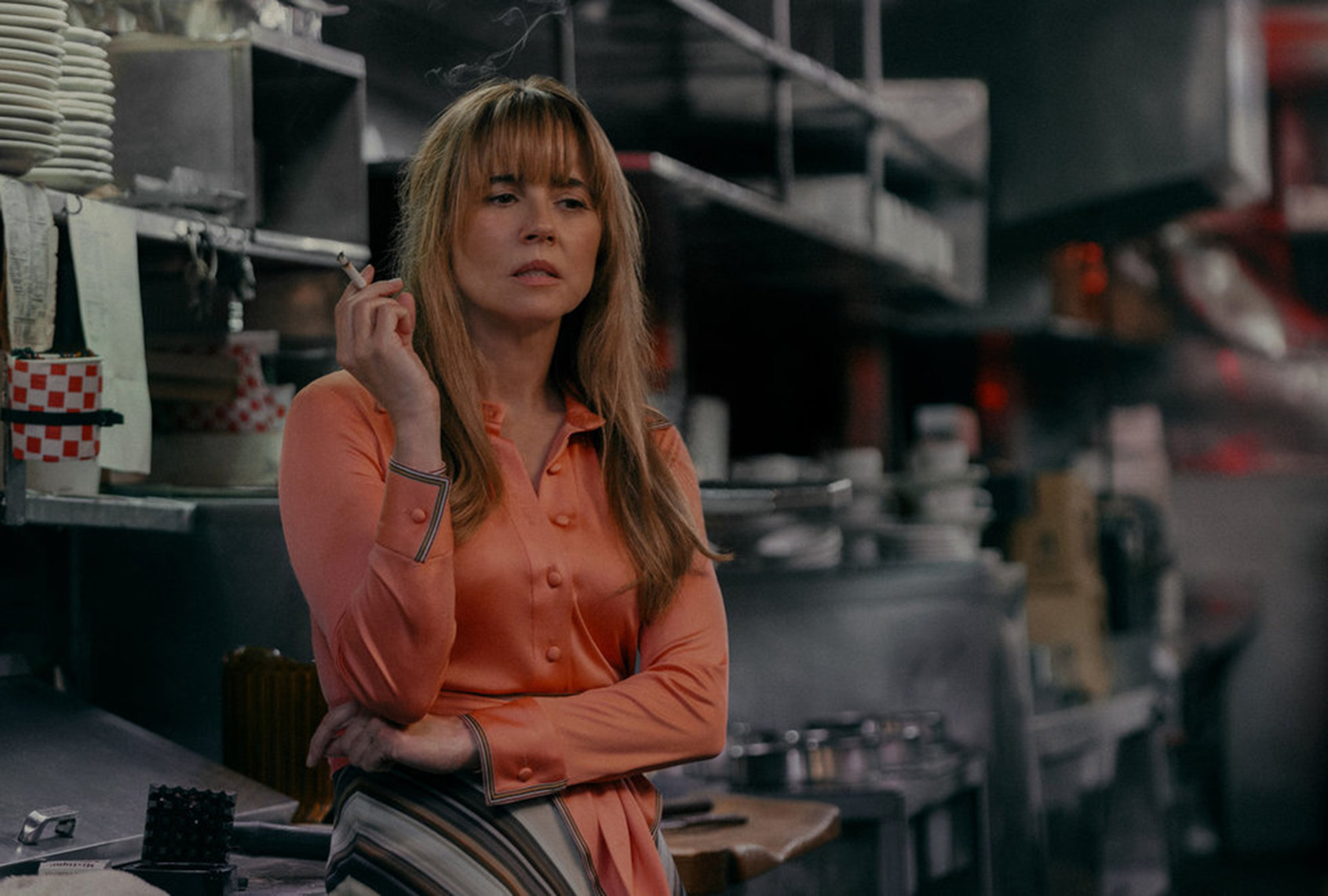
commentary "Phony," "Other Mommy" and "Carrie" rethink one of horror’s oldest archetypes Published October 30, 2026 12:00PM (EDT) Linda Cardellini in "Crystal Lake" (©2025 Peacock TV LLC. All Rights Reserved.) In the opening sequence of “Other Mommy,” Ursula (Jessica Chastain) is making lunch for her daughter, Bela (Arabella Olivia Clark), when she asks if the girl would like to “come into her heart.” It’s an odd request, but that’s because this version of Ursula is not actually Ursula. She is an entity that Bela calls Other Mommy — who looks exactly like her real mother, except that Other Mommy can contort her body into freaky spider-like shapes that scare the hell out of Bela and her stay-at-home father, Russ (Jay Duplass). Also, Other Mommy seems to want to kill or otherwise possess Bela, which is not exactly maternal. Other Mommy promises to nurture Bela, but clearly she represents the worst type of matriarch imaginable: one who is frightening, controlling and dangerous. The scary mommy has been an archetype in storytelling for as long as stories have existed. We’ve seen it in fairy tales, animated films produced by studios ranging from Disney to Laika (in a way, “Other Mommy” is just “Coraline” in live-action form), multiple seasons of Ryan Murphy shows, and, of course, everywhere in the horror genre, from “Psycho” to “Hereditary.” But the scary mommy is really having a moment this spooky season. In addition to “Other Mommy,” Hulu is streaming a new series called “Phony” that has a similar premise: a kid — this time a teenage boy played by Sam Nivola — believes his mother (Connie Britton) has been replaced by an imposter who looks like the real thing but has sinister intentions. Two other streaming series, “Crystal Lake” on Peacock and “Carrie” on Prime Video, place two of the horror genre’s most famous scary mothers in new contexts. Even real life has given us a scary mommy for the ages: Donna Arthur. The estranged mother of Democratic Ohio gubernatorial candidate Amy Acton remained married to Cledith Arthur, who was charged with raping Acton as a child. Donna Arthur later criticized her daughter in a recent attack ad produced by Acton’s Republican opponent, Vivek Ramaswamy. It should be no surprise that there has been intense backlash to that ad. Society and pop culture, not to mention basic decency, have taught us, over and over, to be horrified by a vicious mother. What’s notable about the latest batch of scary mommy releases is that, for the most part, they offer more nuance in their depictions of motherhood than previous examples of the trope often allow. The moms in these movies and shows are, generally, not entirely demonized even if they sometimes do monstrous things. (Universal Pictures) Jessica Chastain in “Other Mommy” Society and pop culture, not to mention basic decency, have taught us, over and over, to be horrified by a vicious mother. “Other Mommy” comes closest to outright blaming its central maternal figure for all the bad things that happen in her home. (Spoilers ahead.) The powers held by the bad version of Ursula seem to grow the more that Bela feels neglected by real-life Ursula, who works constantly and often gets home late. While she loves her daughter, Ursula ultimately admits that she hadn’t initially wanted kids. “I’m sorry for not being the kind of mother that you deserve,” she tells Bela in one of the film’s key moments. Director Rob Savage and screenwriter Nathan Elston do not solely blame Ursula for the problems within her family unit. Her husband is a bit of a slacker who gets high in the middle of the day, and the Other Mommy, a shapeshifter, assumes other forms aside from that of Ursula, including Bela’s babysitter. But the movie strongly suggests that Other Mommy would not have shown up at all if Ursula had simply given her daughter more attention, which is more of a tradwife-adjacent take than I expected walking into the theater. Oddly enough, “Verity,” released in theaters a week before “Other Mommy,” has a lot more fun slyly toying with and ultimately negating the idea that a professionally successful mother (Anne Hathaway’s best-selling author Verity Crawford) must secretly resent her children. Want more from culture than just the latest trend? The Swell highlights art made to last. Sign up here The three aforementioned scary mommy streaming series go much farther out of their way to depict their respective parents as flawed individuals who do care about their kids. In much of the first season of “Phony,” Connie Britton’s Ellen comes across as a totally caring and attentive mom to her boy Sonny. His suspicions about her arise after he’s injured in a car accident and becomes convinced that she looks slightly different post-crash. (CGI alters Britton’s features just enough to make her appear noticeably off.) But she has a very close relationship with him and, even after her supposed heel turn, makes a sincere effort to get him treatment when he begins to struggle emotionally. Her biggest sin is perhaps being too protective of him and overly involved in his life. The only reason she is scary is that Sonny thinks she might be and we’re not sure whether to believe him. “Crystal Lake” and “Carrie” have the unenviable task of taking scary mommies we already know and helping us understand their motivations in new contexts. “Crystal Lake,” an eight-episode prequel to the original “Friday the 13th,” delves into much — perhaps too much? — more detail about how and why Pamela Voorhees (Linda Cardellini in this version) descended into grief and homicidal madness following the drowning death of her son, Jason, at Camp Crystal Lake. In the 1980 “Friday the 13th” the identity of the murderer of all those horny young counselors isn’t revealed until late in the movie, when we realize Pamela, bitter that the camp has reopened, is the perpetrator. Reminder: the homicidal, goalie-masked version of Jason Voorhees doesn’t appear onscreen until “Friday the 13th Part III.” So even though we all think of Jason as the villain of the franchise, one could reasonably argue that the OG baddie is Pamela, the person responsible for most of the kills in the first film and, arguably, for influencing Jason to keep on killing. Jason Voorhees is, according to previous lore, a literal son of a bit*h. (Disney) Connie Britton in “Phony” In “Crystal Lake,” the Linda Cardellini version of Pamela Voorhees still slaughters numerous people, but she’s more than just a one-dimensional crazy bit*h. She’s complicated and more capable of selflessness than the first movie takes the time to suggest when it’s not busy knifing poor Kevin Bacon in the chest. The series, by contrast, invites us to feel empathy toward her, or at least acknowledge the suffering she endured in her life even before losing her son. “Carrie,” developed by Mike Flanagan, the streaming world’s master of horror, attempts something similar but even more extreme. It moves the familiar story about a bullied, sheltered teenage girl to the present. The plot points that are key in Stephen King’s novel and its subsequent adaptations remain. Carrie (Summer H. Howell) is still taunted in the girls’ locker room after she panics over getting her period, and she still loses it in a way that turns the senior prom into a massive, telekinetically-generated disaster. But all of this happens in a world where social media exists, and some of the mean girls at Carrie’s high school wield it like a bucket of pig’s blood that can be dropped on anyone, at any time. The bullying is both more insidious and more soberingly recognizable. What’s notable about the latest batch of scary mommy releases is that, for the most part, they offer more nuance in their depictions of motherhood than previous examples of the trope often allow. As in the original, Carrie’s mother, Margaret, is a conservative Christian who wants to shelter her daughter from the outside world as much as possible. But unlike the most well-known version of that character, portrayed by Piper Laurie in Brian DePalma’s 1976 adaptation, Margaret is not a melodramatic, over-the-top, completely irrational zealot. As portrayed by an excellent Samantha Sloyan, Margaret still punishes Carrie by frequently shoving her into a prayer closet, but she’s also more grounded in her humanity. She’s conservative in a more modern sense: she’s driven by conspiracy theories, overly protective of her daughter, mistrustful of the government, and deeply Christian even though she does not always act like it. There are also times when Margaret’s opinions are actually correct, as in the first episode when Carrie starts going to public school and must participate in a shooter drill for the first time. Margaret confronts the principal and tells him that Carrie was rattled by the drill and that the whole exercise is traumatizing to students. I never thought I would watch any adaptation of “Carrie” and say to myself, “You know, Margaret White makes a good point.” But there I was, saying exactly that. (Robert Falconer/Prime) Samantha Sloyan as Margaret White in “Carrie” Not every element in these films and shows works, nor do any of them completely whitewash their characters’ more deplorable tendencies. But as a collective, they signal that it’s important to look beyond our culture’s tendency to demonize mothers and women in general. Simply being a good mom or a terrible one (within, you know, non-murderous reason) is not the only thing that defines a woman. Weirdly, this fact is also made clear in the most talked-about film of the moment, “You Can See Everything,” in which Elizabeth Holmes, who genuinely seems to love her children, also uses them as a shield in the documentary. In the very first scene, we see and hear her partner, Billy Evans, talking on the phone about his hopes that directors Nathan Fielder and Lance Oppenheim will show a more relatable, likable side of Holmes and prove she is not a monster. As the camera pans out, we eventually see that Holmes is sitting in the room with him. She is holding a baby, the youngest of her two kids, and gently snuggling with the child. “Look at this nice mom taking care of an infant; surely she’s a nice lady who would never defraud anyone or even tell a single, small lie,” the image desperately wants to tell us. But in the end, even being a good mom isn’t enough, on its own, to persuade most rational viewers that Elizabeth Holmes is completely innocent of everything of which she’s been accused. Because just as a scary mommy may have some valid reasons that explain some of her behavior, a seemingly caring mommy can also be kind of scary. Related Topics ------------------------------------------ Related Articles
Scary mommies are everywhere, but this time with more nuance
Full Article
Original Source
Read the full article at Salon →KhanList aggregates and links to publicly available news content. We do not host full articles from third-party sources. Always verify important information with original sources.