
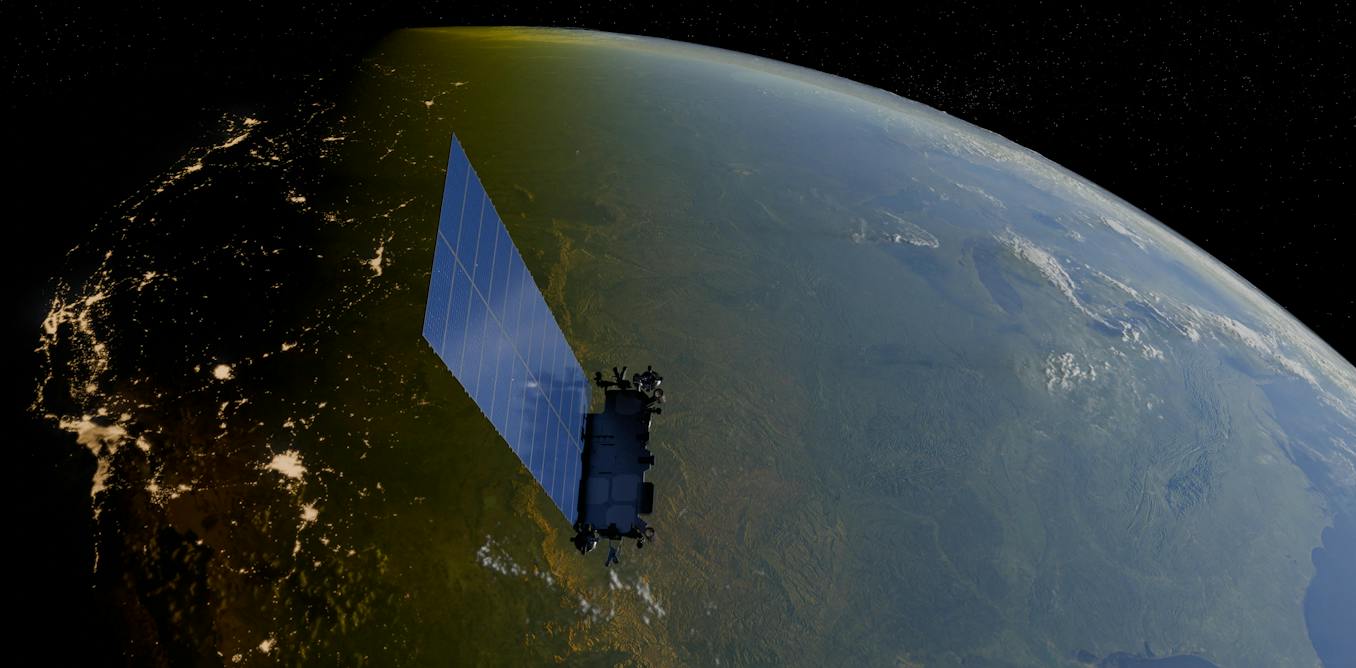
Less than a decade ago, there were about 2,000 operational satellites orbiting Earth. Today there are more than 15,000. Millions more are planned. Much has been made of the “space junk” problem these satellites create. But there’s another problem that has received much less attention: the radio noise leaking from these satellites is impacting telescopes that help us understand the universe and is corrupting the measurements that keep GPS working. Thankfully, there’s a way to fix it – if we act now. Understanding the early universe Radio telescopes can receive signals produced from soon after the Big Bang. They allow astronomers to understand the early universe and how it evolved over the past 13.8 billion years. Radio telescopes can also pinpoint galaxies at great distances, using them as beacons to anchor technologies such as GPS, used for positioning, navigation and timing on Earth. Australia was a radio astronomy pioneer. In the 1940s, researchers at Dover Heights, in the eastern suburbs of Sydney, identified the first individual radio sources beyond our Solar System. In 1946, Ruby Payne-Scott became the world’s first woman radio astronomer. World-leading telescopes such as the MWA and ASKAP headline Australia’s radio astronomy portfolio. The world’s largest low-frequency radio telescope, SKA-Low, is also being built at a remote site in Western Australia. Listening for cosmic whispers is getting harder Cosmic radio waves are exceptionally weak. In order to detect these whispers, radio telescopes have to be protected from the powerful radio signals produced by humans, from mobile phones and radio communications devices. This is why we build radio telescopes in quiet locations. Satellites pose a risk to radio telescopes because their complex onboard electronics can generate unintended and unwanted radio energy. This “leakage” is in addition to the intended radio transmission of data between satellites and ground stations. Satellite operators do already shield electronics to prevent unintended radio energy interfering with their launch rockets, but leakage occurs once they’re in space and operational. The International Telecommunication Union’s Radiocommunication Sector is the body that sets the regulations for radio spectrum use by astronomers and commercial entities. For transmitters on satellites, regulations are based on simulations of what a satellite is designed to transmit. They do not factor in unintended radio energy. Enforcement of the regulations sits with national regulators, such as the Australian Communications and Media Authority. That works for transmitters on the ground – which answer to the same regulator that protects the telescopes – but it doesn’t work for satellites. No telescope’s regulator has jurisdiction over a foreign satellite. Measuring the problem Using a radio telescope in Western Australia, my team measured radio energy emitted from Starlink satellites at low frequencies – 70 to 300 megahertz (MHz). Specifically, we wanted to check whether the emissions by the satellites exceeded the limits set by the International Telecommunication Union. They did, between 50% and 70% of the time. The international guidelines accept that a telescope may have these limits exceeded for up to 2% of measurements, so this finding is far beyond what is considered acceptable. This result is sobering, particularly as the measurements were made in 2024 and there are far more satellites in orbit now than there were two years ago. In other research, a CSIRO-led team used telescopes in New South Wales operating at much higher frequencies – 1 GHz to 14 GHz. This is the frequency range where mobile phones, wifi and satellite TV operate. The team measured licensed signals, harmonics (unwanted copies of the signal at multiples of its frequency), and a faint electrical hum from the onboard electronics. Only licensed signals are regulated. The team used these measurements to model the effect of 12,000 satellites on various Australian telescopes, including those used to measure Earth’s rotation by precisely localising distant galaxies, linking the celestial and terrestrial reference frames (geodesy). They found that with today’s satellite numbers, direct-to-phone satellites already spoil over half (59%) of the geodetic measurements behind GPS. The modelling was then scaled to 300,000 satellites – a small fraction of what’s planned – at which point every geodetic measurement is lost. What is the fix? The growing body of evidence shows satellite operators need to shield electronics over wider radio frequency ranges and to lower the amount of radio energy that leaks. A window exists now to fix these issues, before satellite numbers explode. If we miss this window, it could mean the end of radio astronomy as we know it. It could also threaten technologies of the highest economic importance, such as GPS. An important first step is implementing a system that routinely monitors radio interference from satellites. This would ensure we develop a more robust evidence base which can inform policy decisions, standards work, and ultimately provide evidence for policy enforcement. Australia is in a unique position to lead the way. We have the telescopes, the heritage, and the quietest skies.
Satellites leak noise that interferes with telescopes and GPS. Here’s how to fix it
Full Article
Original Source
Read the full article at Theconversation →KhanList aggregates and links to publicly available news content. We do not host full articles from third-party sources. Always verify important information with original sources.