
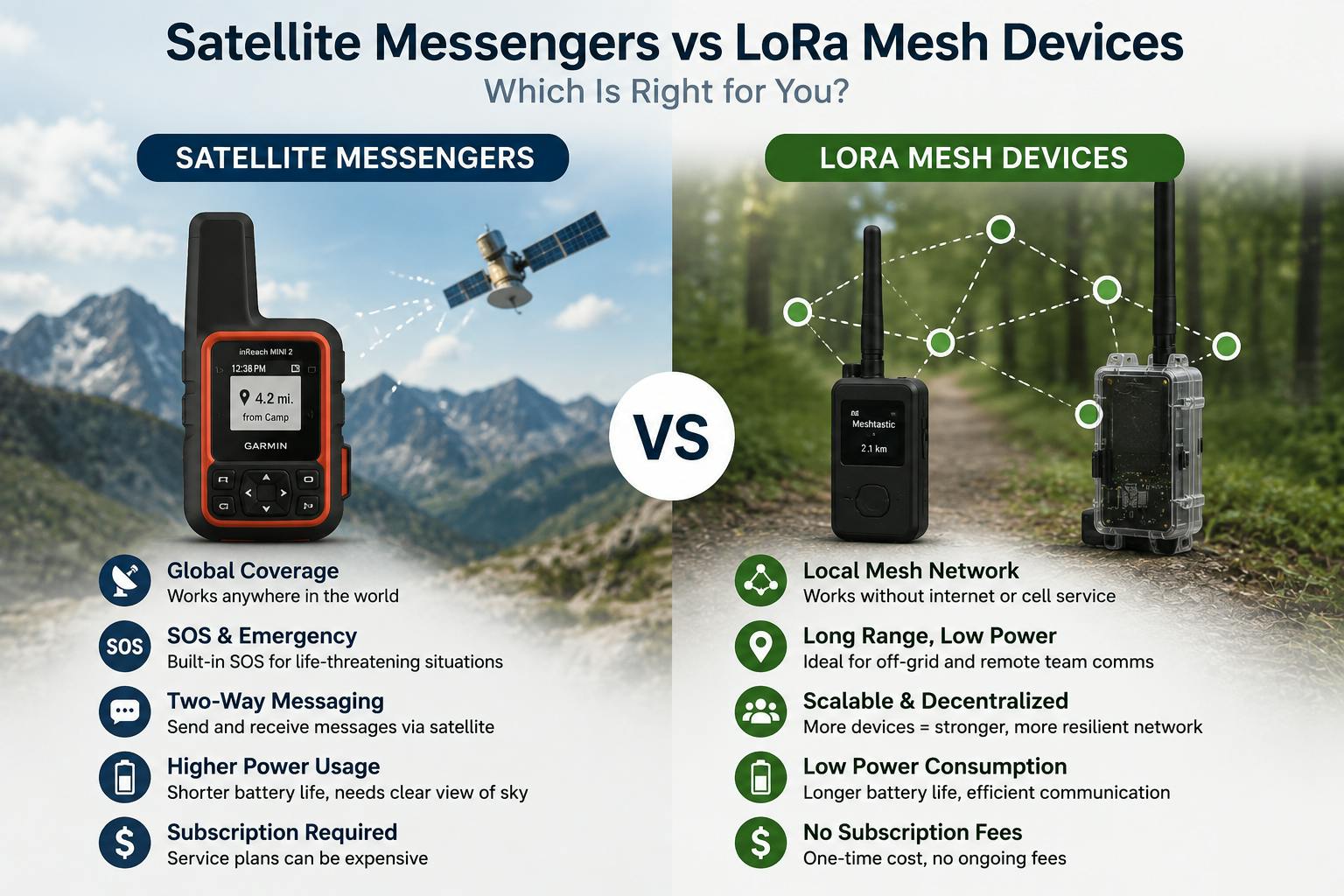
People ask me this one more than almost anything else: "Should I just get a Garmin inReach and call it done?" And my honest answer is usually another question — done for what? Satellite messengers and LoRa mesh solve different problems, and the gear bag I pack depends entirely on which problem I'm actually solving that day. Let me break down what I've learned running both, sometimes on the same trip.Two Different Jobs Wearing Similar Marketing A satellite messenger's job is simple: get a short message off the planet and back down somewhere else, regardless of terrain, with no dependency on anyone nearby. A mesh device's job is different: get a message to another node within range, hop by hop, without needing any infrastructure above your head at all. One solves "I'm alone and need to reach someone far away." The other solves "my group is spread out and needs to talk to each other." People buy one expecting it to do the other's job and end up disappointed for reasons that were never really the device's fault. Cost and Subscription: The Part Nobody Enjoys Talking About This is where the two categories diverge hardest. Garmin inReach devices (Mini 2, Messenger) run in the low-to-mid hundreds for the hardware, then require a monthly subscription to actually function — plans range from a basic safety tier up through unlimited messaging, and the unlimited tiers aren't cheap if you're using this year-round rather than seasonally. Annual contracts get you a better rate than the flexible monthly plans, which is the usual trade: commit or pay a premium for flexibility. Zoleo follows a similar shape — hardware cost up front, then a required monthly plan, with tiers based on message volume. It's often positioned as the cheaper entry point of the three, but the lower tiers cap your message count in a way that can bite you on a longer trip if you're chatty on the device. SPOT (the X and Gen4 devices) tends to run the lowest subscription cost of the three for basic tracking and SOS, but the messaging experience is more limited, and some features live behind add-on tiers rather than a single unified plan. LoRa mesh devices flip this model entirely. Hardware cost varies, anywhere from budget DIY boards to polished commercial units, but once you own the node, there is no subscription. No monthly fee, no annual contract, no message cap enforced by a billing tier. The tradeoff, and it's a real one, is that mesh only talks to other mesh nodes in range. You're not paying a subscription because you're not buying access to a satellite constellation. You're buying a radio that talks to your other radios. If you go out twice a year, a satellite messenger's subscription math is easy to justify. If you're running comms for a group on a regular basis, the lack of a recurring fee on mesh adds up fast, especially across a dozen units. Latency: Different Enough to Matter Satellite messengers are built around a store-and-forward model through a satellite network — messages typically arrive within a few minutes under clear sky, longer under tree cover or in a canyon where the device struggles to get a clean view of the sky. That latency is usually acceptable for check-ins and non-urgent updates, and SOS functionality is prioritized differently on each device's backend, which is worth reading the fine print on rather than assuming. Mesh latency depends entirely on hop count and channel congestion. A single hop between two nearby nodes can be near-instant. A message crossing four or five hops across a spread-out team takes longer, and if the channel is busy, congestion adds delay on top of that. In practice, for a tight group within a few miles of each other, mesh latency beats satellite messaging by a wide margin. Once you're relying on a chain of hops stretching toward the edge of practical range, that gap narrows or can even reverse. Range: The Category-Defining Difference This is the one that actually decides which device you need. Satellite messengers work essentially anywhere with sky visibility — that's the entire point and it's not something mesh can match. If you're solo, off any mesh network, and need a way to reach the outside world from the middle of nowhere, nothing here beats a satellite device. Mesh has no answer to that use case, full stop. Mesh wins the opposite scenario: a group that needs to talk to each other constantly, in a defined area, without infrastructure. Satellite messengers are largely one-to-one or one-to-a-monitoring-service; they're not built for a six-person team pinging positions back and forth every few minutes. You could do it, and you'd burn through your message allowance and your patience in about a day. How I Actually Decide Solo or small team, need a lifeline to the outside world, infrequent use → satellite messenger. Garmin inReach if you want the most mature ecosystem and mapping integration, Zoleo if you want a lower entry cost and don't mind a simpler feature set, SPOT if basic SOS and tracking is genuinely all you need. Group operating together in a defined area, frequent internal comms, no need to reach the outside world directly → LoRa mesh, and skip the subscription entirely. Group operating in a defined area that also needs an outside link → both, layered. Mesh internally, one satellite messenger or a mesh-to-satellite gateway node as the single point of contact with the outside world. That last option is what most serious field setups end up looking like. Not a choice between the two, but a satellite device as the group's one lifeline out, and mesh doing the actual talking among everyone still standing on the ground. Pick based on who needs to hear from whom, not on which device has the better marketing photo on a mountaintop.
Satellite Messengers vs LoRa Mesh Devices: Which Off-Grid Comms Solution Fits You?
Full Article
Original Source
Read the full article at Hackernoon →KhanList aggregates and links to publicly available news content. We do not host full articles from third-party sources. Always verify important information with original sources.