
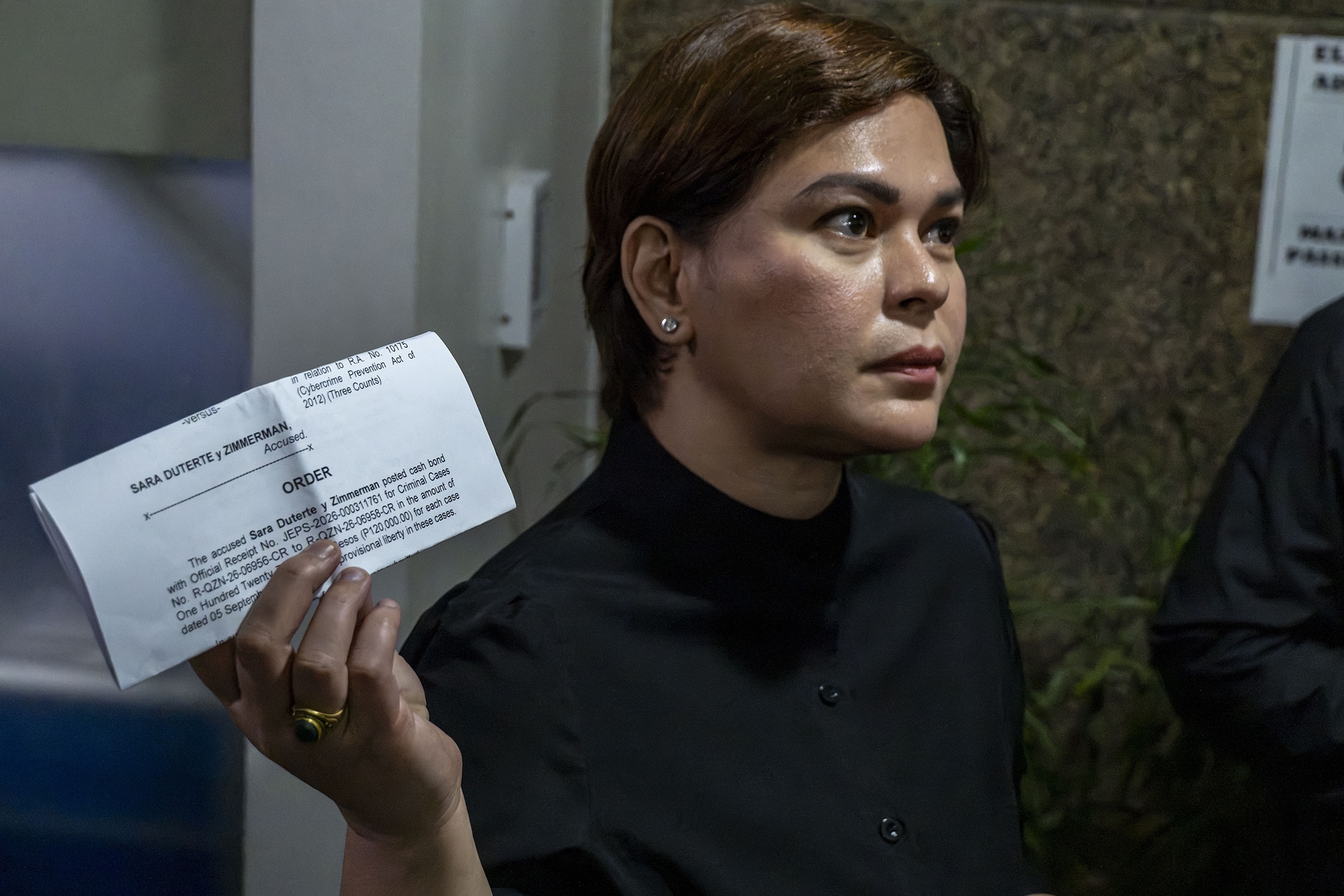
ON THE DEFENSIVE Vice President Sara Duterte arrives at the Quezon City Hall of Justice on Saturday, September 5, 2026, to post bail following an arrest warrant issued by Quezon City Regional Trial Court Branch 98. The warrant stems from three counts of grave threats filed against her. —Inquirer photo/Grig C. Montegrande MANILA, Philippines — Vice President Sara Duterte on Saturday posted a P360,000 bail before a Quezon City court, securing her provisional liberty a day after a warrant was issued for her arrest on charges that she issued grave threats against President Marcos, first lady Liza Araneta-Marcos and former Speaker Martin Romualdez. Duterte appeared before Branch 98 of the Quezon City Regional Trial Court (RTC) shortly before 11 a.m., accompanied by lawyers Michael Poa and Paul Lawrence Lim. Bail was set at P120,000 for each of the three counts of the charge. But what was supposed to be a routine legal proceeding saw the accused—who was haled to court for what she said in a fit of rage—becoming the one expressing fears for her safety. Article continues after this advertisement ‘I do not feel safe’ The case stems from Duterte’s remarks during an online press conference on Nov. 23, 2024, when she said she had spoken to someone about killing Marcos, the first lady and Romualdez if she herself were killed. Duterte has denied the allegations. The same remarks form part of the impeachment case now pending before the Senate. Before entering the Hall of Justice, Duterte repeatedly said she did not trust the police, the courts or even the security personnel assigned to protect her. “I do not feel safe, I really do not feel safe. I don’t trust the court, I don’t trust the police,” she told reporters and her lawyers. Article continues after this advertisement Duterte said she had felt unsafe since 2023 due to the harassment of her family by certain authorities, whom she did not name. She asked: “Who will answer for it if I die later tonight? Who will be held accountable?” Article continues after this advertisement Duterte initially refused to enter the building, laying out several scenarios she feared could put her life at risk. She worried that she could be placed in a small elevator with police officers, leaving her vulnerable. She also pointed to firearms carried by the officers posted at the building and said she could no longer trust even her own security detail because, in her view, they were picked for the job by the Marcos administration. The Vice President remained hesitant even when assured by her lawyers that they would stay by her side. Standing near the staircase at the Hall of Justice, she recalled the 1983 assassination of former Sen. Benigno “Ninoy” Aquino Jr. “Do you remember that Ninoy Aquino died on the (airplane) staircase?” she asked her lawyers in Filipino. Duterte then asked journalists to accompany her to the fifth floor, where she would post bail. “I want a lot of people to see it. I really don’t know what will happen to me in there,” she said. Her appeal effectively asked the media to serve as witnesses to whatever might happen to her inside the building. The discussion between Duterte and her lawyers, held in front of reporters and police officers, went on for about 40 minutes before Poa finally persuaded her to go inside. Duterte later said her lawyers advised her to post bail rather than be in police custody. “They explained that I would be better protected by civilians who could see and notice my situation, compared to remaining in detention where I would be isolated and have less protection,” she said in a statement released by the Office of the Vice President. Duterte also expressed concern for the safety of her mother and children. Lim said Duterte’s lawyers were considering possible legal action over the implementation of the warrant, particularly after she alleged that authorities had gone to places where her mother and children were staying. Duterte said government pressure and harassment against her family had continued since 2023. Her allegations have not been independently verified, and Philippine National Police chief Gen. Jose Melencio Nartatez Jr. said Duterte had not reported any threats to the police. “To date, however, the Vice President has not reported to the PNP any threat to her life or to the safety of her family, including the threats she said date back to 2023,” Nartatez said. He added that the PNP had not monitored any incident posing danger to Duterte or her family. Interior Secretary Jonvic Remulla said authorities “knew of her whereabouts the night before but we did not force the warrant of arrest.” Remulla said the PNP had body-camera footage of the serving of the warrant and of Duterte’s arrival at the Hall of Justice. Historic arrest, routine bail “The PNP accorded her all the respect her position deserves,” he said, adding that the pressure surrounding Duterte’s situation appeared to be affecting her perception. As the Vice President left the Hall of Justice after posting bail, her supporters gathered outside chanted “Duterte! Duterte!” She hugged one of them, who was weeping, before proceeding to her vehicle. Duterte’s lawyers stressed that she was not given special treatment. Lim said his client voluntarily appeared before the court that issued the warrant, so there was no need for her to be physically arrested and have her mug shot taken. “She had to go through the same process,” Lim said. As part of the process, the court received the photos provided by Duterte, an affidavit of undertaking, a barangay certification of her Davao City residence, a sketch of her Davao home and a government-issued ID. But Lim explained that posting bail did not mean Duterte had already surrendered to the court’s jurisdiction. He said her legal team continued to assert that an impeachable officer like the Vice President could not be criminally charged while in office. Constitutional law professor Paolo Emmanuel Tamase of the University of the Philippines College of Law disputed that view. “There’s no basis in Philippine constitutional law for the immunity of a vice president from any type of suit, including a criminal suit,” Tamase said. Unlike the president, who enjoys immunity from suit while in office, the vice president does not have the same constitutional protection, he said. Tamase also distinguished impeachment from criminal liability. Impeachment concerns the removal of an impeachable public official, he said, while a criminal case seeks to hold an official accountable for an alleged criminal act. “If that argument were to be respected or to be given weight, you would have … at least 30 officers who are impeachable and therefore cannot be sued,” Tamase said. Such an interpretation would create a major gap in the system for holding public officials accountable, he added. Tamase called Duterte’s arrest proceedings historically significant because she is the highest-ranking sitting public official in Philippine history to have been subjected to criminal prosecution and arrest proceedings. The bail process itself, however, was routine because the charges are bailable, he said. Tamase said the criminal case before the RTC and Senate impeachment proceedings are separate, although the arrest warrant could influence public opinion. It could reinforce the view that Duterte’s statements constituted criminal threats, he said, but could also strengthen among her supporters the narrative that government institutions were being weaponized against her. Duterte’s request for media to accompany her inside the Hall of Justice came amid that broader dispute over public trust in the institutions handling her cases. FEELING UNSAFE Vice President Sara Duterte tells the media on Saturday she distrusts even her own security escorts and asks them to accompany her to the fifth floor of the Quezon City Hall of Justice, where she later posted bail on three counts of grave threats filed against her. —Grig C. Montegrande Not the first Duterte is not the first Philippine vice president to face criminal complaints while in office. During the presidency of her father, Rodrigo Duterte, then Vice President Leni Robredo was among opposition figures charged in 2019 in connection with the “Ang Totoong Narcolist” videos. Robredo faced complaints for sedition, inciting to sedition, libel, cyberlibel, estafa, harboring a criminal and obstruction of justice. The complaints were based largely on allegations by Peter Joemel Advincula, the self-described narrator of the videos known as “Bikoy.” The PNP-Criminal Investigation and Detection Group filed the complaints against Robredo and other opposition figures in July 2019. Your subscription could not be saved. Please try again. Your subscription has been successful. The Department of Justice dismissed the complaints against Robredo in February 2020 for lack of evidence and probable cause, before the cases reached trial. —WITH REPORTS FROM GILLIAN VILLANUEVA, AND ISABELLE PECHAY
Sara Duterte posts bail: ‘I don’t trust the court’
Full Article
Original Source
Read the full article at Newsinfo →KhanList aggregates and links to publicly available news content. We do not host full articles from third-party sources. Always verify important information with original sources.