
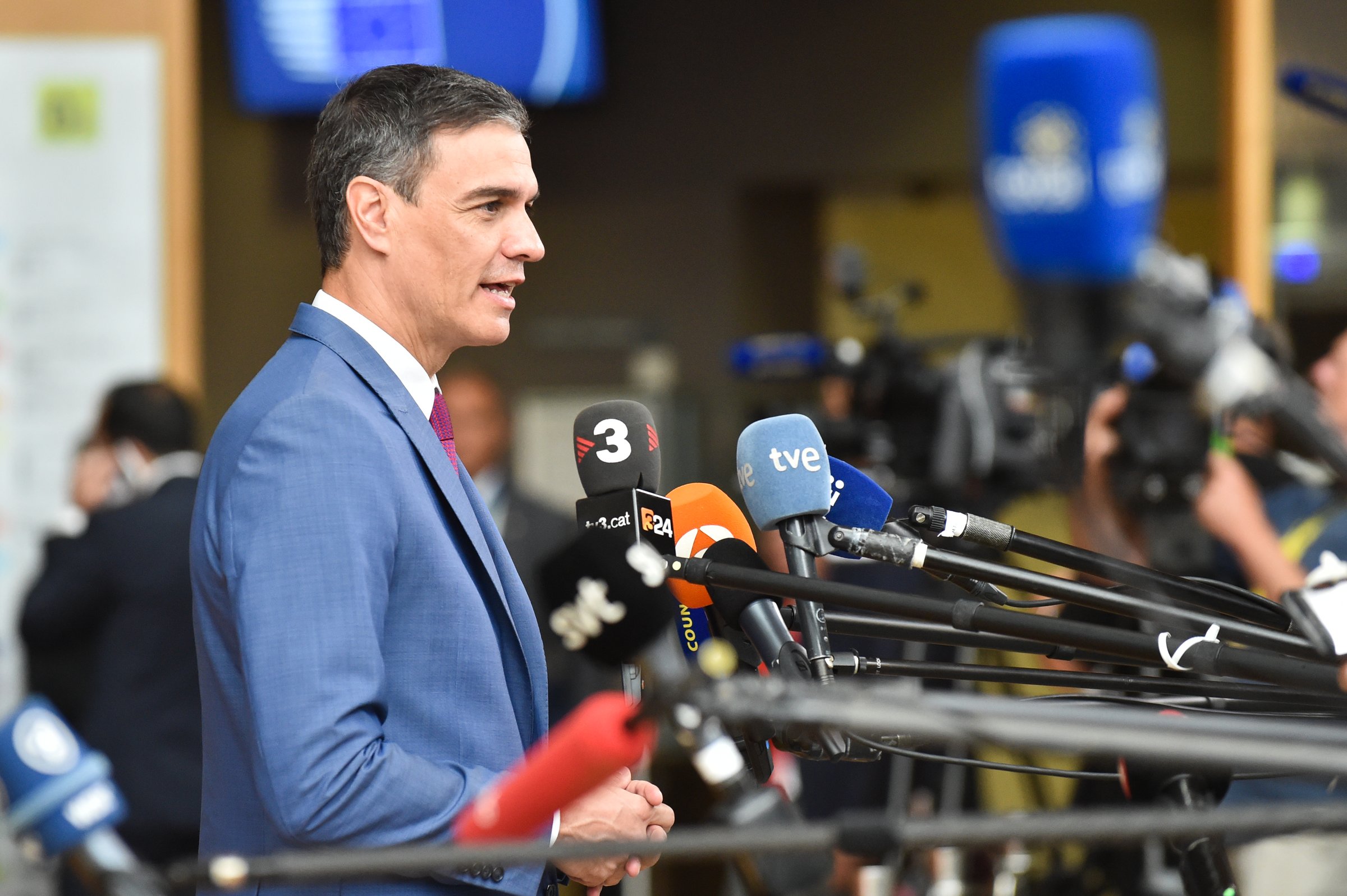
There is no evidence that Morocco bears any responsibility for the migrant surge in Ceuta in late July that led to close to 75,000 migrants crossing the border into the Spanish enclave. So says Spain’s prime minister Pedro Sánchez, who was on the receiving end of vitriol from other EU leaders, notably Italy and the Netherlands. Both Rome and The Hague complained that his government had undermined the integrity of the EU’s passport-free Schengen travel area. “There’s no information from any intelligence agency that raises doubts over the involvement of Moroccan authorities,” he told Spanish radio on Monday (31 August). “Cooperation with Morocco is frankly positive,” added Sánchez, continuing that “this crisis can be resolved only through cooperation – and not through a lack of trust in Morocco, which would only further aggravate the already complex situation we have in Ceuta.” Instead, the Spanish PM says claims of Moroccan complicity are the result of disinformation spread by Russia and Israel. It is a remarkable statement for a European leader to make. It is almost inconceivable that Moroccan authorities, who run a tight intelligence operation and who have deliberately opened the Ceuta border crossing in the recent past, were caught unaware by the surge. But Sánchez’s remarks are consistent with those of other EU leaders, from whom there has been barely a breath of criticism of Morocco in relation to Ceuta. The obvious conclusion to draw is that the EU views Morocco as an ally that is simply too strategically important to cross. MAGA ties In the meantime, Morocco and the US Trump administration, already one of its closest allies, continue to get closer. Last week, Morocco’s parastatal fertiliser giant OCP signed an agreement with CHS Inc., the largest farmer-owned cooperative in the United States, to build a phosphate fertiliser plant in the southern US state of Louisiana, at a cost of $450m [€387m]. The facility will be the first of its kind constructed in the United States since 1984. This agreement makes commercial and political sense. In July, Trump lifted tariffs on Moroccan fertiliser that had been imposed by his predecessor Joe Biden as part of several measures to tackle an ‘emergency’ facing American farmers. The launch event for the OCP/CHS plant was attended by US secretary of agriculture Brooke Rollins and Louisiana’s Republican party governor Jeff Landry. The new plant which should reduce US fertiliser imports by up to 50 percent, say the two partners, clearly has the full support of the Trump administration. The EU’s main bargaining chips are likely to be sweeteners for the bloc’s trade arrangements with Morocco at the expense of Western Sahara. The European Court of Justice has handed down a series of rulings, the most recent in October 2024, that products from Western Sahara cannot be covered by the scope of the EU-Morocco pact. But EU foreign ministers, and most of the EU-27, have now officially recognised Morocco’s plan for limited autonomy and sovereignty over Western Sahara. And member states do not want to rock the boat. In a response on 24 August to a parliamentary question tabled by Die Linke [The Left], the German government said that it had raised no objections about the new EU-Morocco trade agreement covering products from Western Sahara, a disputed territory south of Morocco over which Rabat claims sovereignty. There are also reports that European Commission officials are anxious to move quickly on a revised EU-Morocco fisheries agreement, although Morocco is likely to demand (and expect) more favourable conditions than under the previous arrangement which was suspended because of the ECJ. Last week, a commission spokesperson said that ever, that “there is currently no timetable for negotiation rounds or technical talks” and added: “We are ready to negotiate when Morocco is ready to do so.” It is a longstanding, albeit informal, convention that nothing newsworthy happens in the dog days of July and August when politicians take their holidays. Not so this year. And Morocco has been the big winner.
Sánchez and the EU have decided that Morocco relations are too big to fail
Full Article
Original Source
Read the full article at Euobserver →KhanList aggregates and links to publicly available news content. We do not host full articles from third-party sources. Always verify important information with original sources.