
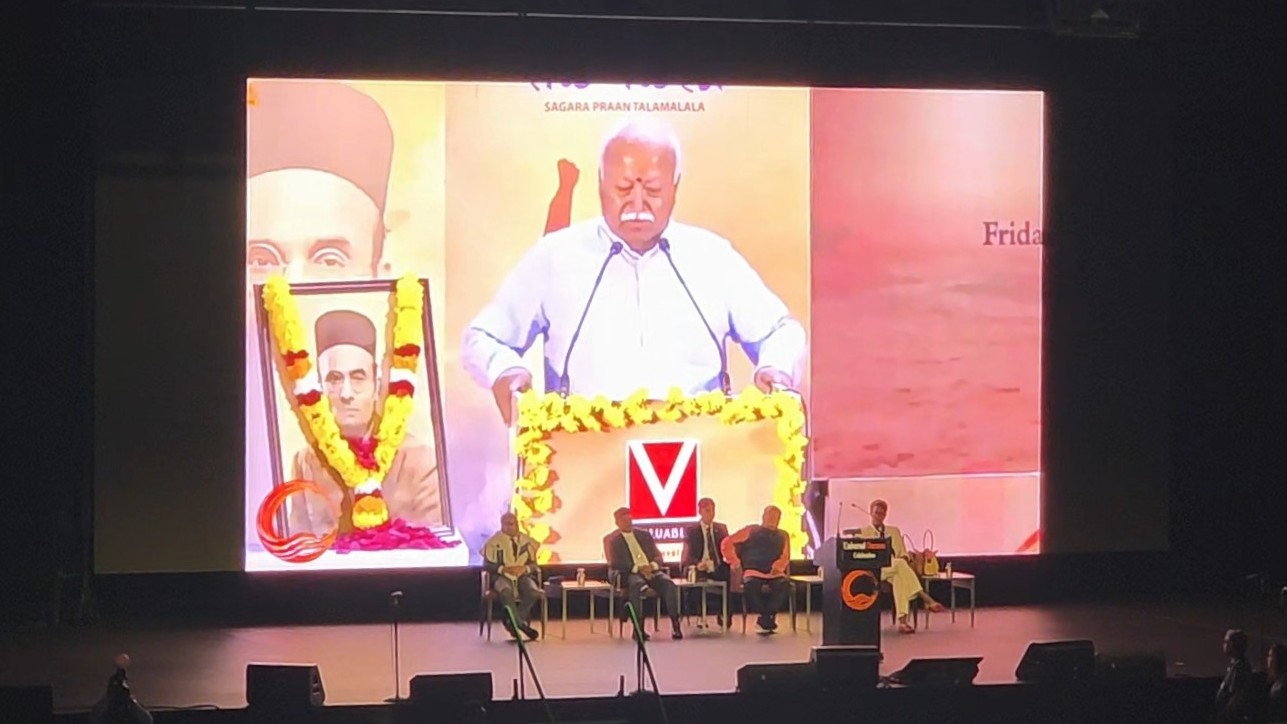
Madison Square Garden, the legendary artistic centre of New York City and a global stage for major sports and entertainment for more than 140 years, is widely regarded as the world’s most famous arena. On Saturday afternoon, however, the event space was home to an audience that did not quite resemble Harry Styles concert-goers or Knicks fans. Crowds of Indian and Hindu Americans of all ages, clad in bright saffron caps, kurtas, and saris, arrived from across the country to see Mohan Bhagwat, the chief of the Rashtriya Swayamsevak Sangh (RSS), a Hindu nationalist paramilitary group, whose affiliate organisations are driving violence against minorities in India. Hosted by American Hindus for Engagement And Dialogue (Ahead), Saturday’s "Universal Oneness Celebration" presented itself as "an afternoon of shared teaching, cultural performance, and common ground". I attended the event as a correspondent for Middle East Eye on Saturday. What I witnessed was a careful repackaging of an entity described by critics as the "world’s largest fascist organisation" into the language of inclusion and pluralism, as escalating communal violence in India continues to claim lives daily. New MEE newsletter: Jerusalem Dispatch Sign up to get the latest insights and analysis on Israel-Palestine, alongside Turkey Unpacked and other MEE newsletters Formed in 1925, the RSS is a Hindu nationalist organisation with more than five million members across the world, with the aim of advancing the vision of Hindutva: a political project that seeks to establish India as a homogenous, Hindu ethnostate. One of its primary ideological progenitors, MS Golwalkar, looked towards Nazi Germany’s ethnic cleansing of European Jews as "a good lesson for us in Hindustan to learn and profit by", referring to India’s Muslims. Likewise, VD Savarkar, regarded as the founder of the exclusionary ideology of Hindutva, viewed the Zionist project in Palestine as a model for India to embody. India’s ruling Bharatiya Janata Party was born out of the RSS’s ideological family, the Sangh Parivar and most of its leading members, including Prime Minister Narendra Modi, are members of the organisation. Senior BJP leaders, including cabinet ministers, have openly called for the killing of India's Muslims in hate speeches, referring to them as "green snakes". Inclusion for all, entry for some Despite its "universal" branding, prospective attendees had to undergo identity-based vetting to attend the free event. This meant listing an affiliated temple or organisation along with a unique five-character code for said organisation, as well as a person of reference within the group. As part of this process, I provided information for a participating organisation that had posted its details online. What is Hindutva and why does it matter? Read More » More than this, however, I believe it was my legibly Hindu, Brahmin name that allowed me to pass the vetting process without any questions, unlike others who reportedly received phone calls from organisers or eventually did not receive tickets. The RSS’s founding ideologues were all Hindu Brahmins, members of the dominant caste within the Hindu caste system, as were its early leaders and proponents. To date, all but one of its chiefs have been Brahmin, and the movement has been described as born out of not only anti-Muslim sentiment, but also out of a desire to maintain Brahmanical dominance in India. Even before entering the event, it was clear that this celebration of "inclusion" was self-selected in favour of a specific demographic, one reflective of the RSS’s values and base. As I joined the more than 5,000 attendees in line to enter Madison Square Garden, this became increasingly clear. The crowd broke out into chants of "Jai Shri Ram", a Hindu religious greeting that has earned a more sinister reputation, as it is now frequently invoked by perpetrators of anti-minority violence. Hindu nationalist groups to assemble at India Day rally in New Jersey Read More » The religious phrase was politicised in the 1980s as a slogan to rally Hindus for the construction of the contentious Ram Temple in the state of Uttar Pradesh's Ayodhya, which was built on the site of a 16th-century mosque demolished by Hindu mobs led by prominent BJP ministers. The crowds also repeatedly chanted "Vande Mataram", "I salute the motherland", referencing the national song of India. The song has been subject to decades-long debate, as its extended version, championed by the RSS, includes references to Hindu religious deities which secular nationalists felt were at odds with the political spirit of the republic. The later stanzas call for 70 million hands to "lift swords" and "drive out every invader who came from land and sea", a dig at the country's Muslims and Christians. Last month, however, the BJP-led government passed the Prevention of Insults to National Honour (Amendment) Bill, which makes disruptions and insults to the "full" song a punishable offence. ‘Which shakha are you part of?’ As attendees filed into MSG’s Infosys Theater, speaking to each other in Hindi, Marathi, Gujarati, and Telugu, among other languages, they made small talk about each other’s whereabouts. A woman and her young son said that they were coming from a "shakha" near Edison, New Jersey, referring to one of the 250-plus chapters of the Hindu Swayamsevak Sangh (HSS), the RSS’s international wing. Another attendee shared that he was a member of the Hindu Students Council, a campus-based network originated by the Vishwa Hindu Parishad of America (VHPA), a member of the Sangh family. An event volunteer recounted his experiences in Hindu Yuva, a similar campus-based project of the Sangh. The Infosys Theater packed with attendees clad in saffron and cultural attire (Shraddha Joshi/MEE) Many attendees wore yellow wristbands from event-organised bus rides from their temples and community centres. On its website, Ahead, whose leadership is intimately tied to the RSS and BJP according to research by anti-Hindutva group Savera, listed more than 250 partner organisations across the country, ranging from HSS Shakhas, Sangh-affiliated student organisations, and religious and cultural groups that had sent members to the event. Outside the event, Rishi Arun, a member of the Anti Imperialist South Asian Alliance, Philadelphia (AISA Philly), and South Asian Left (Salam) - two of the organisations protesting against the gathering - told Middle East Eye that "the people that are coming to the event have gathered here as a result of a decades-long project by Hindutva to legitimise itself amongst the South Asian diaspora, specifically among religious communities in the United States". "These organisations have covertly pushed Hindutva propaganda while masquerading as cultural organisations, and using the language of universality, spirituality, and often inclusion," he said. A celebration of culture The event began with a percussion exposition that journeyed through three types of South Asian drumming styles, but it was not until the Maharashtrian Dhol Tasha, which event organisers described as having military roots, that the auditorium came alive with excitement. Audience members clapped and whistled as an image of Chhatrapati Shivaji Maharaj, a 17th-century Maratha king, was projected on screen. Although many historians dispute this reading, Hindu nationalists have recast his legacy as one of the earliest examples of armed Hindu opposition against Muslim rule in India. The event stage featuring the image of Maratha ruler Shivaji, viewed as an icon for the Hindutva movement (Shraddha Joshi/MEE) Following brief informational videos on "Hindu Dharma" and the nation of "Bharat", the programme featured a dance showcase in which a New Jersey-based Indian dance troupe performed to songs representing all regions of the world. The crowd erupted in cheers as the dancers celebrated the Middle East region with Bahraini singer Flipperachi’s "Fa9la", which was the viral entry song for the Pakistani villain in Dhurandar, a 2025 Bollywood film that has been described as a Hindu nationalist "revenge fantasy". The "Universal Oneness" event captivated its audience with a curated presentation of culture that evoked Hindutva sentiments, without having to verbalise these ties directly. Hindutva in interfaith harmony Following the arts programming, the event turned to a more sober note, as religious leaders from all major faith groups took the stage, representing the "One World, One Humanity" interfaith summit. Mohan Bhagwat stood in the centre, flanked by Jewish rabbis, Muslim imams, and clergy members of other faiths. Bawa Jain, founder of the World Council of Religious Leaders, introduced a "call to action" in commemoration of the "centenary of the RSS", reaffirming global commitments to interfaith harmony. A video on the RSS's history featuring the image of its founder KB Hedgewar (Shraddha Joshi/MEE) The event leadership welcomed faith leaders for brief remarks, including Muslim Imam Talib Shareef, who was praised by organisers for his 30 years of service in the US military. Earlier in the day, Bhagwat had addressed the interfaith summit, stating that "if any Hindu thinks there should be no Muslims in India, he will not remain Hindu". Human rights watchdog Genocide Watch has stated that India is in the preceding phases of an anti-Muslim genocide, crediting the RSS with arming and training Hindu groups to commit organised violence. Rewriting the RSS’s global brand In his 40-minute culminating speech, Bhagwat told the crowd that "every nation has a destiny to fulfil" and that of "Bharat" is to "make the world realise" the idea of "unity in diversity". Many Hindu nationalists use "Bharat" for the country, claiming it was the original name of the "motherland" before Muslim rulers called it "Hindustan" and British rulers called it "India". On Sunday, the RSS leadership praised the New York City event on X, calling it an initiative "taken for global outreach", as part of Mohan Bhagwat’s tour to the US, Canada and UK. Safa Ahmed, board member of the Indian American Muslim Council, and a co-organiser of the protest outside Saturday's event, told MEE that Bhagwat's words were "tailored for the American audience". "[Bhagwat's] words are one thing. And the bloodshed that the RSS commits on a near-daily basis in India is entirely another," she said. '[Bhagwat's] words are one thing. And the bloodshed that the RSS commits on a near daily basis in India is entirely another' - Safa Ahmed, Indian American Muslim Council Ahmed referenced the writing of the RSS's second chief, MS Golwalkar, who wrote that minorities must be "wholly subordinated to the Hindu Nation", stating that ultimately, that was the "RSS's version of a perfect Muslim". Last week, the US Commission on International Religious Freedom called on the US government to sanction the RSS for its role in "violent attacks against religious minorities, including Christians, Dalits, Muslims, and Sikhs". The committee also urged the government to revoke Bhagwat’s visa. In India, RSS shakhas end their prayers with "Bharat Mata ki jai" or "victory to Mother India". Its global affiliates have made the phrase their own, adapting the vision of Indian and Hindu nationalism to their present-day, diaspora context. As the "Universal Oneness" event came to an end, the crowd broke into this version of the chant: "Vishwa dharma ki jai", "Victory to universal dharma", symbolising an RSS globalised.
RSS globalised: Inside the Hindu nationalist paramilitary leader's carefully staged NYC celebration of ‘universal oneness’
Full Article
Original Source
Read the full article at Middleeasteye →KhanList aggregates and links to publicly available news content. We do not host full articles from third-party sources. Always verify important information with original sources.