
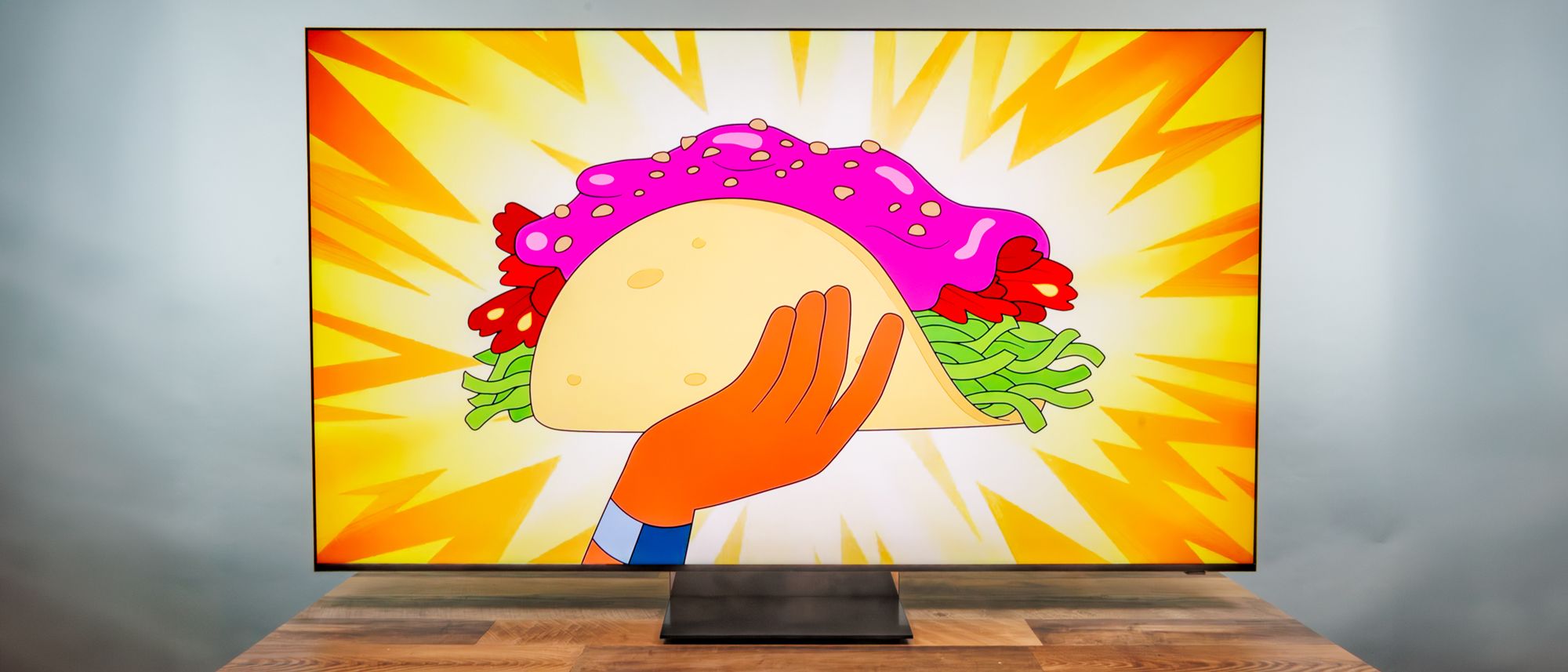
Tom's Guide Verdict The Samsung R95H is not the brightest RGB Mini-LED you can buy, but its anti-glare screen, wide color gamut, and low gaming lag make it a fantastic TV for your living room. Reasons to buy +Clean design with anti-glare panel +Not too eye searingly bright +Great gaming features +Beautiful and vibrant color reproduction Reasons to avoid -Same, boring, small remote -Not the best speakers Why you can trust Tom's Guide Our writers and editors spend hours analyzing and reviewing products, services, and apps to help find what's best for you. Find out more about how we test, analyze, and rate. Jump To: Pricing & availability Design Performance Test results Gaming Sound Smart TV & remote Verdict Samsung R95H: SpecsScreen Size: 65-inchesDimensions: 56.58 x 35.04 x 11.89 inches with stand/ 56.58 x 32.52 x 1.17 inches without standWeight: 52.47 poundsDisplay: Micro RGBHDR Format: HDR 10+Refresh Rate: 165 Hz with VRR SupportConnectivity: Bluetooth 5.3, Wi-Fi 6EPorts: 4X HDMI 2.1, 2 x USB-A, optical digital audio output, ATSC 3.0, Ethernet, RS-232C port. Samsung One Connect boxThere’s no hiding it anymore: some of the best TVs are using new RGB backlighting. We’ve been impressed with both the Hisense UR9 and the Sony Bravia 9 II, two TVs that use their own proprietary RGB MiniLED and True RGB-based display technology. Now, there’s the Samsung R95H, which is taking a similar approach to the competition with Samsung's own MicroRGB tech.I found plenty to like about this TV. Not only is it slightly more affordable than Sony’s and Hisense RGB flagships, but the new panel still delivers some solid performance.While our lab benchmarks show that the TV won’t match some of its rivals directly, that isn’t necessarily a bad thing. Because the R95H doesn’t get eye-searingly bright, it delivers natural, vivid colors without over-saturating movies and TV shows. It also sports a sleek design, making it a fantastic TV for any living room. Read the rest of my Samsung R95H to see how it compares to its rivals.Latest Videos FromTom's GuideSamsung R95H review: Pricing and availabilityOur 65-inch Samsung R95H review unit comes in at a cost of $3,199.99, but as of this writing, it is on sale for $2,799.99. Pricing for the full range is below.65-inch: $3,199.99 | Sale $2,799.99 [TESTED]75-inch: $4,499.99 | Sale $3,799.9985-inch: $6.499.99 | Sale: $5,499.99 (Image credit: Tom's Guide)Samsung’s R95H is slightly cheaper than the $3,599 Sony Bravia 9 II, one of its strongest competitors. It also is priced lower than the Hisense UR9, which comes in at $3,499.99. Both of those sets feature RGB technology. If you’re after more value, the SQD-Mini LED TCL QM7L starts at $1,200 for a 65-inch model.Samsung R95H review: DesignHaving tested more than 24 different TVs this year, there’s three things that I love about the design of the R955H: The sleek center facing stand, the anti-glare panel, and overall slimness of the TV. It’s clear that Samsung has learned some lessons from its competitors to help make a TV that can fit seamlessly into any living room. (Image credit: Tom's Guide)Similar to the Sony Bravia 9 II, setting up the Samsung R95H takes little effort. Just slide the two plastic feet into a larger plastic stand, and then slide the stand into the back of the TV. There are no screws required.Tom's Guide: Direct to Your InboxGet instant access to breaking news, the hottest reviews, great deals and helpful tips.That center facing stand also has a neat design feature that Samsung calls "Infinity Stand.” It has a mirrored finish on the front that reflects whatever is sitting near it, which helps hide the feet and any wires that might hang below the set. (Image credit: Tom's Guide)Sony’s Bravia 9 II and the Hisense UR9 lean on the thicker side, but Samsung managed to keep the R95H’s profile to under 1.5 inches — impressive considering that there’s a lot of backlighting tech behind the panel. When you combine that with the thin bezels and the anti-glare panel, this TV has a minimalist look that fits perfectly in most bright living rooms. (Image credit: Tom's Guide)Unlike on Sony’s Bravia 7 II, Samsung doesn’t skimp out in the connectivity on the TV. A win for gamers like me, all four HDMI ports support the full HDMI 2.1 standard at up to 165Hz (with eARC available on HDMI 3). That’s in addition to optical digital audio output and the ATSC 3.0 tuner as well as the USB-A ports, Ethernet, and the RS-232C port. (Image credit: Tom's Guide)Note that this TV doesn't include the Samsung Wireless One Connect box, but you get a little plastic slot to fill the hole where it would be at the rear of the TV.Samsung R95H review: PerformanceAcross all my tests in Filmmaker mode, the R95H excelled with vibrant color reproduction, decent black levels, and good enough brightness without being too eye searing like some of its competitors. Best of all, thanks to the anti-glare panel, there were no distracting reflections from our bright studio lighting. (Image credit: Tom's Guide)Watching “28 Years Later,” the natural skin tones in the children in the opening scenes stood out to me right away, down to the subtle flush of red in one of the child’s cheeks. The rich realistic brown-ish red hues in the blood made this scene feel a little too realistic and unselling, too. In a later outdoor shot of a church, the black roof looked impressively deep, showing this TV is capable of great contrast.Samsung R95H review: How we testIn our New York City test lab, my lab assistant and I personally test every TV across SDR and HDR benchmarks using the 10% window method. For color accuracy, we switch the TV over to Filmmaker Mode, usually the “best” mode on the TV first. We also disable any intrusive ambient light sensors that could skew our meter’s readings.For our tools, we use the Jeti spectraval 1501-HiRes spectroradiometer to profile the Klein K10-A colorimeter. Once profiled, these work with the Murideo 8K-SIX-G Metal pattern generator and a Tom’s-Guide specific workflow in Portrait Displays’ Calman Ultimate software which helps us determine the TV’s overall brightness and color accuracy across HDR and SDR.For testing gaming performance, we use a Leo Bodnar 4K Video Signal Lag Tester. This tool is used on the screen in the TV’s Game Mode to measure how responsive the TV really is. Once all technical lab testing is done, and we’ve tested the majority of the TV’s remaining picture modes, we put the TV through subjective testing using a curated selection of films and shows, both on streaming services, and on our lab’s Blu-ray player.Visit our “How we test TVs” guide for a more in-depth explanation on the process.Much to my surprise, at the 15-minute mark, during the high-contrast transitions where the movie shifts rapidly between black-and-white and full color, the TV maintained deep blacks with zero noticeable blooming around bright objects.When streaming a “Mr. and Mrs. Smith” episode on Amazon Prime Video, more of the same applied. The R95H pushed out lots of fine detail and natural skin tones. In a scene that takes place on the NYC subway, the skin tones of people onboard the train looked true to life, and the freckles on Maya Erskine’s face had a crisp detail, making it feel like she was looking right at me.Fine details popped right out from the screen, like the gray glow and tones in a car that Maya was leaning against, to shimmer in Donald Glover’s gold chain. The bright city and illuminated lights looked great against the dark skies, with no blooming around their highlights. Even Maya’s blue Mets hat seemed the same color as the one I was wearing myself while evaluating the TV.I also switched the R95H to Standard Mode to watch SDR content on YouTube. Highlights of the 2026 Monaco Grand Prix were impressive; the image was even more color-rich and brighter than Filmmaker mode. All the paint schemes on the car popped against the grays of the track asphalt, especially the red in Lewis Hamilton’s Ferrari. I even noticed the finer details like the marbles in the racing line. (Image credit: Tom's Guide)Finally, I pumped the TV’s brightness to the max in Dynamic Mode and turned to watching the animated Disney Series, “Hailey’s On It!” This mode intentionally pumps up the vibrancy, but I was blown away by the extra punch and vibrancy, as this really shows the R95H’s color gamut and brightness performance. Cooking scenes were eye catching, as the greens in vegetables had a crisp punch against the brown cutting board. Hailey's hair and face had an amount of richness that my OLED TV at home never could deliver. (Image credit: Tom's Guide)An important note: Regardless of which mode I watched, the AI mode features on this TV brightened up and blew out the contrast of the image too much for my liking. I preferred to watch with the feature turned off. This TV also does not support Dolby Vision, though, but it does get you HDR10, HDR 10+ Adaptive, Advanced, and HLG support.Samsung R95H review: Test results Swipe to scroll horizontally Test Name Samsung R95H Sony Bravia 9 II Hisense UR9 Samsung S95H OLED TCL 75QM7L SDR Brightness (10%, in nits) 187 101 188.6473 253.3784 266.7681 Delta-E (lower is better) 3.4674 3.6522 2.211 2.2444 2.6443 Rec. 709 Gamut Coverage 99.612 99.7646 99.8965 113.301 99.4808 HDR Brightness (10%, in nits) 2162.94 3903.026 4370.264 2721.272 2270.33 UHDA-P3 Gamut Coverage 144.09 99.18 99.65 99.92 97.64 Rec. 2020 Gamut Coverage 92.54 89.23 93.14 89.6 90.28 Input latency (in ms) 10.1 9.28 12.1 9.7 9.4 Our lab results show that the Samsung R95H isn't a chart-topper in raw peak brightness. Rather, it delivers solid, comfortable performance across both SDR and HDR testing. (Image credit: Tom's Guide)With our 10% window brightness measurement in SDR (which represents everyday viewing), this TV hit 187 nits. That puts it right up against the UR9’s 188 nits, but not quite as high as Samsung's own S95H OLED that topped out at 253 nits, or the SQD-Mini LED TCL 75QM7L, which hit 286 nits.For SDR color accuracy, the R95H hit a Delta-E of 3.47. Lower is better in this case, so it falls behind the Hisense UR9 (2.21), Samsung’s own S95H OLED (2.24), and the TCL QM7L (2.64). It is slightly ahead of the Sony Bravia 9 II (3.65). (Image credit: Tom's Guide)On our Rec. 2020 test, which gauges a TV’s HDR color performance, the R95H covered 92.54%, putting it ahead of the Sony Bravia 9 II (89.23%), Samsung S95H OLED (89.60%) and TCL QM7L (90.28%). This is just behind the Hisense UR9 (93.14%), showing how strong this TV is for watching HDR content.When it comes to the UHDA-P3 gamut, another HDR color measurement, the R95H yielded a result of 144.09%. This high reading reflects strong color volume performance. It might seem unusual, but it is common for modern RGB displays. It shows that the TV is exceedingly good with HDR colors. (Image credit: Tom's Guide)Backing up my experience with HDR streaming, the R95H reached 2,163 nits of brightness using a 10% window. Again, that is not the brightest against others in our list since this TV puts color replication first, but it is comfortable enough for most everyday viewing. The TV falls way behind the Sony Bravia 9 II (3,903 nits) and leader, the Hisense UR9 (4,370 nits). It also trails Samsung’s own S95H OLED (2,721 nits) and TCL QM7L (2,270 nits). (Image credit: Tom's Guide)The gaming performance of the R95H is pretty good, too. It hit 10.1 input latency in our tests, which puts it ahead of the Hisense UR9, but behind the Sony Bravia 9 II, and the much more affordable TCL 75WM7L. It also falls behind the Samsung S95H OLED.Samsung R95H review: GamingFor games testing, I played the latest PlayStation 5 exclusive, Marvel’s Wolverine on our lab’s console. With this TV sporting four 165HZ HDMI 2.1 ports, gaming was smooth as butter. I encountered no lag when playing through a Nightmare Door and battling hordes of enemies to score a gold medal. All my inputs for quick combat actions were lining up with the motions on the screen. (Image credit: Tom's Guide)To no surprise, this TV has Samsung’s Game mode built in, allowing for AI Gaming optimizations, choosing a game genre in the picture menu, activating game motion plus smoothing, adding a virtual aim pointer, and adding mini map zoom.It also has Xbox game streaming built into Samsung’s Game Hub, so you don’t necessarily have to own a game console to enjoy the TV. I can’t forget the support for ALLM, AMD FreeSync Premium Pro, HGiG, and Nvidia G-Sync, too.Samsung R95H review: SoundThe audio on the Samsung R95H isn’t the best. By default, the TV’s 4.2.2-channel speaker system and sound profiles were a little muted, especially with the score at the start of “28 Days Later.” I had to pump the sound up to Amplify to better enjoy it. (Image credit: Tom's Guide)When listening to Coldplay’s “My Universe,” the acoustic instruments in the song had little depth, and the Amplify mode made things sound more deep. Bass output definitely was within my standard, though, catching the details like the drums. (Image credit: Tom's Guide)Game audio, though, was great with the Amplify sound option. I enjoyed the score of Marvel’s Wolverine on the main menu. The violins carried heavy weight and sounded warm and weren't too flat. (Image credit: Tom's Guide)I still suggest you check out our list of the best soundbars to match the TV’s visual performance with better sound.Samsung R95H review: Smart TV and remoteSamsung continues to disappoint me with its remotes. The R95H uses the same, small, solar-powered remote that many of its other TVs come with. This is downright embarrassing, when TCL, Sony, and other companies have bigger backlit and more comfortable rechargeable remotes. (Image credit: Tom's Guide)When it comes to the user interface, though, my disappointment was lifted. Samsung slightly redesigned its Tizen OS this year and the R95H is a TV that gets the new look. Navigating the layers of the OS has now moved to a glass-like bar at the top of the TV’s main screen. It’s a nice little change that makes things less confusing, but TinzenOS is still not as clean as GoogleTV’s or Roku’s interface.Samsung R95H review: VerdictThe Samsung R95H is an impressive RGB TV that prioritizes rich, natural colors over outright brightness. Its glare-free screen, slim design, and excellent gaming features make it a compelling choice for a living room, especially if you want vibrant HDR performance without the oversaturated look that can come with brighter displays.If you’re more budget-conscious, you might be more enticed by the TCL QM7L which is $1,200 for a 65-inch model. You have to give up some of the R95H's premium RGB technology and get 144Hz support on only two HDMI ports, but those may be worthwhile compromises if value is more important. The QM7L still will dazzle with its brightness and its SQD-Mini LED technology.Since it is slightly cheaper than both Hisense and Sony’s RGB offerings, the Samsung R95H is still a well-balanced TV. It might not be a chart topper against its competition when it comes to raw benchmarks for brightness, but that only means it's a great TV for real-world watching in most living rooms. Arif is the New York-based lab tester at Future Media, Tom's Guide's parent company. He works closely with the head of testing Matthew Murray. Everyday, Arif runs rounds of benchmarking tests on laptops, phones, tablets, and tech gadgets for Future's editorial brands, including Tom's Guide and sister websites like Laptop Magazine. Arif has over eight years of experience in the technology journalism field and is known to be a collector of Windows PCs and laptops. You must confirm your public display name before commenting Please logout and then login again, you will then be prompted to enter your display name.
Samsung R95H review: Stunning RGB color with a living-room friendly shine
Full Article
Original Source
Read the full article at Tomsguide →KhanList aggregates and links to publicly available news content. We do not host full articles from third-party sources. Always verify important information with original sources.