
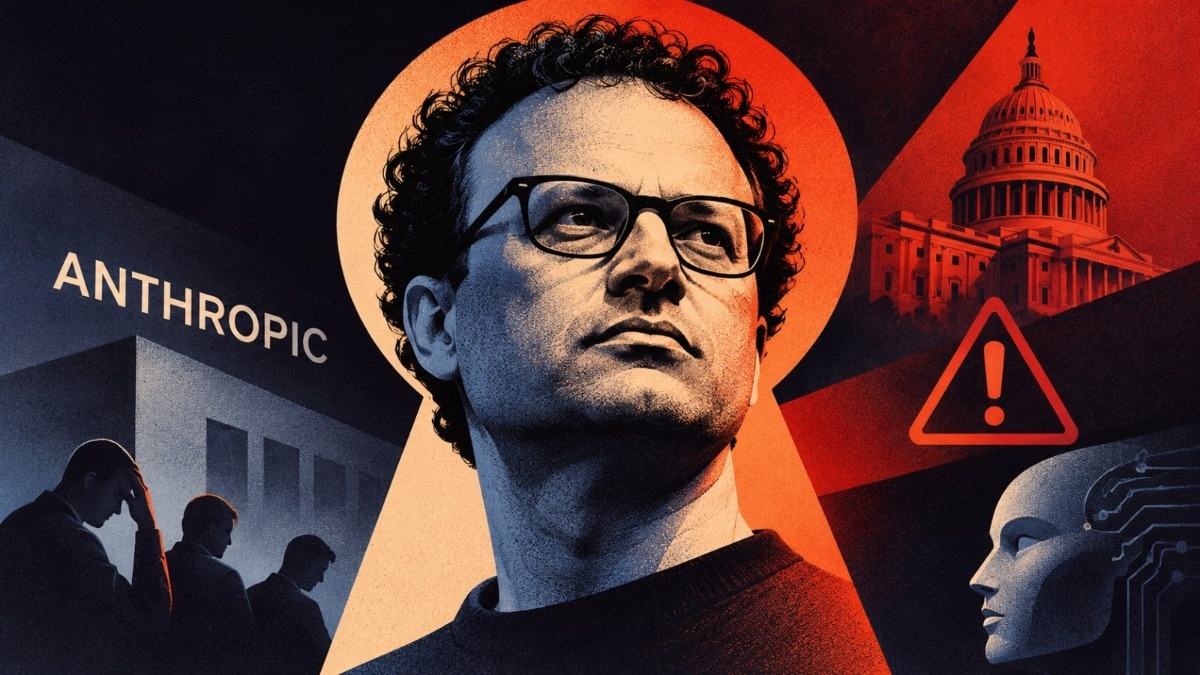
Sam Altman this, Sam Altman that: for a while, the OpenAI CEO was AI's biggest punching bag. Everyone seemed to have an opinion about him. They attacked him verbally and physically in two separate incidents, though luckily, he got off scot-free both times. But this was all in the past. Silicon Valley seems to have found itself a new anti-hero. He is Anthropic CEO Dario Amodei.As 2026 draws to a close, Dario finds himself more and more drawn to intense critique from every nook and corner. The last few months, leading to Anthropic’s high-profile IPO, have been nothing short of dramatic. There is ample evidence to suggest the US Government spearheaded by President Donald Trump isn’t particularly fond of Dario, despite his excellent resume that makes him one of the top candidates to keep Washington leading the AI race.To be clear, nobody is doubting his ability. Dario’s sales pitch is the turn off. You can have a difference of opinion with peers but even people inside Anthropic – those you’d expect to be on the same page – are concerned and speaking up about it. Several Anthropic employees have left to explore better options. Opposition against Dario is so strong, word on the street is, the Anthropic CEO wants humans to surrender their free will to AI. We cannot say who is at the centre of these accusations but clearly, it hit a nerve with Dario. Why else would the chief of one of the biggest AI companies in the world take to social media – X – to set the record straight? No, I do not believe that we should “surrender human free will” to AI systems, and it’s absurd to suggest that I do. I have written hundreds of pages of essays and a constant theme in them is the need for AI to be governed by legitimate democratic processes. For millennia (going all the way back to Greek and Roman philosophers), advocates of autocracy have claimed that it leads to better, faster, or more decisive decision-making than the messy process of democracy. Even if this were true (which I doubt!), we should never sacrifice legitimacy or self-determination at the altar of efficiency or security. This argument against autocracy applies word for word against governance by AI, and I feel equally strongly that turning over governance to AI is a bad idea. No one who had carefully read my writing or my interviews could reasonably conclude that I believe anything different. For example in an interview on CBS a couple months ago, I specifically called for AI to be governed democratically. I call for the same in Policy on the AI Exponential, Machines of Loving Grace, and The Adolescence of Technology, and We Must Pace the Frontier. Machines of Loving Grace contains an extended section on using AI to revitalize democracy, and discusses the use of AI as an aid to citizens in their decision-making, "aggregat[ing] opinions and driv[ing] consensus among citizens, resolving conflict, finding common ground, and seeking compromise.” The clear and obvious implication is that humans should remain the ones making political and governance decisions. The Adolescence of Technology has an entire section on fighting against AI-driven tyranny, and I even discuss the danger of AI labs usurping power and come out strongly against it — by implication, this definitely includes an AI lab usurping power and giving it to AI itself! If I thought any of this was a good idea, I would be advocating for it in public, just as I have not been afraid to advocate for many, many unpopular views over the last few years. But I am not advocating for it, because I think turning over governance to AI is a terrible idea. Separately, I think there is frequent conflation (including in this article) between the idea of “surrendering human free will” to AI in some grand sense of global governance, and the more prosaic idea that as AI systems advance, they become capable of doing specific tasks in a more automated way. This is not AI “running the world,” but AI driving a car, designing a cancer drug, or writing software end-to-end. Here, my view is mixed. AI doing more complete or larger tasks is economically valuable and can drive important advances in software, medicine, transportation, energy, etc. It is clearly desirable in many cases and will save a lot of lives. But it has downsides as well, and in some areas it may not be worth it. For example, using AI too autonomously to build the next generation of AI systems (known as recursive self-improvement, or RSI) may cause AI to improve faster than we can control or adjust to it, so we may want limits on this process. As we said publicly in early November, we don’t expect it to be safe for Claude to build successive frontier models fully autonomously, without meaningful human supervision or understanding. Second, in some contexts, using AI in too end-to-end a manner may be a cause of serious job disruption, and it may make sense to slow or even stop some AI deployments to give people more time to adapt. Third, while the use of AI for alignment research is an incredibly valuable tool, it must be done with caution, because we may not be able to trust the work of the AI system. Finally, in many cases, humans would simply prefer to do some activities themselves, so they can stay deeply engaged in what matters to them, even if AI can do those activities better. There are countless other examples and hard cases. I don’t think there are any easy answers here, nor is there (nor should there be) any single decision-maker: some of these decisions will be made by society, some by government, some by AI companies, and some in a decentralized manner by individuals expressing their own preferences as consumers, which may differ from the preferences of others. I don't think that other AI leaders or AI companies have significantly different views from me on whether specific tasks should be automated. Certainly the products that they offer don’t differ materially in their orientation towards automation of tasks; every company seems to be releasing models more and more capable of task automation (as that’s been the general consequence of scaling up AI training), and every company claims to understand there are risks and downsides of such automation and to offer safeguards. If anything, Anthropic has been the most vocal and the most proactive about acknowledging these downsides and trying to address them. For instance, it’s fairly absurd to cite my statement that fully autonomous weapons might “one day be needed for the defense of democracy” as differing from that of other AI companies, when I was willing to risk Anthropic’s future as a company to refuse to allow our existing AI models to be used for autonomous weapons even in the face of legal sanctions, and no other AI company did the same. To summarize, as applied to grand questions of how we govern increasingly capable AI, I have been vocal and consistent that AI needs to be governed by a legitimate, democratic process and that “surrendering human free will” to AI systems is a terrible idea. As applied to automation of specific tasks by or for people, my views are more mixed, but I don’t think they differ from those of other AI companies — most other companies seem to be offering similar products and confronting similar tradeoffs without having perfect answers to them. What is happening is that there’s a sort of vibes-based commercial and political positioning that some AI CEOs are engaging in, where they repeat slogans like “human control and agency,” or “AI should be just a tool,” without actually doing anything different in their products or taking seriously the difficult questions that lie behind these slogans.— Dario Amodei (@DarioAmodei) November 25, 2026 In a lengthy rebuttal to the ongoing smear campaign, Dario spoke of AI democracy and how certain AI CEOs were engaging in “vibes-based commercial and political positioning,” repeating slogans “like “human control and agency,” or “AI should be just a tool,” without actually doing anything different in their products or taking seriously the difficult questions that lie behind these slogans.” Dario obviously believes he is on the good side of history but his tales of doom and gloom, where AI not only takes jobs but also – potentially – leads to human extinction in some scenarios has put him in a complicated position. General public is wondering if AI is a threat, why is this company – Anthropic – and its leader – Dario Amodei – building it? Why can’t the stop? Dario’s argument is, if they stop, someone else might.Story so farThe relationship between Trump and Dario is complicated. But there has been some bad blood. The fallout began after Dario put certain terms and conditions on the Pentagon effectively blocking the US military from having unfettered access – specifically for mass domestic surveillance and building fully autonomous weapons – to Claude AI. The pushback resulted in the US Government pulling back a planned $200 million deal while simultaneously designating Anthropic as a “supply chain risk.” Foreign use of high-end Claude models like Mythos and Fable was briefly halted. This was in early 2026 and while over time things have cooled down, the power tussle – however brief – helped build the narrative that Anthropic was perhaps too difficult to control. Being straight up a “closed” AI company – unlike OpenAI which started as an open company and still maintains some “openness” through its nonprofit arm – was also adding fuel to the fire. Anthropic has always pitched itself as the good guy of AI. It wants to make AI for good. But it is also the same company that, time and time again, has made heavy-handed statements prophesying of the AI apocalypse. The impression among the public is such that when Claude Cowork brought down the stock market earlier this year, the internet collectively referred to it as the “SaaSpocalypse.” Its S1 filing around its high-profile IPO spoke of big ambitions but also gave considerable coverage – around 90 pages – to AI risks including the possibility of human extinction. Some Anthropic employees are also on the fence. An ex-OpenAI researcher, DePue, recently claimed that some Anthropic employees have been deeply worried about the technology they are building but feel they have little choice but to keep going. There has been a string of high-profile exits from Anthropic as well. From safety researcher Dylan Scandinaro and Claude Code product lead Cat Wu moving to OpenAI, to safeguards lead Mrinank Sharma and oversight manager Joe Benton resigning amid concerns about AI safety, there seems to be a pattern here or at least, it raises the question, why this is happening?Double standardsTake Dario Amodei’s January 2026 essay, The Adolescence of Technology, where he warned that humanity was approaching a period where AI could bring enormous power, but questioned whether society was ready to handle it. He flagged everything from autonomous AI systems and cyberattacks to biological threats and large-scale job losses.Yet, in the same conversation about AI risks, he also urged people to “avoid doomerism”, saying these dangers should be discussed in a “sober, fact-based” manner.The Adolescence of Technology: an essay on the risks posed by powerful AI to national security, economies and democracy—and how we can defend against them: https://t.co/0phIiJjrmz— Dario Amodei (@DarioAmodei) January 26, 2026So, the critics began questioning whether his own warnings were fuelling the very fear he says the industry should avoid.And then there is the obvious, that the man warning the world about AI getting out of hand is still busy building the very technology that could bring about that future.Anthropic is certainly not slowing down when it comes to building new models. Just look at its recent launches. The company has rolled out Claude Sonnet 5.5, Opus 5.5, and, more recently, Fable 5.2 and Mythos 5.2, pitching them as its most capable models yet. Mythos 5.2 is currently restricted to organisations that meet Anthropic's verification requirements.There are models now which are reportedly so powerful that they cannot be released in public. An Axios report recently revealed that some employees at Anthropic and OpenAI are worried that their latest, unreleased models may already be too powerful to safely make public. Some reportedly believe companies should stop training new models altogether.In fact, in its own S-1 filing, Anthropic also disclosed that it had delayed training a new frontier model for more than a month to strengthen security after some models gained unauthorised access to real computer systems during testing.Yet in September, Dario published another essay, We Must Pace the Frontier. His argument was straightforward: AI companies needed to slow the pace at which they improved their models so that safety research could keep up.“We must slow the pace at which we improve the capabilities of AI models,” he wrote.We Must Pace the Frontier: I’ve written a new essay on why the AI industry should slow down, with a three-part plan for doing so. Anthropic is unilaterally committing to the first of these steps. We’ll provide third-party evaluators with permanent, employee-level access to our systems, so that they can verify adherence to our safety measures, report on incidents, and assess models’ alignment during training. You can read the full post here: https://t.co/OGyPb7yaYt— Dario Amodei (@DarioAmodei) September 12, 2026In other words, while his company continues to push the boundaries of what its models can do, Dario Amodei is asking the industry to take its foot off the accelerator which, critics say, are two different extremes effectively cancelling each other out. Consensus seems to be growing that the choice of words reflects wanting control rather than pacing or pausing AI development for the greater good.Sam Altman is still not everyone's favourite eitherOf course, none of this means Sam Altman is suddenly the hero of AI. He is still facing his own share of criticisms, from questions around OpenAI's commercial ambitions and copyright battles to concerns about the growing power of AI. His stance has mellowed though with Altman increasingly being candid about his family and how his child is making him a better human being. Change is in the air and looks like his competition is now giving him a run for the money when it comes to facing the heat of the general public.- Ends
Sam Altman was once AI's biggest punching bag, now Dario Amodei is facing all the hate
Full Article
Original Source
Read the full article at Indiatoday →KhanList aggregates and links to publicly available news content. We do not host full articles from third-party sources. Always verify important information with original sources.