
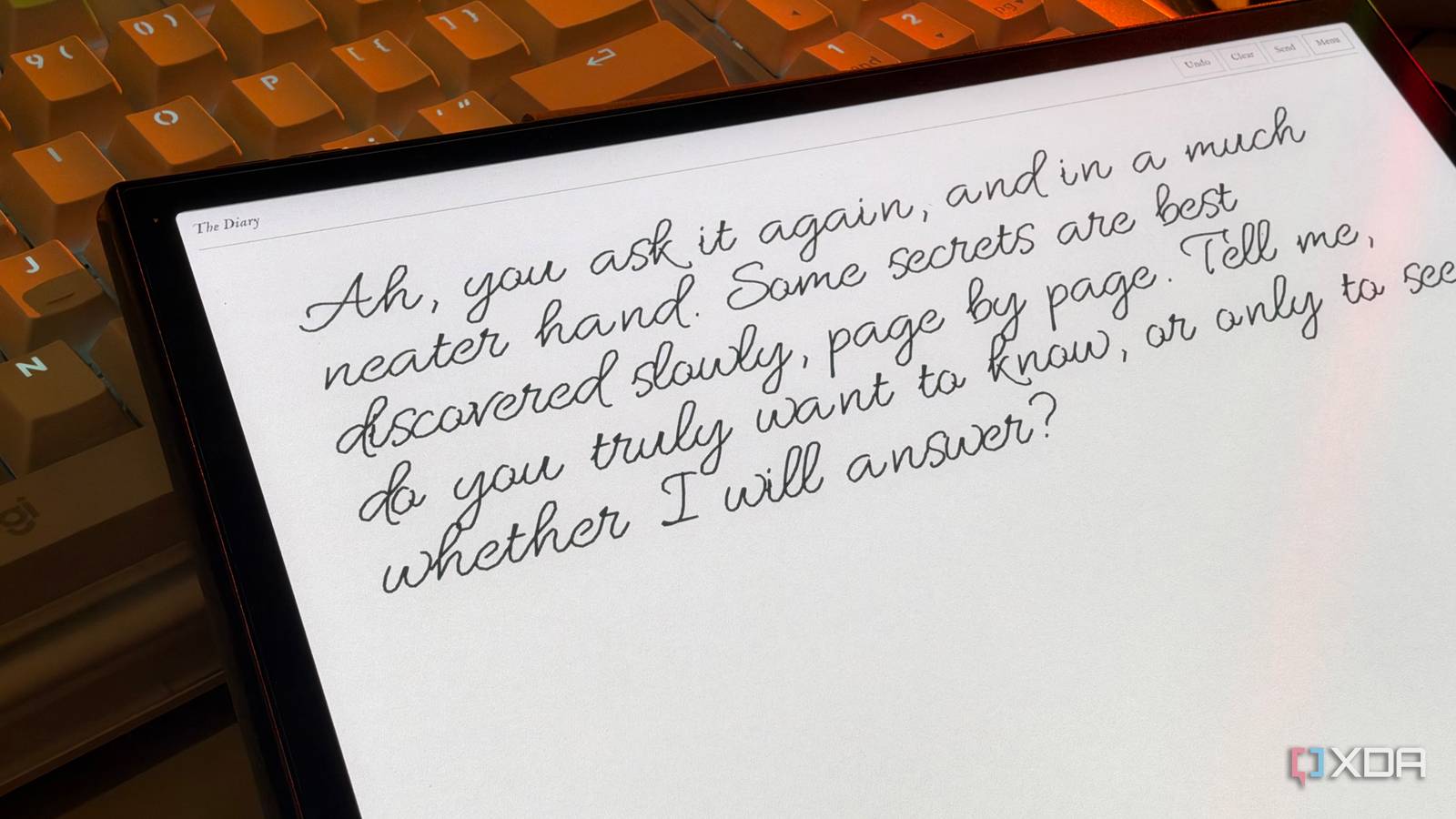
Published Nov 27, 2026, 7:30 AM EST Mahnoor Faisal is a tech journalist covering AI and productivity tools with bylines at XDA, SlashGear, MakeUseOf, Laptop Mag, and Android Police. She's been writing professionally since she was sixteen, and has since penned hundreds of articles. This includes in-depth coverage of AI tools like NotebookLM to breaking news across the AI space. Her passion for technology started when she received her first iPod Touch (4th generation) on her 8th birthday, and she's been deep in the tech world ever since. Currently pursuing a degree in computer science, Mahnoor brings both a journalist's eye and a technical foundation to her coverage of how AI is reshaping the way we work and learn. There are some moments in your life you can't quite forget. I say that as someone who constantly jokes about having a memory worse than that of a goldfish. Despite that, one memory that's etched into my brain is the first time I read and then watched the entire Harry Potter series. It's obviously been years since, but I still remember how badly I'd wished some of the things I'd read about actually existed. One of those things was a diary that could write back to me. I've recently been using vibe coding to relive bits and pieces of my childhood, from recreating the games I grew up playing to the gadgets I grew up using. So, when I came across a post on X of someone who'd used AI to bring that very diary to life on their reMarkable, I immediately knew what I wanted to build next, except on an e-reader I already owned: my Boox. Straight out of the Chamber of Secrets If you've never read or watched Harry Potter and the Chamber of Secrets, Tom Riddle's diary was a seemingly ordinary diary with blank pages. What made it so fascinating was that anything you wrote in the diary would disappear into the pages, and the diary would then write back to you. The idea was always something that just felt like... magic to me. Even though I'm a lot older now, I still think there's something inherently magical about the idea of putting pen to paper and having the paper write back to you. So, you can probably imagine my excitement when I saw a developer named Maxime Rivest recreate that very experience on his reMarkable Paper Pro using Anthropic's Fable model. The project, aptly named Riddle, is open-source, and Rivest has made the entire thing available on GitHub. Much like the diary in Harry Potter, there are no text boxes to type into, no send buttons to hit, and nothing that remotely resembles a traditional chatbot interface. Instead, you simply write on your reMarkable as you normally would. Once you stop writing for 2.8 seconds, the application converts what you've written into an image and sends it to a vision-capable large language model (LLM). Your handwriting fades into the page, and the diary responds in cursive, stroke by stroke, as though someone on the other end is physically writing back to you. Rivest even went as far as implementing a memory system that lets you retrieve previous diary entries by simply writing out what you're looking for. I used the same AI model to build a version for my Boox My Boox was due for a little enchantment While the developer made Riddle open-source and you can run it on your own reMarkable, I currently don't own one. I do have a Boox Note Air 6C though. Given that Rivest had used Anthropic's Fable model to build the diary, I figured I'd see if the same model could whip up a version for my Boox. You can try the diary out for yourself on any device with a web browser here. You'll just need to sign into your Claude account and grant it permission to use AI. I began by asking Fable 5.2 to do some research on Rivest's project, followed by an extremely simple prompt asking it to build a version I could use on my Boox. I deliberately didn't give Fable any instructions on how to approach building the diary or what features to include, since I'd already given it enough context about Rivest's project. Rather than building a native Android app that I'd need to sideload onto my device, Fable built the diary as a Claude Artifact that I could access directly through my Boox's browser. The first version was relatively basic, so I followed up by asking Fable to build a more full-fledged version of the diary. This time, it went as far as adding a black cover with T. M. Riddle's name on it, implementing a proper stroke-by-stroke handwriting animation, and giving the diary a persistent memory system. The diary felt every bit as magical as I'd imagined The closest I'll get to attending Hogwarts Since the diary was built as an AI-powered Claude Artifact, it could generate responses using my existing Claude account. All I needed to do was open the link on my Boox, sign into Claude, and grant the diary permission to use AI. I'll admit that even though I knew exactly what was happening behind the scenes, watching my handwriting disappear into the page and seeing the diary write back to me felt every bit as magical as I'd imagined it would as a kid. The only noticeable difference between Rivest's version and the one Fable built for me was that the diary wrote back to me a little too quickly for my liking. I preferred the comparatively slow animation in Rivest's version, though that's something I could easily tweak. What impressed me considerably more than the animation, though, was how well the diary's memory system worked. I'd initially introduced myself to the diary as Mahnoor. When I opened it again later and introduced myself as Harry to see how well it'd stay in character, it brought up the fact that I'd previously introduced myself as Mahnoor and questioned which of the two I actually was. Since the diary sends an image of whatever I write to an LLM rather than just converting my handwriting into text, I also wanted to see how well it'd interpret drawings. I drew a lightning bolt on the page, without writing a single word alongside it, and the diary responded: Ah, a lightning bolt. The very mask a certain boy wore upon his brow. Is it the sketch of a scar or a clever joke? Tell me which of you drew it, Mahnoor or Harry? Not only had it correctly interpreted what I'd drawn and linked it to the Harry Potter universe, but it'd also managed to tie it back to our previous conversation. I went on to ask the diary about the Chamber of Secrets, and it continued to respond exactly as you'd expect Tom Riddle's diary to. Even when I repeatedly asked it about the Chamber of Secrets, it refused to break character, instead questioning why I was so interested in it in the first place. It's the little details like these that made the experience feel a whole lot closer to interacting with the diary I'd read about years ago than interacting with an AI chatbot. The magic isn't tied to my Boox Another unexpected perk of Fable building the diary as a Claude Artifact rather than a native Boox app is that I'm not limited to using it on my Boox. I opened the diary on my laptop and phone, and it worked just as well. Plus, the diary's memory carries across devices, too. It remembered not only the two different names I'd introduced myself with, but also the lightning bolt I'd drawn and bits and pieces of our earlier conversations.
I recreated Tom Riddle's diary from Harry Potter with Claude, and it feels like magic
Full Article
Original Source
Read the full article at Xda-developers →KhanList aggregates and links to publicly available news content. We do not host full articles from third-party sources. Always verify important information with original sources.