
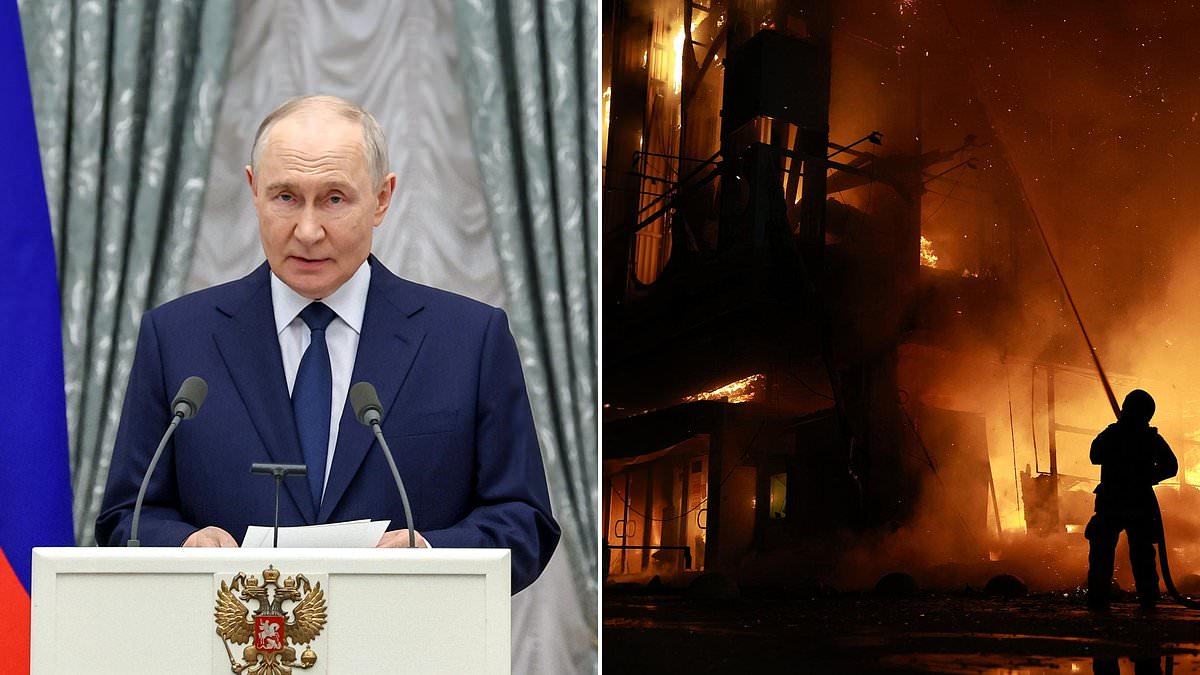
Europe's spy chiefs have warned that Russia may be about to test Nato, with one saying an attack could come in a matter of months.Meanwhile, Russia's ruling party that supports Vladimir Putin is set for a landslide victory in the country's first wartime parliamentary elections, widely regarded as a 'sham'. The warnings come amid growing concern among EU leaders over the threat posed by Russia to the continent. Polish PM Donald Tusk recently said that intelligence assessments suggested Russia could launch a drone or missile attack on Nato territory in the coming months, in an attempt to demonstrate that Article 5 is 'more theoretical than practical'.Meanwhile, French President Emmanuel Macron warned Friday of the growing threat posed by Moscow's shadow operations across Europe, saying he had ordered measures to protect France's critical infrastructure from Russian 'hybrid attacks'.Since Moscow's full-scale invasion of Ukraine in 2022, Kyiv's European allies have raised the alarm about 'hybrid attacks' linked to Russia.The attacks have fallen below the threshold of open warfare, but have included drone flights near sensitive sites, airspace violations, and cyberattacks.This month Berlin blamed Moscow for an incident at Leipzig airport, which the European Union said bore all the hallmarks of 'state-sponsored terrorism'. A rescue worker puts out a fire at the Intrade trade center after a Russian drone strike on Zaporizhzhia, Ukraine on MondaySpeaking to The Guardian, Michal Koudelka, the head of the Czech Republic's BIS security service, said that a Russian incursion on Nato territory was possible.This along with false-flag provocations and an influence campaign could begin to take place in a matter of 'months, not years,' he said.Meanwhile, Normunds Mežviets, the director general of the VDD, Latvia's state security service, said that although there were clear signs of Moscow ramping up interference in Europe, the agency does not 'see indications of an imminent attack'.'It's still an open question if they have direct and concrete plans or if it's just within the context of their overall attempts to spread fear and uncertainty in western society,' he added.Mr Mežviets said it was ultimately a positive development that Western Europe had woken up to the threat posed by Russia. 'Before 2022, we constantly warned our western European partners about the threat from Russia, but most of the time our voices were not listened to. In 2022, the approach of our partners changed. They said it turns out the Balts and the Poles had been right,' he said. Western officials have argued that Moscow's targeting of European states has increased in recent months as the front line in Ukraine has become largely static.The Russian defence ministry said on Monday its forces hit multiple targets in Ukraine, including two cargo vessels used for the military, a gas distribution station, Izmail port infrastructure and the BDU Logistic center in the Kyiv region. Countries close to Russia including Poland, Lithuania and Romania have confirmed various violations, but the Kremlin's shadow war has also spread throughout the continent.Security expert and journalist Philip Ingram told the Daily Mail that these types of attacks are likely to become increasingly common, building on tactics Russia has already used.These include assassinations and the use of nerve agents such as Novichok, as well as radiological weapons such as Polonium-210 on the streets of London.He also pointed to suspected sabotage in warehouses in London and the use of explosives on drones at Leipzig Airport, alongside unexplained drone activity near Ireland, over US Air Force bases in the UK and above critical infrastructure and military sites across Germany, Denmark, Sweden and other European countries.There have also been direct threats against the CEOs of arms companies in Scandinavia and Germany, as well as threats against British companies helping to supply Ukraine, while cyber attacks have become another increasingly prominent tool in Russia's arsenal.Mr Ingram said that Europe can expect to see a growing wave of these shadow war attacks because 'the West, Nato, Europe, the United Kingdom and the United States haven't responded robustly to the Russians'.'I think we need to be more aggressive in the way we're dealing with Russia. A Polish soldier kneels next to a military vehicle during a military exercise A serviceman of Russia's Emergencies Ministry sits under a mural depicting Russian President Vladimir Putin during Russia's parliamentary election'We need to be imposing even greater sanctions against what Russia's doing. We should be increasing our support to Ukraine because the only way to properly stop Putin is to topple Putin.'And Mr Koudelka said the Kremlin's current tactic was 'escalate to de-escalate', with Russia attempting to exploit weak points in European societies to suppress their support for Ukraine's war effort. 'They believe if they escalate enough, then European countries will decide not to support Ukraine,' he said.And while the US has recently made another attempt at restarting peace negotiations between Russia and Ukraine, experts say Putin most likely does not have any interest in these talks.Thomas Nilsson, the head of Sweden's military intelligence and security service, told The Guardian: 'I haven't seen any signs that there is a serious consideration in Moscow about real negotiations.' 'My assessment is that they are still thinking that they could achieve their strategic objectives, so they are just playing negotiation theatre,' he added.The three spy bosses all agreed that Russia's shadow war is likely to intensify in the coming months.Mr Nilsson said: 'To have an armed UAV drone sent in to a busy airport in the middle of Europe … If you have attacks that could result in losses of life or losses of very critical infrastructure that have a huge implication for society, I think that is a gamechanger.'Mr Mežviets warned that the Kremlin was shifting from random acts of sabotage and arson designed to create panic towards targeting specific sites and organisations linked to Western support for Ukraine.Mr Koudelka said the sabotage campaign was also putting a strain on intelligence services, as uncertainty can persist over whether incidents were deliberate acts of sabotage or the result of other causes.'Now every fire or every malfunction needs to be investigated by intelligence services as a potential terror attack, and that is a good result for them,' he said. It comes as Russia's ruling party that supports Vladimir Putin is set for a landslide victory in the country's first wartime parliamentary elections, widely regarded as a 'sham'.The pro-war United Russia party is projected by early counting to take around 58 per cent of the vote, with its closest rival the Communist Party on track for just 14 per cent.Polls closed to the 111 million-strong electorate on Sunday just hours after Ukraine fired more than 1,000 drones into Russia, including an 'unprecedented' number at the capital Moscow.Voting stretched to Russian-held areas of Ukraine, prompting Kyiv to urge foreign governments against recognising the outcome. Members of a local electoral commission count votes as they stand near portraits of Russian President Vladimir Putin and Denis Pushilin, the Moscow-installed leader of the Russian-controlled parts of the Donetsk region A police officer in protective clothing works at Leipzig/Halle Airport after a drone was spottedPutin was not on the ballot paper because these elections were for the state Duma – Russia's parliament – rather than the presidential seat. He is also not a member of United Russia, but he served as its leader between 2008 and 2012.The current leader is Mr Putin's ally, former president and prime minister Dmitry Medvedev. He has already vowed to implement the dictator's will in the new parliament.The result of the election – which ran across three days at a turnout of 56 per cent – was never truly in doubt because the Kremlin exerts tight control over the voting process.They are broadly similar to the results of the last election in 2021, despite growing unease over the war among civilians.Russian elections have for decades been marred by corruption allegations, and this year's was no different.Evidence emerged that some ballots had been pre-marked to force votes of United Russia. There were also reports of ballot stuffing, where a voter casts more than their one permitted paper.Credible opposition is virtually non-existent in Russia, with critics of the current regime barred, jailed or exiled – particularly if they begin to gain political traction.Human rights groups estimate more than 2,000 people are currently locked up for political reasons.Russia's only overtly anti-war party Yabloko – meaning Apple – had been banned from standing to prevent any criticism of Putin's military policy, but some of its candidates contested individual constituencies.
Russia could launch attack on Nato within 'months not years', Western spy chiefs warn
Full Article
Original Source
Read the full article at Dailymail →KhanList aggregates and links to publicly available news content. We do not host full articles from third-party sources. Always verify important information with original sources.