
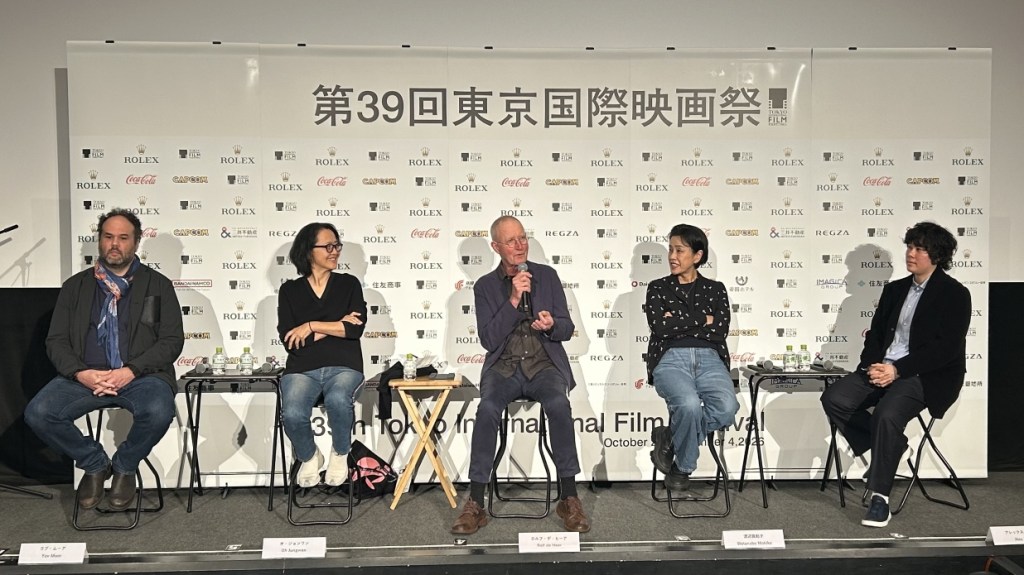
Australian filmmaker Rolf de Heer, president of the competition jury at this year’s Tokyo International Film Festival, talked about the significance of ‘A-list’ ratings for film festivals at the jury press conference today. Tokyo has recently had its status as an A-list festival reaffirmed by the Fédération Internationale des Associations des Producteurs de Films (FIAPF), a Brussels-based global organization that rates film festivals. But the practice of rating festivals, and the process and criteria for rating them, has proved controversial over the years. In March this year, FIAPF overhauled its festival accreditation system for the first time since 2007, with a new framework that classifies 17 festivals as “A-list” and expanding the overall number of accredited festivals around the world. Five of these festivals are based in the Asia Pacific region, including Tokyo, Busan, IFFI Goa, Cairo and Shanghai. When asked about the ratings system, De Heer said: “Tokyo has always been considered an A-list festival by most people who attend festivals, so in that sense I don’t think it makes a lot of difference. This sort of categorization seems to be becoming more important in terms of the quality of films that are available to a festival, so in that sense it may help that Tokyo now officially has that rating again, but I don’t think it changes the festival so much.” Watch on Deadline FIAPF’s old system classified festivals in four groups: competitive, specialized, non-competitive and documentary and short film festivals. The 2026 reform collapsed the four categories into one group of 49 accredited festivals across 29 countries on five continents. When pushed on the subject with another question, De Heer said: “It matters a great deal to some people and not at all to others, and that is at it should be.” De Heer is heading the main competition jury at this year’s Tokyo film festival, along with Korean producer Oh Jungwan, New York and Tokyo-based producer Alex C. Lo, French colorist Yov Moor and Japanese actress Makiko Watanabe. The jury also talked about international co-productions, as several films in this year’s line-up of 15 competition titles have been structured this way. Lo agreed with a question from the audience about the growing trend: “I didn’t notice there’s an increasing number of co-productions in the festival line-up, but it’s true that a lot of producers in Europe, US and the rest of the world are increasingly seeking co-production opportunities, mainly due to the link to their local government production support.” When asked about the potential for co-productions between Japan and Australia, De Heer noted that the Australian film industry does not approach co-production in the same way as European producers: “It makes no sense for a Japanese film to shoot in Australia, and it makes no sense for an Australian film to shoot in Japan. Europe is very good at doing co-productions only on a financial basis. Australia is not so good at that. “The sort of co-productions that work out of Australia have a natural story where some things need to be shot in Japan, some things in Australia. Those will always be possible if the scripts come and if they’re right.” The jury also talked about their criteria for judging the 15 films in competition, which includes titles from across Europe and the Asia Pacific region. Oh Jungwan said: “For me as a jury member, I’m looking at whether I’m convinced by the story the director is telling and the way he’s telling it.” She later said she’s also prepared to fight for the films she loves and once had a seven-hour discussion about a film when serving on another jury. Yov Moor said: “When watching each film, I’m looking at what is interesting and sincere in the film, but also really trying to imagine what the next film of this director could be.” Makiko Watanabe added: “I try to see films without any preconceived notions and don’t try to look for answers while watching. As jury, there are other things we need to look at, but mostly I’ll look for what touches me and later digest what I took from the film.” Tokyo International Film Festival opened last night and runs until November 4 in the Hibiya-Ginza district of Tokyo. It closes with the awards ceremony and a screening of Korean filmmaker Yeon Sang-ho’s Colony.
Rolf de Heer & Fellow Tokyo Jury Members Talk Festival ‘A-List’ Ratings, Co-Production & How To Judge Films
Full Article
Original Source
Read the full article at Deadline →KhanList aggregates and links to publicly available news content. We do not host full articles from third-party sources. Always verify important information with original sources.