
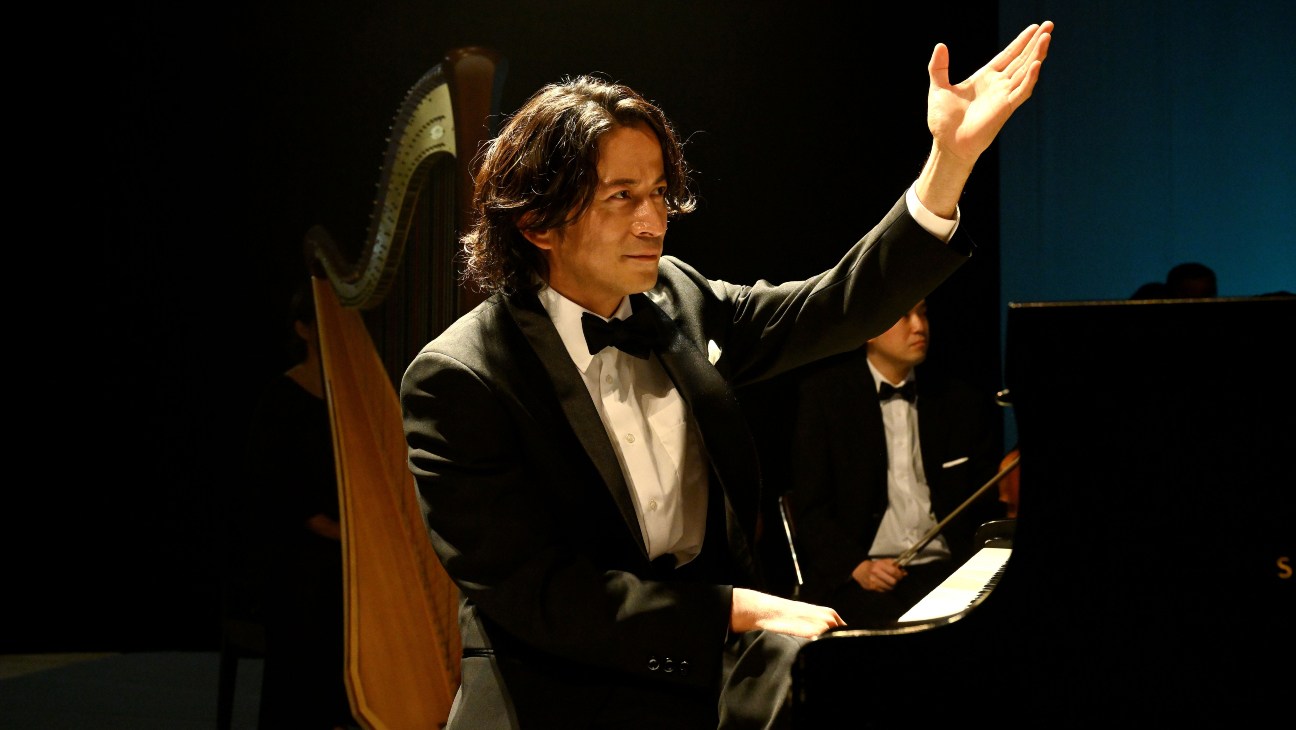
Opening the 2026 Tokyo International Film Festival is Sukiyaki, Takahisa Zeze’s drama charting the backstory of the 1960s song that became a global hit and a symbol of Japan’s recovery from postwar devastation and humiliation. Centered on composer and jazz pianist Hachidai Nakamura (Junichi Okada), the film tells of his partnership with lyricist Rokusuke Ei (Tori Matsuzaka), and how singer Kyu Sakamoto (Taiga Nakano) turned their combination of a jaunty melody and plaintive lyrics into an unlikely global pop culture phenomenon. Though the tale behind the tune was ripe for onscreen telling, the song’s legacy is perhaps even more remarkable. An ill-fated recital left Nakamura struggling with debt and addiction as rockabilly eclipsed jazz. He was save by forging an unlikely partnership with Ei, a radio writer who had never penned song lyrics, to write a rockabilly score for a 1959 movie from Toho (the company also distributing the 2026 film). In 1961, Nakamura and Ei wrote “Ue o Muite Aruko“, which translates as ‘I look upwards as I walk,’ for which Nakamura incorporated traditional Japanese scales, jazz chords and U.S. pop influences. Ei’s melancholic lyrics were inspired by the failure of the mass Anpo protests to stop a Tokyo-Washington security treaty that maintained a huge American military presence in Japan, and the looking upwards in the song is to stop tears of sadness falling from his eyes. Singer Sakamoto was brought in on short notice for its premiere at Tokyo’s Sankei Hall on July 21, 1961 – only given the sheet music two hours beforehand. Unrehearsed, Sakamoto went into a minor key on an ad lib, sang the 4-beat song as an 8-beat, and came in a beat late, mimicking Japanese balladeers he had grown up listening to. These quirks added further layers to the song’s distinctiveness. Released as a single, it was the Music Life best domestic song from November 1961 to January 1962, selling 300,000 copies. Kyu Sakamoto on his global tour in 1963. Sjöberg Bildbyrå/ullstein bild via Getty Images It found its way overseas via Louis Benjamin of British label Pye Records visiting Japan in 1962 and falling for its catchy melody. He gave it to Kenny Ball and his Jazzmen to record an instrumental version titled “Sukiyaki,” which made the British top ten in February 1963. One story is that Benjamin came up with the name after eating sukiyaki, a hotpot dish, in Tokyo, while another version has Ball picking one of the only Japanese words he knew because he figured the original title was too difficult for listeners. After a U.S. release of Ball’s version, and another instrumental cover by Billy Vaughn, failed to make waves, Capitol US decided to gamble on the original Japanese version — but with the “Sukiyaki” title. It hit record stores on May 3, 1963 and in June topped the Billboard Hot 100 for three weeks. This made Sakamoto the only Japanese artist to ever have a U.S. No.1, and the song the first from Asia to do so. It would not be until BTS’s “Dynamite” in 2020 that another Asian artist would repeat that feat. The appeal of the infectious tune and Sakamoto’s whistling reached far beyond the U.S., with “Sukiyaki” topping rankings from Australia to Norway. The single eventually sold more than 13 million copies worldwide. As the Japanese public began to realize people around the world were whistling along to a song in their native tongue, Toshiba capitalized and reissued the single. The 1963 cover added “Sukiyaki” to the title, rendered in the katakana syllabary for foreign words, along with the packaging legend: “global hit!” Japan’s economy was by then registering double-digit growth as companies like Sony and Toyota were becoming global brands. The worldwide success of “Sukiyaki” was another source of pride for a national psyche still bruised by wartime defeat and occupation. International cover versions of “Sukiyaki” then came thick and fast, with dozens in Chinese languages alone, as well as interpretations in Spanish, German and French. Scores of Japanese artists have also covered the song. Among the U.S. fans of the 1963 release was a nine-year-old Janice-Marie Johnson, who later founded R&B and funk outfit A Taste of Honey. A few years after their No.1 hit Boogie Oogie Oogie, Johnson decided she wanted to do a version of “Sukiyaki” and contacted lyricist Ei in Japan, who provided her with a rough English translation. She worked these into her own take on the song, but faced stiff opposition from her label and producer, who were convinced R&B audiences had no interest in Japanese-sounding music. Johnson’s persistence was justified when their “Sukiyaki” topped the Billboard R&B chart and reached number three on the Hot 100 in 1981. The band appeared alongside Sakamoto on Japanese TV. Johnson’s lyrics were used in hip-hop duo Doug E. Fresh & Slick Rick’s 1985 classic “La Di Da Di.” On the evening of August 12, 1985 Sakamoto boarded Japan Air Lines flight 123 from Tokyo to Osaka. Twelve minutes after takeoff the Boeing 747 suffered catastrophic mechanical failure. The pilots managed to keep the plane in the air for around half an hour — enough time for many passengers to write messages to loved ones — before it crashed into a mountainside in central Japan, killing 520 of the 524 onboard, including Sakamoto. It remains the deadliest single-aircraft disaster in aviation history. Sakamoto’s song is played at the annual memorial service. “Sukiyaki” was revived as a symbol of melancholic hope in the wake of the 2011 earthquake, tsunami and nuclear disaster in Japan when it was sung by 71 celebrities in a television commercial. It was also featured in that year’s Ghibli movie From Up on Poppy Hill, leading to a reissue. Tokyo Ska Paradise Orchestra played it at the closing ceremony of the pandemic-delayed Tokyo Olympics in August 2021. Sukiyaki, the film, opens in Japan on Christmas Day, reuniting on screen the trio Sakamoto had said he wanted to bring back together just days before his death. From left: Director Takahisa Zeze, stars Jun’ichi Okada, Tôri Matsuzaka and Nana Seino attend the ‘Sukiyaki’ world premiere at the 2026 Tokyo International Film Festival. Tokyo International Film Festival
The ‘Sukiyaki’ Phenomenon: The Song Behind the Tokyo Film Festival’s Opening Film
Full Article
Original Source
Read the full article at Hollywoodreporter →KhanList aggregates and links to publicly available news content. We do not host full articles from third-party sources. Always verify important information with original sources.