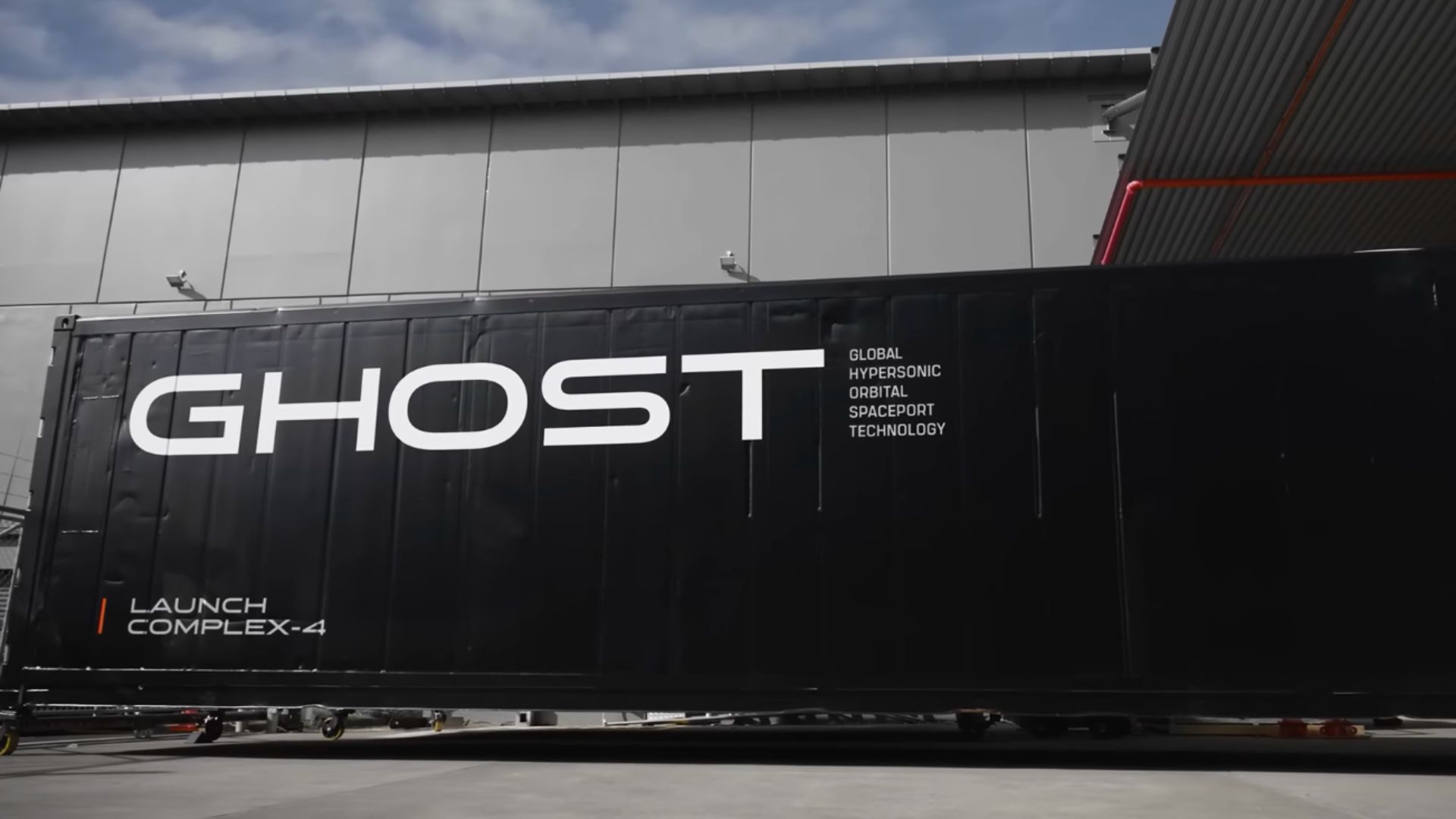
Looks like an entire orbital launchpad could be hitched to a semi-truck and driven anywhere on Earth, thanks to space launch provider Rocket Lab. The company has unveiled GHOST, which is short for Global Hypersonic and Orbital Spaceport Technology. GHOST is a deployable, containerized launch infrastructure designed to fire rockets into orbit or suborbital trajectories from nearly anywhere on Earth. It is like a spaceflight in a box. GHOST houses everything required to execute a flight campaign: the rockets themselves, ground support equipment, launch pads, and complete range control systems. With this technology, Rocket Lab aims to make launch operations fully portable, especially for national security and international space defense. Furthermore, GHOST’s primary advantage is its ability to support both Electron orbital rockets and HASTE hypersonic test vehicles using a single shared ground infrastructure. “We’ve been leading the field in small launch for missile defense and national security for years. Our reliability, repeatability, and affordability sets us apart from everybody else, and creating GHOST is about packaging that up into a deployable system that can serve the world’s most important programs from wherever those missions need,” said Sir Peter Beck, founder and CEO of Rocket Lab. Dual mission profiles Rocket Lab depends on two primary vehicles: Electron, its 59-foot workhorse launcher with 83 missions under its belt since debuting in 2017. It is the second most frequently launched US rocket annually after SpaceX’s Falcon 9. And HASTE (Hypersonic Accelerator Suborbital Test Electron) is a suborbital derivative designed for testing hypersonic flight technologies. First launched in June 2023, HASTE has flown nine times to date, offering customers dedicated testing environments alongside Electron’s small-satellite orbital rides. This new containerized setup supports dual-vehicle launches out of a single system. As a result, defense partners and international allies can rapidly establish independent launch points while completely overcoming the high costs of fixed concrete infrastructure. “Whether it’s for missile defense and deterrence, or opening up more trajectories, orbital missions, and sovereign launch capabilities in allied nations, GHOST is the answer to launching anywhere, anytime, and without compromise,” Beck added. GHOST: Launch-anywhere capability Rocket Lab will debut its containerized GHOST system in 2027 with a suborbital launch from its newly established Launch Complex 4 at Alaska’s Pacific Spaceport Complex. Featuring two pads built for high-frequency flight campaigns, this addition brings Rocket Lab’s global network to six operational pads across two hemispheres, expanding beyond its active sites in New Zealand (LC-1) and Virginia (LC-2 and LC-3). Rocket Lab has expanded its Virginia facility with a second launch pad to support Neutron, its upcoming medium-lift rocket designed to be larger, more powerful, and partially reusable — similar to SpaceX’s Falcon 9. Although Neutron‘s maiden flight slipped past its original 2024 target, developmental delays are typical for new launch vehicles, and the company continues to make steady progress toward its operational debut. Earlier this year, Rocket Lab secured its largest launch agreement to date through a $190 million Department of Defense contract for 20 flights of its suborbital HASTE rocket. Serving as the core testbed for the DOD and Naval Surface Warfare Center Crane Division, HASTE allows defense agencies to evaluate payloads and maneuverable hardware at Mach 5+ speeds. This high-cadence testing pipeline directly supports the U.S. military’s drive to accelerate its capabilities in hypersonic technology and defense systems against fast, low-altitude aerial threats. National security space strategy is shifting fast. Fixed launch pads are stationary targets. Through compact, modular launch systems, GHOST could bring mobility-driven deterrence to space defense, allowing swift, on-demand launches directly from allied lands. Recommended ArticlesGet the latest in engineering, tech, space & science - delivered daily to your inbox.Mrigakshi is a science journalist who enjoys writing about space exploration, biology, and technological innovations. Her work has been featured in well-known publications including Nature India, Supercluster, The Weather Channel and Astronomy magazine. If you have pitches in mind, please do not hesitate to email her.
Rocket Lab’s GHOST to enable rocket launches to take place from anywhere on Earth
Full Article
Original Source
Read the full article at Interestingengineering →KhanList aggregates and links to publicly available news content. We do not host full articles from third-party sources. Always verify important information with original sources.