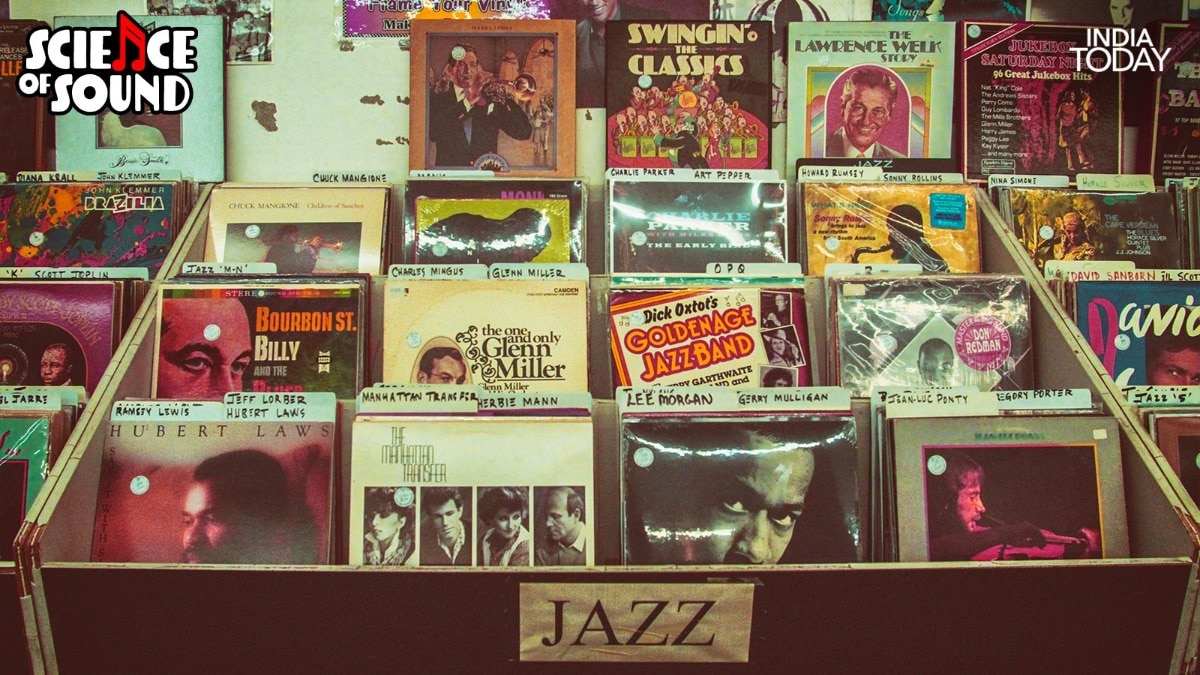
You know a song's genre before you know the song. Press play, and within a heartbeat, long before the first word arrives, your brain has already figured out the music genre: this is metal, this is a ballad, this is a dance floor at midnight. Nobody taught you to do this, and you could not explain how you did it.We tend to assume that recognition is a matter of taste, or culture, or the music we happened to grow up on. It is really something far more physical.Underneath every genre label sits a set of numbers: how rough the sound is, where its energy lies, how squashed its loudness is, how the beat leans, and how long each note takes to fade. Shift those numbers and a song slides from one genre into another, even if not a single word of the lyric changes.In this instalment of Science of Sound, we follow the handful of physical quantities that separate one Western genre from another, analysing famous songs and films for each, and then arrive at the harder question of where the physics runs out and something else takes over. THE INGREDIENTS EVERY MUSIC GENRE IS BUILT FROMBefore music splits into styles, it is all the same raw material.A note is just air vibrating. How fast it vibrates is what we hear as pitch, high or low. How hard it vibrates is what we hear as loudness. A quick distinction. A tone is a single, steady sound at one pitch. A note is that same sound once music gives it a name and a place, like Sa, or C. Every note is a tone which is put to work in a piece of music.Now the interesting one. A flute and a guitar can play the exact same note at the exact same volume, and you still know instantly which is which. That difference is called timbre, said tam-ber, and it simply means the colour of a sound. Timbre comes from harmonics.When any instrument sounds a note, whether it is a plucked string, a blown pipe or a struck drum, it does not make a single clean tone.It makes the main note plus a stack of much fainter notes ringing quietly above it. Every instrument lights up a different pattern of those faint notes, and that pattern is its fingerprint. Pitch, loudness, timbre and the faint harmonics ringing above every note are the raw materials from which all music is built. (Photo: Unsplash) Harmonics, then, are those faint higher notes that ring automatically above the main one, and the particular mix of them is what gives each instrument its own voice.It is why a trumpet and a violin never sound alike, even on the same note.Musicians have their own famous list of the building blocks of music, usually seven.Melody, the tune you can hum. Harmony, the extra notes stacked underneath it to fill it out. Rhythm, how the sound is arranged in time. Dynamics, how loud or soft the music gets. Timbre, or the colour of the sound, which we just met. Texture, how many layers are playing at once, a single voice being thin, a full orchestra thick. And form, the overall shape of a song, its verses and choruses.That is the whole toolkit. Every genre is built from these same pieces. What makes rock sound nothing like jazz is simply which pieces each one pushes hardest.ROCK AND METAL: THE VIOLENCE IN A GUITAR STRINGRock's signature is distortion, and distortion is a physical accident turned into a style.A guitar string on its own produces a smooth, rounded wave. Feed that wave into an amplifier and push it harder than the amplifier can handle, and the amp simply cannot reproduce the tallest peaks. It flattens them off.The rounded wave becomes almost a square one, and squaring a wave automatically manufactures a tall stack of new harmonics that were never in the string. The note stays the same, but the sound around it turns dense, bright, and aggressive. Pushed past its limit, an amplifier flattens a guitar's smooth wave, creating the harsh extra notes that give rock and metal their roar. (Photo: Unsplash) You can hear this at its rawest in AC/DC's Back in Black. The amplifiers are pushed so hard that they flatten the guitar's sound wave, giving it that thick, gritty roar. Underneath it runs a heavy, steady drumbeat.It is the sound of shouting your feelings from a rooftop. Anyone who has listened to Bohemian Rhapsody heard the same physics in Queen's guitar tone, the thick, singing distortion that fills a stadium.The heavier the music, the harder the amplifier is pushed. Take Metallica's Master of Puppets. Here the guitar's wave is squashed almost completely flat, and the flatter it gets, the more of those extra hidden notes pile on top.That is what turns the sound harsh and sharp, like metal being torn. Add drums pounding fast underneath, and you get the raw, aggressive edge that heavy metal is all about.HIP HOP: THE FREQUENCIES YOU FEEL IN YOUR CHESTSome music does not stop at your ears. It reaches into your chest.Every sound has a pitch, and the lowest pitches of all are called bass, the deep, heavy end of sound, the opposite of a shrill whistle.Bass is not just heard. At its deepest, it is felt, a physical thump against your ribs, the way thunder rattles a window.Hip hop's heartbeat is a particular kind of bass called the 808, named after the machine that first created it, the Roland TR-808, built in the early 1980s.Rather than a drummer hitting real skin, this sound is generated electronically, a deep, rounded boom sent right down into that felt-not-heard territory.And it does something clever. It does not sit still on one note. It starts a touch higher and slides gently downward as it fades, which is exactly what gives it that heavy, falling thud. The deep bass of hip hop sits so low it is felt against the ribs rather than heard, which is why clubs need enormous subwoofers. (Photo: Unsplash) Here is a strange thing about your own ears. They do not treat every pitch equally. You hear middle-range sounds, like a human voice, most clearly.But the lower a sound goes, the harder your ear must work to notice it at all. Two scientists, Harvey Fletcher and Wilden Munson, proved this back in 1933, and engineers still use their findings today.It means that to make a deep bass note feel as powerful as an ordinary voice, you must play it far louder. That single fact is why nightclubs install enormous speakers, called subwoofers, built for nothing but bass, so the low end can finally hit as hard as it was always meant to.Hip hop turns this into art. Kendrick Lamar's HUMBLE. rests almost everything on a stripped-back, booming bassline, while his voice stays cool and unhurried above it, letting the low end carry the weight his words do not need to shout.Travis Scott's Sicko Mode goes further still, built around a bass hit so deep it seems to arrive through the floor before your ears have even caught it.This is music built from the ground up, taking one of our oldest instincts, the pull to move to a beat, and running it entirely through modern machinery.POP AND CLASSICAL: THE LOUDNESS THAT NEVER BREATHESWhat makes pop sound like pop is not really the tune. It is what happens to it in the studio.Every recording has quiet moments and loud ones. The gap between the softest and the loudest is called dynamic range.A pop song deliberately shrinks that gap, using a tool called compression. The quiet parts are pushed up, the loud parts pulled down, until the whole song sits at one steady, unchanging level.Why do that? So the song survives anywhere. It sounds equally loud in a noisy car, a busy kitchen, or a pair of cheap earphones. It has been ironed flat on purpose so that it never gets lost. Compression irons a pop song flat to one constant level, while Beethoven and Debussy keep the natural whisper and roar of live sound. (Photo: Unsplash) Now think of two friends telling you the same story. One tells it at exactly the same volume from beginning to end, so you never miss a word, even in traffic. The other tells it the way stories are really told, dropping to a hush at the frightening part, then rising at the thrilling one, trusting you to lean in.Beethoven's Fifth Symphony is that second friend. It whispers through the woodwinds, then erupts into brass, and that swing between soft and loud is the entire point.Debussy's Clair de Lune does the same on a single piano, left completely unsquashed, breathing gently, soft one moment and full the next.Play a pop song and a symphony one after the other, and you will hear it at once. The symphony breathes. The pop song never does.BLUES AND SOUL: THE NOTES THAT LIVE IN THE CRACKSBlues plays notes that do not exist on a piano.A piano gives you 12 fixed notes in each octave, and not one thing in between. Press a key, and you land exactly where the maker decided you would land.Blues refuses to stay there. A singer or a guitarist bends the note, sliding it into the narrow gap between two keys, usually settling just below where the note is supposed to sit.These in-between sounds are called blue notes, and no piano key can reach them.Think of a friend telling you something painful. Someone composed says it plainly, landing on each word. Someone truly struggling lets their voice waver and slide, unable to hold anything steady. That waver is not a mistake. It is the most honest part of what they are telling you.That is exactly what a bend does. The 2025 film Sinners, set in the Mississippi Delta of 1932, is soaked in this sound, played on an old slide guitar so that every note aches on its way to where it is going.B.B. King's The Thrill Is Gone shows it most clearly, his guitar and his voice both sliding into those cracks, like someone holding back tears. Robert Johnson's Cross Road Blues goes further still, using a glass slide along the strings so the pitch glides without ever settling on a fixed note.Soul singers do the same thing with nothing but a throat. When Stevie Wonder curls a run through Superstition, or Aretha Franklin drives Respect, they slide into notes rather than stepping neatly onto them. The slide itself is the feeling.JAZZ AND DANCE: THE WAY A RHYTHM LEANSAsk a machine to play a beat, and it splits each count into two exactly equal halves. Tick, tick, tick. Jazz never does that.In jazz, the first half of each beat is stretched a little longer and the second half clipped a little shorter. The rhythm rolls and limps forward instead of marching, and that is precisely what people mean when they say a song swings.For years, this feeling was thought impossible to measure, until researchers recorded real drummers and counted it. They found the stretch was widest at slow speeds and narrowed as the music sped up, until at the fastest tempos the two halves became almost equal, according to a study by Friberg and Sundstrm published in Music Perception in 2002.Picture two old friends talking late into the night. Neither speaks to a clock. One leans back a beat longer before answering, the other jumps in a shade early, and somehow the conversation flows better than if they had taken strict turns. That easy trust in each other's timing is swing.Miles Davis's So What leaves the music hanging open, as though the conversation has not decided where it is going. You can hear the same swing carrying the whole of La La Land, and the film Whiplash is entirely about a drummer chasing that feel until it nearly destroys him.Dance music does the exact opposite, and does it deliberately. Every note is locked onto a perfect grid by a computer, the way a speech read word for word from a page never wavers or leans.Daft Punk's One More Time holds a rock-steady beat, and Deadmau5's Strobe is built from computer-made sound with no human unevenness at all.That unevenness is the whole difference. A human drummer drifts by a few thousandths of a second without meaning to, and that tiny imperfection is what makes music feel alive rather than recited.REGGAE: WHERE THE ACCENT FALLSTwo songs can move at exactly the same speed and still feel like opposites, purely because of which beat carries the weight.Every bar of music has four counts, like a steady tick: one, two, three, four. Rock stamps down hard on counts two and four, the sharp snare hit that makes a stadium nod together, like boots landing in step.Reggae turns that upside down. It leaves those main counts nearly empty and lets the guitar chop in on the small gaps between them, called the offbeats.Imagine two people walking side by side. One marches firmly, foot down on every count. The other steps only in the spaces between, loose and swaying, refusing to march. Both are moving to the same beat. Only one of them floats.Bob Marley's Three Little Birds lives entirely in that floating offbeat, resting on a slow, heavy bassline. Toots and the Maytals' 54-46 That's My Number does the same, landing hard in those in-between gaps.Not a single note has changed from rock. Only where the weight falls has moved, and that alone flips the whole feeling of the song.ALTERNATIVE POP: THE ROOM HIDDEN IN THE RECORDINGEvery recording quietly tells you what kind of room the singer is standing in, even though you cannot see it.The trick is called reverb, which is simply another word for echo. If a voice bounces around for a long time before fading, your brain assumes it is in a huge space, like a cathedral. If there is no echo at all, your brain assumes somewhere small and close.There is an opposite trick too, called close-miking, where the microphone sits almost touching the singer's mouth and catches the tiny sounds, breath, the click of lips, air moving. Breath is not a musical note at all. It is just noise. But leaving it in tells you the singer is inches away.Think again of two conversations with a friend. One happens across a vast empty hall, their voice reaching you but sounding far off and a little haunted. The other happens with their mouth beside your ear, so close you hear them breathe before they speak.Lana Del Rey's Blue Banisters somehow gives you both at once, a close, dry voice floating inside a huge echoing space, which is exactly what it feels like to be lost in your own thoughts in a crowded room. Billie Eilish's Bad Guy chooses only the second conversation, a near-whisper recorded so close that every breath survives. That closeness is the entire style.WHERE PHYSICS STOPS AND GENRE BEGINSPhysics carries you a remarkably long way. It can separate rock from hip-hop from pop without a single human listening, which is exactly how music apps sort millions of songs by themselves.But it reaches a wall.A slow, soft, gentle song could be a love song, a hymn, or a farewell at a graveside. The sound alone cannot tell you which.Picture two people humming the very same quiet tune. One is soothing a crying child. The other is standing at a grave. The notes are identical. What they mean is not.At that point, the difference has left the sound entirely. It lies in who made the song, who it was made for, and when.That is the quiet lesson running through this whole series. Sound gives us real, measurable clues, and those clues are universal. But deciding what a song truly means, whether it is joyful or sacred or heartbreaking, is something only a listener can finish, using their own memory and their own life.- EndsPublished By: Radifah KabirPublished On: Jul 26, 2026 08:30 IST
Rock, jazz or pop? The science of sound that sorts every song and music genre
Full Article
Original Source
Read the full article at Indiatoday →KhanList aggregates and links to publicly available news content. We do not host full articles from third-party sources. Always verify important information with original sources.