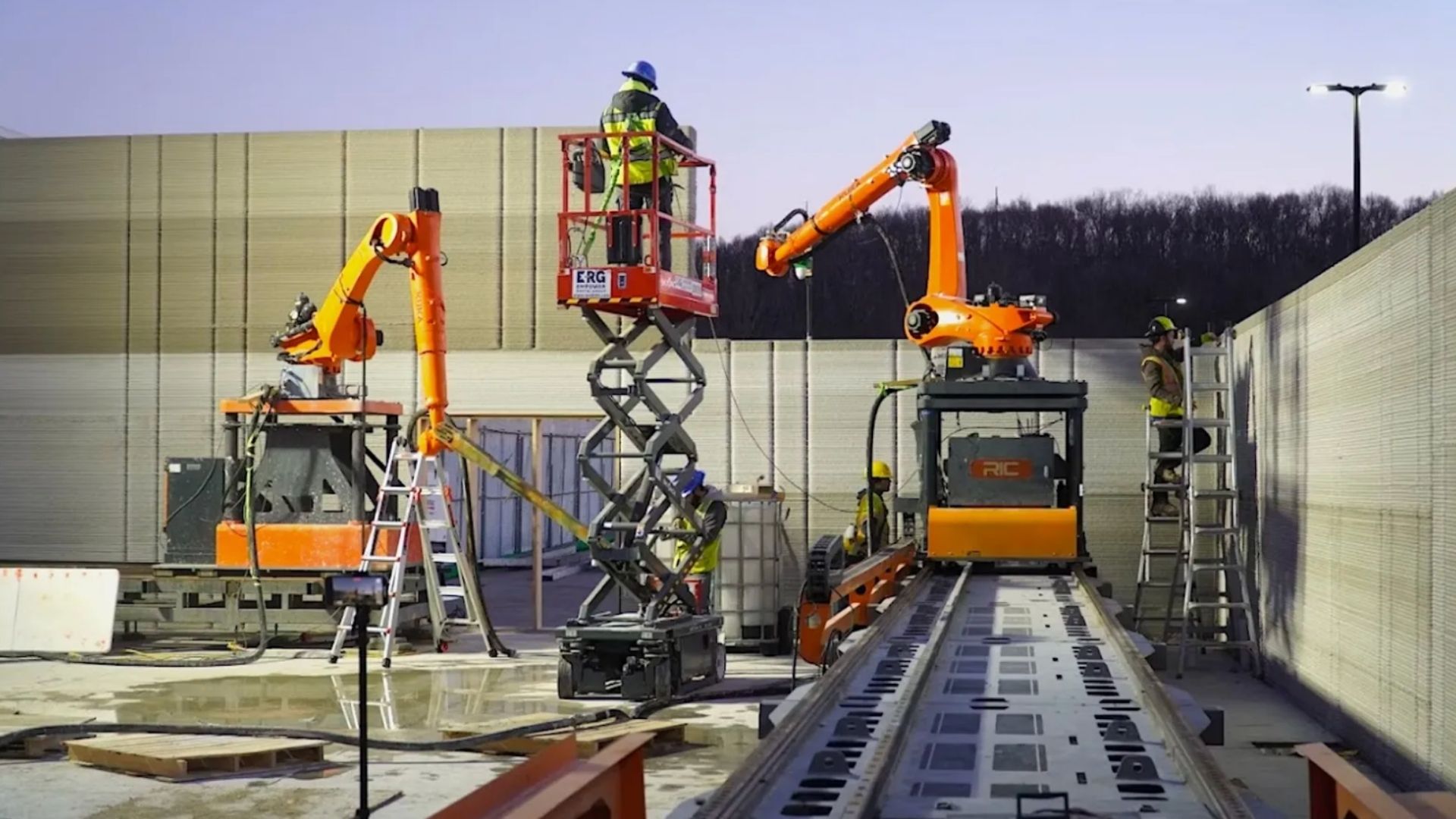
A 55-acre development in Salida, Colorado, is taking shape as one of the world’s largest planned 3D-printed residential communities. Called Cleora, the project will feature more than 65 robotically constructed homes alongside infrastructure managed through its own metropolitan district. Developed by Cleora with 3D-printing contractor True North and technology provider RIC Robotics, the project aims to demonstrate that robotic construction can move beyond prototypes and support entire neighborhoods. Two systems construct over 65 homes Cleora follows nearly seven years of research into construction technology, development strategies, and scalable housing. Its developers evaluated several technology providers before choosing RIC Robotics to help deliver the 3D-printed homes. Two autonomous RIC printing systems are currently operating across the site. More than 65 homes are expected to use the company’s robotics and 3D-printing technology, creating one of the largest planned deployments of robotic construction within a single US residential development. “From day one, our vision wasn’t simply to build 3D-printed homes, it was to prove that robotics could transform how entire communities are designed and delivered,” said Greg Kenny, Managing Partner at Cleora. “Cleora is demonstrating that this technology is ready to move beyond prototypes and become a practical, scalable solution for real neighborhoods. RIC Robotics has been an outstanding technology partner in helping bring that vision to life,” he added. True North’s first model home is now under construction, and its shell is expected to be completed this month. Production will be expanded gradually as developers assess how the systems perform at community scale. Moving robotic construction beyond prototypes Most 3D-printed housing projects have involved standalone residences or small demonstrations. Cleora is instead testing whether autonomous construction systems can be integrated into a functioning community while maintaining architectural variety and controlling costs. “Much of the conversation around 3D-printed construction has centered on individual homes and demonstration projects,” said Dr. Ryan Cox, CEO of RIC Robotics. “Cleora represents a significant step forward because it demonstrates how robotics can be integrated into a real community at meaningful scale,” he added. “The project is helping answer important questions about how technology can support the future of housing delivery, from construction efficiency and workforce development to long-term community growth,” Dr. Cox further explained. The development could offer insights into addressing construction-sector challenges, including worker shortages, building efficiency, and the difficulty of scaling new housing methods. Training workers for automated construction Cleora will also serve as a training hub through a partnership with Colorado Mountain College. Students will receive hands-on experience with construction robots, 3D-printing systems, and digital design software. The collaboration is expected to support future training programs and certifications for emerging construction technologies, preparing workers for roles in an increasingly automated industry. Cleora has also established the county’s first 3D-printed metro district. The structure will support water treatment, utilities, recreation, commercial facilities, and other essential services within the development. By combining robotic homebuilding, workforce training, and integrated infrastructure, the project is testing more than a faster way to erect walls. Its developers want to establish a repeatable model for delivering complete, technology-driven communities at scale. Get the latest in engineering, tech, space & science - delivered daily to your inbox.Atharva is a full-time content writer with a post-graduate degree in media & amp; entertainment and a graduate degree in electronics & telecommunications. He has written in the sports and technology domains respectively. In his leisure time, Atharva loves learning about digital marketing and watching soccer matches. His main goal behind joining Interesting Engineering is to learn more about how the recent technological advancements are helping human beings on both societal and individual levels in their daily lives.
Robots construct 65 distinctive homes in planned US 3D-printed metro district
Full Article
Original Source
Read the full article at Interestingengineering →KhanList aggregates and links to publicly available news content. We do not host full articles from third-party sources. Always verify important information with original sources.