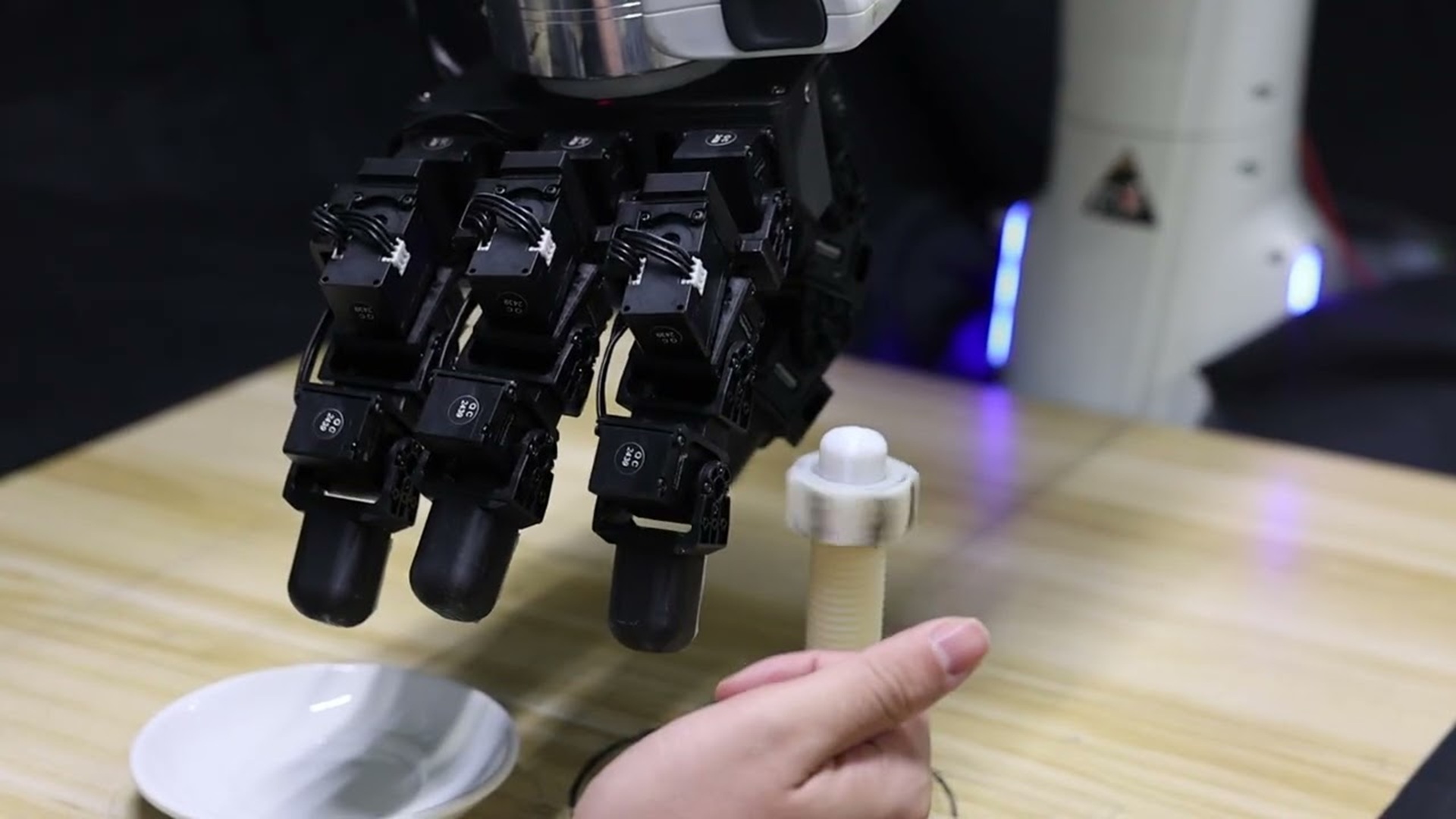
A robot has learned to bowl, fold towels, unscrew lids, pour drinks, and prepare fresh orange juice by first imitating human demonstrations and then refining its skills through autonomous learning. Researchers developed a new training framework called RL-100 that combines imitation learning with reinforcement learning, enabling robots to perform a wide range of real-world manipulation tasks with high reliability. In tests, the system adapted to unfamiliar situations, recovered from disturbances, and even matched or outperformed human teleoperators in several tasks. The robot also operated continuously for seven hours serving fresh juice in a public mall without a single failure. Smarter robot learning Developed by researchers led by Shanghai Jiao Tong University, the framework, called RL-100, allows robots to first acquire safe, human-like behaviors from demonstrations and then improve those skills through autonomous trial-and-error. The approach overcomes one of robotics’ biggest challenges: moving beyond simply copying humans to achieving faster, more reliable, and more adaptable performance in unstructured environments. The researchers drew inspiration from how children learn. Babies initially rely on guidance from parents before gradually refining their abilities through independent practice. RL-100 follows the same philosophy through a three-stage learning pipeline. The first stage uses imitation learning, where the robot observes teleoperated demonstrations performed by human experts. These demonstrations train a diffusion-based visuomotor policy, enabling the robot to learn the relationship between visual inputs—captured through RGB cameras or 3D point clouds—and the corresponding manipulation actions. This stage provides a stable behavioral foundation but remains limited by the quality and efficiency of the human demonstrations. To overcome this “imitation ceiling,” the second stage introduces iterative offline reinforcement learning. Instead of relying solely on human data, the robot repeatedly performs tasks, stores the resulting experiences, and retrains itself using both demonstration data and its own successful attempts. A unified Proximal Policy Optimization (PPO)-based objective allows the system to refine the diffusion policy without destabilizing previously learned behaviors, while an offline policy evaluation mechanism prevents updates that could reduce performance. The final stage applies a smaller amount of online reinforcement learning directly on the physical robot. This phase specifically targets rare failure cases that remain after offline training, improving reliability from roughly 90 percent success to near-perfect task completion while requiring relatively little additional real-world data. Robots master manipulation RL-100 also addresses a key practical limitation of diffusion policies—their computational latency. Standard diffusion models require multiple denoising steps before producing each action, making them too slow for high-frequency robotic control. To solve this, the researchers developed a consistency-model distillation technique that compresses the multi-step diffusion policy into a single-step controller, reducing inference latency from around 100 milliseconds to about 10 milliseconds while maintaining performance. This enables faster reaction times and smoother control during deployment. The framework is designed to be task-, robot-, and representation-agnostic, supporting both single-arm and dual-arm robots, single-action and action-chunk control, and either RGB images or 3D point clouds without changing the underlying learning framework. Researchers evaluated RL-100 across eight challenging manipulation tasks involving rigid objects, deformable materials, liquids, and precision assembly. These included bowling, towel folding, pouring, unscrewing lids, folding boxes, and two stages of orange juicing. After completing the full training pipeline, the robot achieved a 100 percent success rate across 1,000 evaluation trials, matched or exceeded expert human teleoperators in task completion speed, adapted to unseen objects and environmental changes without retraining, and remained robust even when researchers physically interfered with its actions. In a real-world deployment, the robot continuously prepared fresh orange juice for customers in a shopping mall for seven hours without a single failure, demonstrating the framework’s potential for reliable long-term operation in homes, factories, and public spaces.Recommended ArticlesGet the latest in engineering, tech, space & science - delivered daily to your inbox.Jijo is an automotive and business journalist based in India. Armed with a BA in History (Honors) from St. Stephen's College, Delhi University, and a PG diploma in Journalism from the Indian Institute of Mass Communication, Delhi, he has worked for news agencies, national newspapers, and automotive magazines. In his spare time, he likes to go off-roading, engage in political discourse, travel, and teach languages.
Robot learns like a child, then masters bowling, folding, and juicing on its own
Full Article
Original Source
Read the full article at Interestingengineering →KhanList aggregates and links to publicly available news content. We do not host full articles from third-party sources. Always verify important information with original sources.