
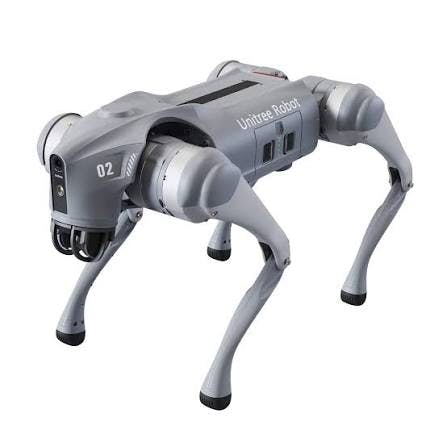
Disclosure: I represent AI Robot Supplier, which lists quadruped robots and other advanced technology products. This article discusses a product category connected to my work. Robot dogs once looked like expensive laboratory experiments built mainly to impress audiences. Today, quadruped robots are becoming smaller, more affordable and more capable of working outside controlled demonstrations. The most important development is not that these machines can walk, run or perform tricks. It is that manufacturers are combining mobility, environmental sensing, wireless communication and onboard computing into platforms that developers and organisations can actually use. This transition reveals something important about embodied artificial intelligence: intelligence in the physical world is not only about having a powerful AI model. A useful robot must also balance itself, understand its surroundings, manage limited battery power, survive physical shocks and continue operating when the environment changes. Why Give a Robot Four Legs? Most mobile robots use wheels because wheels are efficient, mechanically simple and easy to control. In warehouses, hospitals and shopping centres with smooth floors, wheeled robots often remain the most practical choice. The weakness of wheels becomes obvious when the environment includes stairs, loose ground, narrow passages, debris, uneven surfaces or large obstacles. A quadruped robot can place each foot independently. It can adjust its body position, redistribute its weight and select different contact points while moving. This makes legged robots attractive for places designed for people and animals rather than machines. Research into quadruped locomotion has demonstrated that legged systems can adapt to slopes, uneven terrain and disturbances by combining information from their joints, body position and contact with the ground. This does not mean robot dogs can travel anywhere. Mud, deep water, loose cables, extreme temperatures, reflective surfaces and unpredictable human behaviour can still cause problems. However, four-legged mobility gives engineers more options than a fixed wheeled platform. The Unitree Go2 as a Sign of the Market’s Direction The Unitree Go2 is a useful example of how quadruped technology is becoming more accessible. The Go2 family combines twelve motorised joints, wireless connectivity, camera-based remote monitoring and an ultra-wide 4D LiDAR system on supported configurations. Unitree lists the robot at approximately 15 kilograms and offers several versions designed for different users. Higher configurations can reach speeds of approximately five metres per second in laboratory testing. Unitree also advertises battery endurance of roughly two to four hours, depending on the battery, configuration and operating conditions. Those specifications are interesting, but the larger significance is accessibility. In the past, a capable quadruped robot was usually available only to major research institutions, defence organisations or corporations with large robotics budgets. Platforms such as the Go2 are bringing similar mobility concepts to universities, developers, technology companies and smaller robotics teams. This does not automatically make the Go2 a fully autonomous worker. It is better understood as a mobile robotics platform. Its practical value depends on the sensors, software, payloads and operating procedures added to it. Embodied AI Is More Than a Language Model Inside a Machine The excitement around generative AI has created the impression that adding a conversational model to a robot will immediately make it intelligent. Physical intelligence is more complicated. A chatbot can produce a wrong answer without falling down a staircase. A robot operating in the physical world must understand distance, friction, weight, momentum, obstacles and the limits of its own motors. A practical embodied-AI system requires several layers working together: 1. Perception to identify obstacles, people, objects and terrain. 2. Localisation to estimate where the robot is positioned. 3. Motion control to determine how each joint should move. 4. Planning to select a safe route or sequence of actions. 5. Communication so a human operator can monitor or control the system. 6. Safety systems to stop movement when conditions become dangerous. 7. Task-specific software that turns mobility into useful work. Large AI models may eventually improve reasoning, language interaction and task planning. But reliable locomotion, sensor calibration and safety remain equally important. The future of robotics will probably not be created by one powerful model controlling everything. It will come from combining specialised systems that operate at different speeds. A balance controller may react within milliseconds. A vision system may analyse the environment several times per second. A higher-level AI system may interpret instructions and decide what task should be performed next. Where Robot Dogs Can Produce Real Value . The strongest applications are tasks where mobility, repeatability and distance from danger matter more than human-like manipulation. Industrial inspection An industrial facility may contain stairs, pipes, narrow corridors, hot equipment and areas that are difficult to inspect safely. A quadruped can carry visual, thermal, acoustic or gas-detection sensors through the facility. It can record gauges, identify unusual heat patterns and collect information from the same locations repeatedly. Boston Dynamics already markets its Spot quadruped for visual and thermal inspection, automated data collection and hazardous environments. This shows that the commercial value of a robot dog is often not in moving objects. It is in moving sensors. Hazardous environments A robot can enter locations containing radiation, unstable structures, dangerous gases or extreme heat while the operator remains at a safer distance. Quadrupeds are particularly useful when the area includes stairs or uneven ground that a conventional wheeled inspection robot might struggle to cross. The robot does not eliminate risk completely. Communication can fail, batteries can run out and the machine may become trapped. However, losing or recovering a robot may be preferable to exposing a person to an unnecessary hazard. Healthcare and emergency response Researchers have previously mounted contactless vital-sign monitoring equipment on a quadruped robot so healthcare workers could evaluate patients from a distance. The system used cameras and a tablet to measure and communicate with patients while reducing direct contact. This demonstrated that a robot dog can act as a mobile sensor and communication platform rather than pretending to replace a doctor. Similar concepts may eventually support epidemic response, emergency assessment and remote medical communication. Such systems would still require clinical validation, trained operators and regulatory approval. Education and robotics research Universities and technical schools can use quadruped platforms to teach locomotion, computer vision, mapping, reinforcement learning and human-robot interaction. A student can work with a complete physical system instead of limiting experiments to simulation. Real hardware introduces problems that simulations often hide, including sensor noise, battery limitations, mechanical wear and communication delays. Security and remote observation A robot dog can patrol a predetermined route, stream video and carry environmental sensors. This does not mean it should independently confront people or make security decisions. The safer role is observation, detection and communication, with a human responsible for interpreting the situation. What Robot Dogs Still Cannot Do Reliably Marketing videos often show robots completing carefully selected movements in favourable conditions. Real deployments are less predictable. Battery life remains one of the largest restrictions. A robot that can operate for several hours may still require charging, battery changes and supervision during a full working shift. Payload capacity is another limitation. Smaller quadrupeds can carry cameras and lightweight sensors but are not designed to transport heavy industrial equipment. Autonomy also varies greatly. Following a person, avoiding a visible obstacle and completing a pre-recorded route are different from understanding an unfamiliar environment and safely solving an unexpected problem. Maintenance must also be considered. A quadruped contains multiple motors, joints, sensors and moving parts. Frequent outdoor or industrial use can expose the system to dust, impacts, moisture and mechanical wear. Organisations should therefore evaluate robot dogs as complete operational systems, not entertaining pieces of hardware. Questions Buyers Should Ask Before Purchasing Before choosing a quadruped robot, a buyer should define the task clearly. What exact problem should the robot solve? Will it be remotely controlled, semi-autonomous or expected to follow scheduled missions? What terrain will it encounter? What sensor or payload must it carry? How long must it operate before charging? Is a software-development kit available? Can the robot integrate with existing cameras, mapping software or data systems? Who will maintain and operate it? What happens when wireless communication is lost? What safety controls prevent collisions with people? Different Go2 configurations, including commercial Go2 models available through AI Robot Supplier, are designed for different levels of development and use. Buyers should compare computing power, sensors, payload support, battery options and software access rather than choosing only by appearance or maximum speed. The Real Future of Robot Dogs Robot dogs are unlikely to replace ordinary wheeled robots, human workers or specialised industrial machines. Their value lies in the gap between those systems. They can move through spaces built for people, carry sensors into difficult areas and create a mobile base for experiments in embodied AI. As hardware becomes more accessible, more developers will be able to test ideas that were previously restricted to advanced robotics laboratories. The next major breakthrough may not be a robot that looks perfectly human. It may be a reliable machine that repeatedly walks through a power plant, construction site, hospital or disaster area and delivers useful information without placing a person in danger. Quadruped robots show that embodied AI is becoming less about demonstrations and more about deployment. Disclosure: I represent AI Robot Supplier, which offers robotics and technology products. The opinions and technical analysis in this article are my own.
Robot Dogs Are Leaving the Lab: What Quadrupeds Reveal About Embodied AI
Full Article
Original Source
Read the full article at Hackernoon →KhanList aggregates and links to publicly available news content. We do not host full articles from third-party sources. Always verify important information with original sources.