
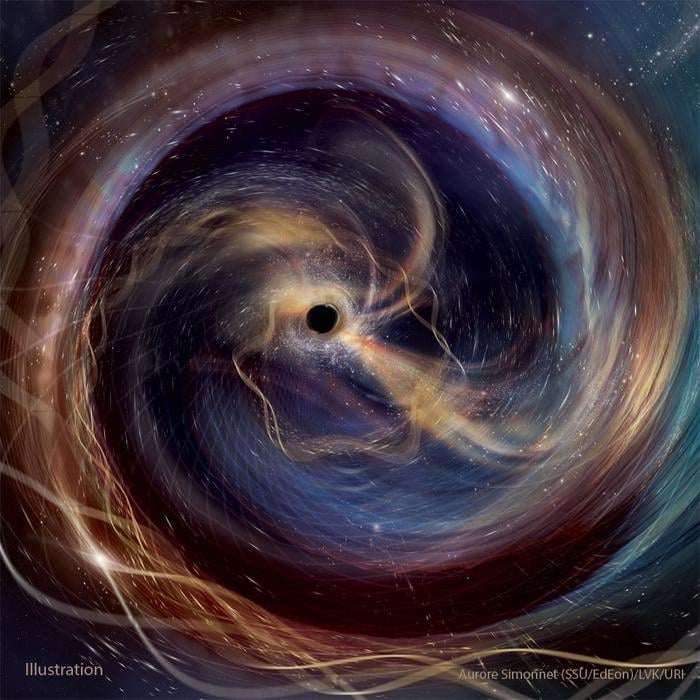
Black holes remain some of the most mysterious and awe-inspiring celestial objects ever studied. This primarily comes from the fact that they literally can’t be observed unless they interact with something in its surrounding environment, most notably a star. Adding to their mystery, several types of black holes exist, including free-floating black holes that drift independently throughout space, stellar-mass and are produced from exploding stars, and supermassive black holes that exist at the center of galaxies like our own. But arguably one of the most mind-blowing mysteries about black holes is figuring out what happens when they collide, and even merge. Now, a team of more than 70 researchers might be one step closer to solving this decades-long conundrum as they used a combination of computer models and a literature review to analyze how black holes behave when they collide, specifically focusing on a well-known “ringing” phenomenon that occurs when black holes collide and merge. In a recent study published in Classical and Quantum Gravity, the primary motivation behind the study was to advance black hole research by establishing a long-known method called black hole spectroscopy from a theoretical concept to a practical one. Black hole spectroscopy involves measuring the gravitational waves that are produced from two black holes colliding and merging, specifically focusing on the “ringdown” phase, or the waves produced from the newly merged black hole. In the end, the researchers successfully found that hundreds of observed black hole mergers’ “ringdown” behavior match the longstanding Einstein's theory of General Relativity. While the researchers note current observational methods present limitations for providing more accurate measurements, they emphasize how next-generation ground-based gravitational wave detectors could have the necessary technology for more in-depth and accurate observations of gravitational waves. “By listening to the ringing of newly formed black holes, we are turning gravitational waves into a tool for exploring some of the deepest questions in physics, from the nature of gravity itself to the possibility of discovering entirely new forms of matter and energy,” said Dr. Gregorio Carullo, who is an assistant professor in the School of Physics and Astronomy at the University of Birmingham and a co-author on the study. Introduced in mathematical equations and a longer paper in 1915 and 1916, respectively, Einstein’s theory of General Relativity challenged the longstanding hypothesis that gravity acted as an invisible force. In contrast, Einstein proposed gravity behaved like a fabric in both space and time, woven together in a phenomenon called spacetime. As a result, massive celestial objects like stars and planets create curves and warps within this fabric, with the mathematical aspect of the theory also predicting the existence of black holes while also proposing the existence of gravitational waves. However, Einstein himself didn’t believe they existed and took this belief to his death in 1955. The reason for his disbelief is because he was convinced that matter was not capable of collapsing inward on itself to create such a state where something like a black hole is produced. It wasn’t until 1964, nine years after Einstein passed away, that the first black hole was discovered, which astronomers designated as Cygnus X-1 and is locate about 7,200 light-years from Earth. And it wasn’t for another 51 years that gravitational waves were first detected, 100 years after Einstein first proposed their existence in mathematical equations. Going forward, the researchers of this latest study anticipate that next-generation observatories could unlock longstanding secrets abut black holes, including gaining insight into their formation and evolution, along with continuing to uphold or challenge theories from Einstein and other scientists. What new insights into ringing black holes will researchers make in the coming years and decades? Only time will tell, and this is why we science! As always, keep doing science & keep looking up!
Ringing Black Holes Offer Precision Tests of Relativity
Full Article
Original Source
Read the full article at Universetoday →KhanList aggregates and links to publicly available news content. We do not host full articles from third-party sources. Always verify important information with original sources.