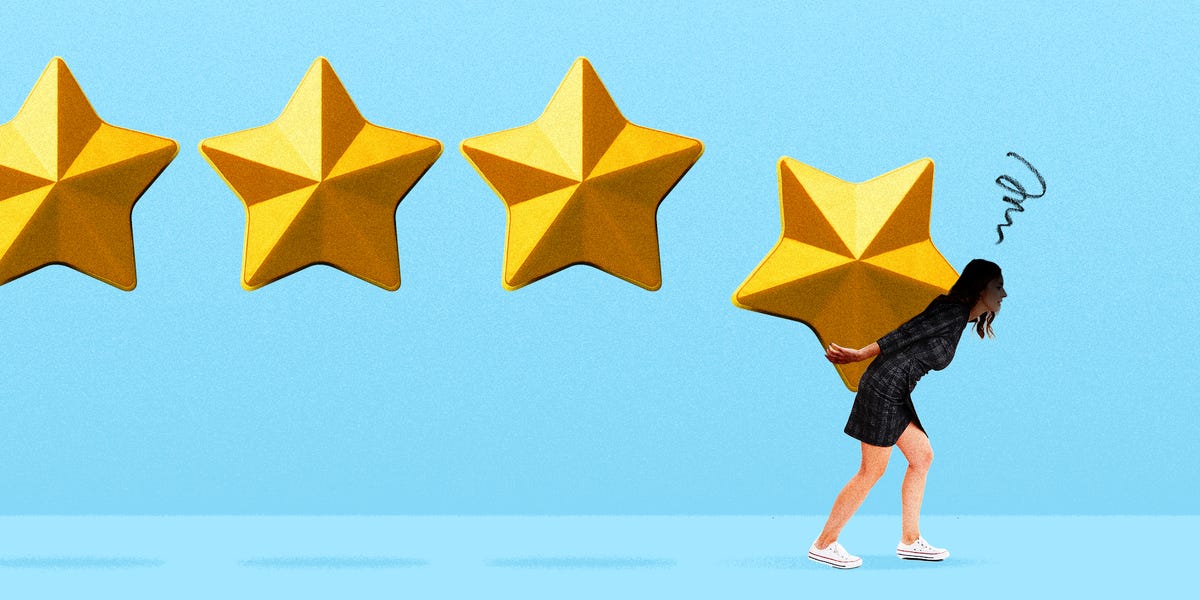
Getty Images; iStock; Tyler Le/BI Reviews are ruining your life Our obsession with online recommendations is ruining our vacations, homes, and nights out Getty Images; iStock; Tyler Le/BI James Hardaway has a reputation among his friends and family for being a reviews guy. Before making a big purchase, he'll check Wirecutter and Consumer Reports, do a drive-by of Reddit, and see what's being said on YouTube. He's an avid film fan, and he eagerly combs through Rotten Tomatoes scores and media writeups ahead of new releases to make sure he's in tune with the cultural moment. He feels that if he's not doing his homework, he may not be making the best use of his money.Still, Hardaway, a 38-year-old manufacturing manager in Texas, isn't sure if all the ratings-related rigamarole is meaningfully improving his life. He and his wife spent $450 on the supposed "best" stroller when their first child was born and swapped it out for cheaper options in a matter of months. He's not in love with their reviews-driven dishwasher or mattress, though he does like the internet-approved noise machine. For the most part, all the choices and all the noise leave him constantly wondering whether he could have done better."There are more and more things that are getting reviewed," he says. "Maybe I don't need the best plunger, but something in my brain thinks that I do."Many Americans treat every product, service, and experience they buy like a research project. In 2016, the Pew Research Center found that eight in 10 Americans read online reviews before buying something for the first time, and more recent industry surveys suggest the habit has only become more entrenched. Case in point: a 2026 Yelp questionnaire found that an overwhelming majority of Gen Z consumers do research on at least one platform before picking a restaurant, gym, or beauty salon.Reviews are a remarkably useful invention that let us tap into the wisdom of the crowd. However, we may be taking review culture too far. We're drowning in endless options and endless opinions about those options. It leaves us less satisfied with our selections and strips spontaneity even from simple picks. Instead of helping us make good decisions quickly, reviews tempt us to believe there's some perfect decision to be found if we just keep scrolling."Once you're out for the best, the path to misery is pretty straight," says Barry Schwartz, a professor emeritus in social theory and social action at Swarthmore College and the author of the book "The Paradox of Choice." "It's the price we pay for getting what we said we wanted — which we shouldn't have wanted — which is unlimited options."Reviews have democratized information. Instead of relying on brand marketing or a newspaper critic (a dying breed anyway), people can learn from the experience of hundreds of other customers. But the volume of it all makes it easy to get overwhelmed. It's a familiar experience: You decide to have, say, pizza for dinner and start browsing through the local options. After 30 minutes, you've identified 15 possible restaurants and read dozens of reviews, and you are still no closer to a decision. One pizza is probably better than the other, but also, any pizza is probably fine, and here you are spending most of your Tuesday night on an unexpected, illogical quest to identify the ideal pie.Once you're out for the best, the path to misery is pretty straight."One can get overly indexed on trying to find the best of something or all the information that they could find to make that perfect decision about it," says Michael Luca, a professor at Johns Hopkins Carey Business School. "When do we need to be optimizing? When do we need to be satisficing? And just finding something that works for what we're looking to do?"The internet reinforces the instinct. Google surfaces stars before websites, Amazon displays reviews before a price, and AI search engines increasingly summarize the online consensus before users see a link. Small businesses live and die by the algorithms and online rating systems.Having such an abundance of options can lead to anxiety and decision paralysis. Take the earlier dinner example: You may feel so inundated or dispirited that you forgo the pizza entirely and head to the kitchen to make a sandwich. Moreover, tastes vary, and we often don't know much, if anything, about the people whose perspectives we're using for guidance."You're flipping coins because you don't know the source of any of these reviews, but somehow it gives your decision a certain authority that otherwise it wouldn't have," Schwartz says. The fact that our consumer choices are so intertwined with our identities gives each decision more weight, he adds: "The stakes go up for even trivial decisions, and that pushes even more in the direction of looking at what other people have to say and letting that guide your own decisions."As though the reviews themselves weren't enough, artificial intelligence is increasingly deciding which reviews people see and how they're interpreted, adding in a layer of complication for consumers and businesses alike.Some platforms are using AI to summarize reviews, boiling down hundreds of opinions into a handful of sentences. This may help consumers get a general sense of the feedback and make the reviews section feel more useful, but it also has its drawbacks. Power users who like to comb through ratings aren't going to get a lot out of a summary, and while research shows that AI summaries increase purchase intention for products like electronics and appliances, they don't move the needle for experiences, like restaurants and hotels.It's also not always clear whether an AI overview is accurate or surfaces the most pertinent information. It can flatten commentary into a generic package, overrepresent a small number of negative comments in an effort to be "fair," or simply get things wrong. On sites such as Reddit, it's easy to find small business owners lamenting that AI summaries include extra-negative or incorrect content."AI could be helpful if it's helping to figure out how to tailor information and combine it to one's own preferences. But if it's doing more of a one-size-fits-all summary, it's not clear that it's getting you closer to that thing that specifically fits your preferences," Luca says.Doug Straton, the chief marketing officer at Bazaarvoice, a software company that helps brands collect and display ratings and reviews, says that when AI platforms crawl the web for reviews, they tend to look at volume, recency, and average rating. That is used to determine which products the bot talks about, but not necessarily what it says or the context opinions are coming from — maybe the reviewer the AI is channeling never likes the scent of cucumber, so they rate a bodywash negatively because of that, and all the AI reader sees is that it smells bad. "Because you're superficially scraping the sites, you don't have this depth of data," he says. Straton's company is working with AI companies to place more weight on the Bazaarvoice community's reviews, which they say are more trustworthy and thorough than the random ones.AI, of course, brings with it another issue: fakery. It's easier than ever to use AI tools to spin up reviews, and harder than ever for consumers to know what's AI-generated. To be sure, fake reviews are hardly new — Kay Dean, a former federal criminal investigator and the founder of Fake Review Watch, an industry watchdog, tells me they've long been a "massive" problem and that platforms aren't aggressive enough in cracking down on it. "They sweep it under the carpet," she says.You make a lot of choices, and most of them are irrelevant and unmemorable.There are all sorts of tactics, AI-related and otherwise, for engaging in review-related trickery, Dean says. Some businesses will barter and trade reviews, or even go to Facebook groups to enlist reviewers, while marketers may enlist review brokers. "There's a whole cottage industry of review providers," she says. "There is a robust black market, openly and flagrantly."The Federal Trade Commission has tried to crack down on fake reviews and, in 2024, put in place a rule that bans false ratings and testimonials, prohibits incentivizing reviews with a specific sentiment, and imposes financial penalties on violators. "It was a good step, but the review platforms escape liability," Dean says, because under federal law, online companies generally aren't liable for the content other people post on their platforms.We don't need to go back to a reviews-free society, where your best hope is that your neighbor has a decent recommendation for a contractor, but we probably could stand to adjust our approach when every single thing we might try or buy comes with a giant ratings system.Sheena Iyengar, a professor at Columbia Business School who studies choice and innovation, says it really helps for people to have clarity on their preferences and goals before diving into the online comments. If you're just looking for the "best" bar or the "best" gym, you're going to have a lot of work ahead of you and may very well end up disappointed. If, however, you're looking for a decent espresso martini at a relatively quiet place with lots of seating or an establishment with plenty of weights and spin classes, you're likely to be more satisfied with the results.We often flip through reviews faster than our brains can process the information, and in those cases, it's important to slow down, especially when it's a big decision, like booking a vacation. It's also key to remember that in the vast majority of situations, it's just not that deep."You make a lot of choices, and most of them are irrelevant and unmemorable," Iyengar says. "Most of your choices in life, because of information overload, you probably should make them on autopilot, save your cognitive energy for the choices that matter."That's easier said than done for all the aforementioned reasons — the drive to find the best, the sense that every purchase says something about our identity. Yet there's something to be said for going with the flow. If the point of an evening is to catch up with a friend, there's no need to walk 20 blocks to what Yelp and TikTok say is the most happening spot instead of stopping at one of the eight places you pass on the way. Plus, you might discover at the end of your walk that a bunch of other optimization-seekers had the same idea, and now the place is too crowded to get in.Hardaway still checks reviews and probably always will. But he's learned the online chatter isn't the gospel and that no matter how much research he does, things may not work out. Sometimes, the best baby stroller isn't the one the gurus recommend — it's the one you actually wind up using.Emily Stewart is a senior correspondent at Business Insider, writing about business and the economy. Business Insider's Discourse stories provide perspectives on the day's most pressing issues, informed by analysis, reporting, and expertise. Reviews Reddit Discourse More Most popular Business Insider tells the stories you want to know about the world of business, technology, and finance Business Insider tells the stories you want to know about the world of business, technology, and finance Business Insider tells the stories you want to know about the world of business, technology, and finance Business Insider tells the stories you want to know about the world of business, technology, and finance Business Insider tells the stories you want to know about the world of business, technology, and finance Business Insider tells the stories you want to know about the world of business, technology, and finance Emily Stewart is a senior correspondent on Business Insider’s Discourse team. She focuses on consumerism, culture, and the economy, among other topics. Some of her biggest stories have explored Red Lobster’s demise, middle-class shoplifting, convenience stores’ struggles, the rise of illicit drugs as work performance-enhancers, and generational finance trends, including Gen Z’s love for AmEx and the impending avalanche of baby boomers’ stuff. She also writes regularly about sports betting, the alcohol industry, work, millennials, and economic trends. Emily appears regularly on nationally syndicated radio shows and podcasts, including Marketplace, The Weekend Dive, and Today, Explained. She has guest hosted C-SPAN’s “After Words” and moderated multiple panels on economic policy and workplace dynamics.Before joining Business Insider, Emily was at Vox, where she covered business and the economy and wrote a newsletter, “The Big Squeeze,” about how people experience the forces of the economy and capitalism day to day. Prior to that, she worked at TheStreet.
Reviews are ruining your life
Full Article
Original Source
Read the full article at Businessinsider →KhanList aggregates and links to publicly available news content. We do not host full articles from third-party sources. Always verify important information with original sources.