
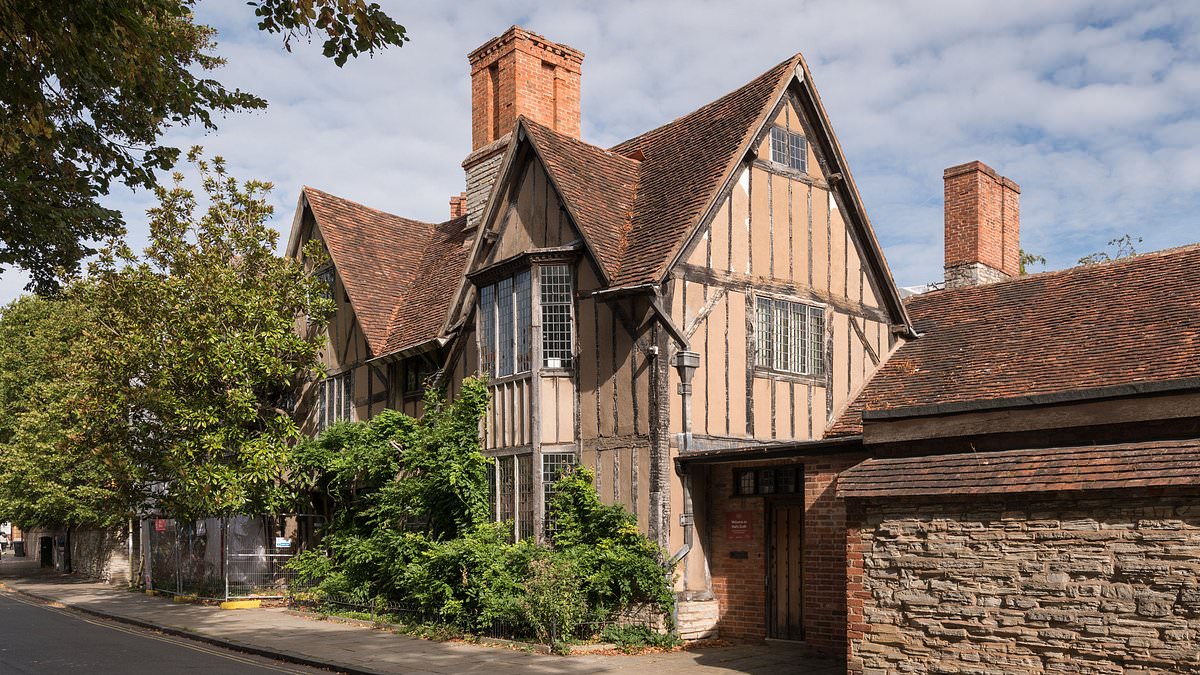
A secluded writing retreat used by Charles Dickens is facing the worst of times after becoming one of scores of English landmarks at risk of being lost for ever. Nearly 200 sites have been added to Historic England's latest Heritage At Risk Register due to neglect, decay, damage and inappropriate development.Among these is Hall's Croft in Stratford-upon-Avon, the 17th century home of Shakespeare's daughter Susanna, which requires urgent funding to repair its exterior, including damage caused when it was struck by a vehicle.Charles Dickens' Writing Chalet in Rochester, Kent, where he wrote some of his best-known works including Our Mutual Friend, is also under threat unless major conservation work is done to fight worsening timber decay. The author is believed to have installed mirrors upstairs so he could practise performances and perfect the voices and mannerisms of his characters. Claudia Kenyatta CBE and Emma Squire CBE, Co-CEOs of Historic England, said: 'Our historic buildings and places help tell the story of where we live and contribute to the character and identity of local communities.'The most effective way to protect our buildings is to bring them back into use as places that create connection and enjoyment for local people.' Among the newly listed sites are William Shakespeare's daughter Susanna's home, Hall's Croft in Stratford-upon-Avon Charles Dickens' Writing Chalet in Rochester, where he wrote some of his acclaimed works, also requires significant conservation work thanks to decaying timber The annual register highlights almost 5,000 historic places across England that are considered at risk, including churches, archaeological sites, parks and conservation areas.Another added to this year's list is Hastings Castle, in East Sussex, which is depicted on the Bayeux Tapestry.It was commissioned by William the Conqueror after the Norman invasion of 1066 to secure his position along the south coast.The exposed setting and coastal erosion have long shaped the ruins - but recently sections have become vulnerable.Also added to the list is the Grade I-listed Corn Exchange in Bristol, which was built between 1741 and 1743 as a meeting place for the city's merchants and requires repairsThe world's earliest purpose-built independent commercial materials testing laboratory, Kirkaldy's Testing Works in Southwark, has been listed because of water damage and extensive damp. Another added to this year's list is Hastings Castle, in East Sussex, which is famously depicted on the Bayeux Tapestry Another concern is Bidston Windmill in Merseyside, an 18th-century landmark overlooking Liverpool and the Welsh mountains, which now requires urgent conservation work Fylingdales Moor in North Yorkshire has also been added after a major wildfire in 2025 damaged more than 20 scheduled monuments and six listed buildingsAnother concern is Bidston Windmill in Merseyside, an 18th-century landmark overlooking Liverpool and the Welsh mountains, which now requires urgent conservation work.Fylingdales Moor in North Yorkshire has also been added after a major wildfire in 2025 damaged more than 20 scheduled monuments and six listed buildings.Historic England said many of the sites are facing growing pressures from ageing structures, flooding, coastal erosion and extreme weather.In total, there are now 4,991 entries on the Heritage at Risk Register, including historic buildings, places of worship, archaeological sites, parks, battlefields and conservation areas.There is some good news, however, with 85 sites removed from the register after being restored or brought back into use.Among them is Cornwall's historic Newlyn Harbour, which was one of the area's most important fishing ports during the 19th century.A major restoration project which saw local specialists restore its granite structures and wrought iron railings has helped conserve the 700-year-old harbour. Also added to the list is the Grade I-listed Corn Exchange in Bristol, which was built between 1741 and 1743 as a meeting place for the city's merchants There is some good news, however, with 85 sites removed from the register after being restored or brought back into use. This includes Gloucestershire's Dr Jenner's Hut, where the world's first vaccination was pioneered Cornwall's historic Newlyn Harbour, which was one of the area's most important fishing ports during the 19th century, has also been restoredAnother saved is Gloucestershire's Dr Jenner's Hut, where the world's first vaccination was pioneered.The doctor is credited with saving more lives than any other human and is known as the father of immunology.It was from this hut that he pioneered his theory of vaccination, carrying out trials of his vaccine and giving free jabs to the district's poor.It was added to the Heritage At Risk register last year, but works have now been completed to save it.Heritage Minister Baroness Twycross said: 'Every part of the UK is bursting with history, so it is vital we protect the heritage sites at the heart of communities which help tell the stories of our nation.'The Heritage at Risk Register plays a crucial role in identifying these historic places that need our support. It's fantastic to see the much-loved site of Newlyn Harbour removed from the list this year, having received a grant from our Heritage at Risk Capital Fund.'However, this year's Register is an important reminder of the pressures facing our historic environment, from ageing buildings and structural deterioration to the impacts of extreme weather.'I want us to build on our progress to ensure our heritage is protected for generations to come.'
Revealed: The 197 historic sites in England that are at risk of being lost FOR EVER - including Shakespeare's daughter's home and Charles Dickens' writing chalet
Full Article
Original Source
Read the full article at Dailymail →KhanList aggregates and links to publicly available news content. We do not host full articles from third-party sources. Always verify important information with original sources.