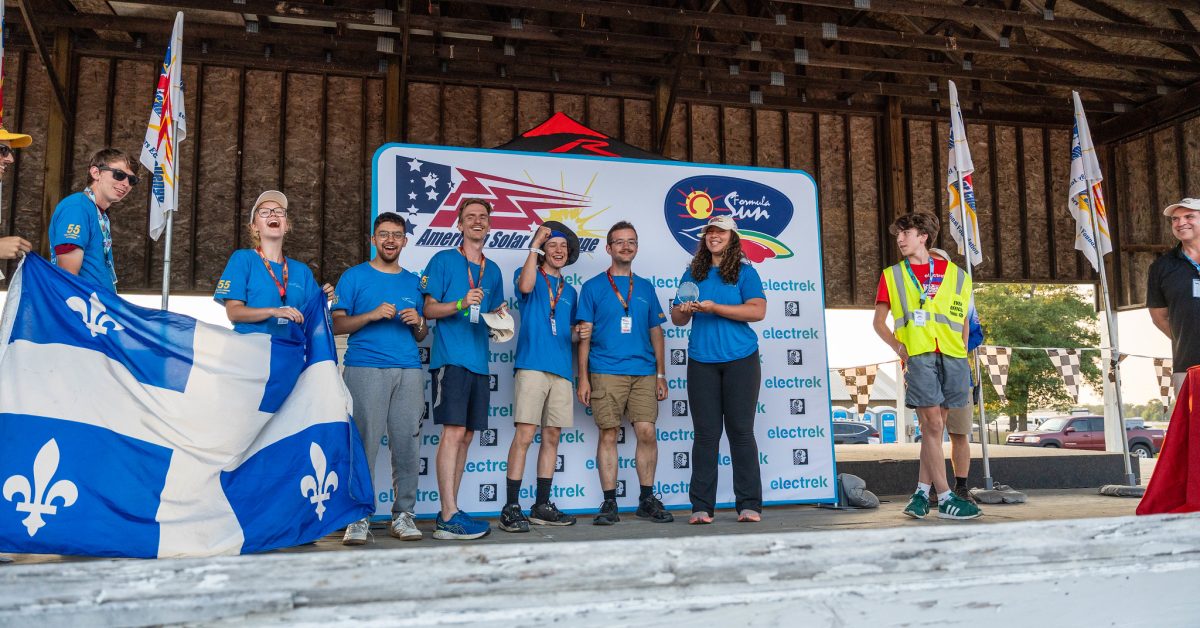
On Thursday, the conclusion of the 2026 Electrek Formula Sun Grand Prix came in a high-energy awards ceremony. However just days prior, 39 teams from around the world descended upon Brainerd, Minnesota for the event, which for many was a high-stakes do-or-die moment for the opportunity to qualify and compete in the 2026 Electrek American Solar Challenge cross-country event. Here are the results from the final day Formula Sun Grand Prix (FSGP) and which teams will be moving on to the American Solar Challenge (ASC). 16 teams moving on, three are getting a provisional shot Sixteen cars cleared the ASC mileage bar by the time the track went cold Thursday. That’s up from the 12 I reported at the start of the day, so the last eight hours mattered a lot for a lot of people. ICYMI, teams needed 200 miles (65 laps) in a single day, or 300 miles (97 laps) across two consecutive days, to earn a spot on the cross-country route. Thirteen of those 16 are Single-Occupant Vehicles. Only three are Multi-Occupant. Three more teams are getting provisional qualifications, I’ve learned: Illinois, SIUE, and Wisconsin. None of them cleared the mileage bar on track, so their shot at the cross-country route comes with strings attached. All three are running Single-Occupant Vehicles (SOVs). That puts as many as 19 cars on the starting line in Minneapolis. Single-Occupant Vehicle class FSGP winners École de technologie supérieure (ÉTS) swept FSGP with 345 laps. That’s roughly 1,070 miles of Brainerd’s 3.1-mile road course in 24 hours of driving. Officials say this is an event record, no team has achieved over 1,000 miles driven during the track event. Delft University of Technology finished second with 319, and KU Leuven’s Innoptus took third with 303. Delft held onto the fastest lap of the entire event, setting a 3:12 on the first day. That works out to about 58 mph. Keep in mind, that’s on a student-built car running on nothing but sunlight! 1st Place: École de Technologie Supérieure (Éclipse) 2nd Place: Delft University of Technology (Delft Solar Team) 3rd Place: KU Leuven (Innoptus) Fastest Lap: Delft again at 58.1 mph Day three was where a lot of teams saved their week. Principia College went from 6 laps to 80 and qualified for the ASC. Berkeley went from 40 to 84. Also punching through on the last day: University of Florida, Illinois State, and Michigan State came close but didn’t get there. Washington, Florida Poly, Stanford, Western Michigan, Virginia Tech, and Waterloo round out the SOV teams headed south. Multi-Occupant Vehicle class FSGP winners MOV is where things stayed rough. This year nine cars entered, but only three qualified. Georgia Tech Solar Racing won the class outright with a perfect score of 100, backed by 244 laps and nearly 2,000 person-miles. App State’s Team Sunergy finished right behind at 94.6, and Polytechnique Montréal’s Esteban took third at 51.1. 1st Place: Georgia Tech (Solar Racing) 2nd Place: Appalachian State University (Team Sunergy) 3rd Place: Polytechnique Montréal (Esteban) Fastest Lap: Iowa State University snagged a 52.1 mph Worth noting that MOV isn’t ranked on laps alone. Half the score is distance and half is an optimization figure based on person-miles completed per external kWh pulled from the grid. App State and Poly Montréal both finished the event having charged zero kWh externally. They ran completely solar the entire time. Iowa State posted the fastest MOV lap of the week at 52.1 mph and still isn’t on the ASC list. MIT finished fifth. Altair Siemens Challenge University of California, Berkeley walked off with the huge $10,000 grand prize in this year’s Siemens Challenge (previously Altair). University of Florida took second and the University of Minnesota took third. ÉTS picked up the unofficial Coolest Design award, capping a very good week for the Montreal-based team. The challenge tasked teams with redesigning a battery enclosure using Siemens’ Simcenter Inspire. Next up: the 2026 Electrek American Solar Challenge As I write, cars are head to Minneapolis for display day at the University of Minnesota’s Northrop Mall, where the MOV teams also go through practicality judging. That score folds into their final ASC result alongside distance and efficiency. Then the real event happens. The Electrek American Solar Challenge starts July 25 at the University of Minnesota and runs 1,500-plus miles down the Great River Road and Historic Route 66, finishing August 1 at Arts in the Sunset in Amarillo, Texas. You can follow along with the teams on the official American Solar Challenge site. More images from the 2026 Electrek Formula Sun Grand Prix can be found here. FTC: We use income earning auto affiliate links. More.
Results are in! These teams are moving on to the 2026 Electrek American Solar Challenge
Full Article
Original Source
Read the full article at Electrek →KhanList aggregates and links to publicly available news content. We do not host full articles from third-party sources. Always verify important information with original sources.