
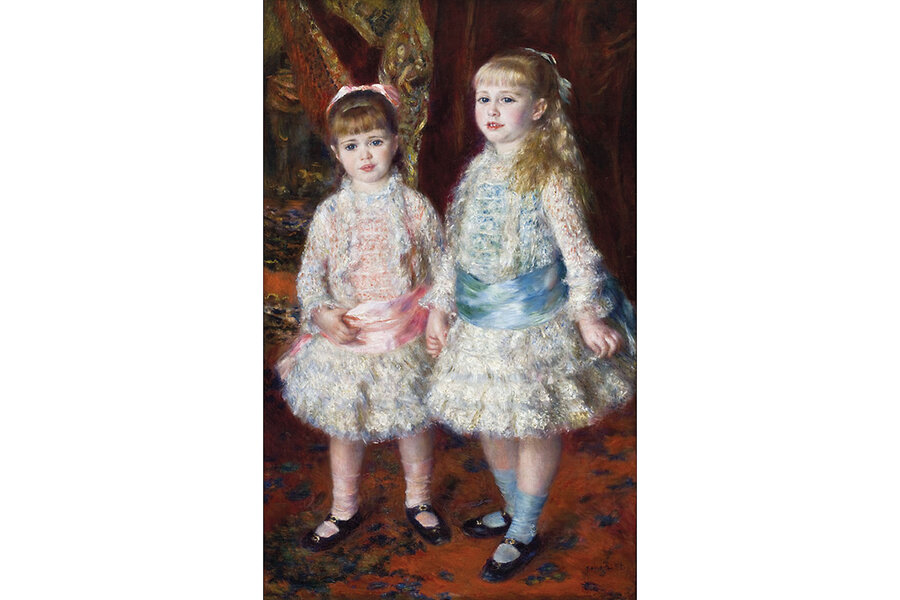
Among the many celebrated portraits by French Impressionist Pierre-Auguste Renoir are two works featuring sisters from the same prominent family. “Pink and Blue, the Misses Cahen d’Anvers” is an 1881 painting of Elisabeth and Alice, then ages 6 and 4, respectively, clad in frilly white dresses with pastel-colored sashes. An 1880 portrait of their older sister, known as “Little Irène,” foregrounds the 8-year-old’s elegant dress and striking red hair.The paintings depict the Cahen d’Anvers family’s gilded milieu in Belle Époque Paris. But in the compelling new book “The Renoir Girls: A Hidden History of Art, War, and Betrayal,” Catherine Ostler documents the insidious antisemitism of the purportedly tolerant era. “All the artistic glories of Impressionism – its inventiveness, its innovative way with light, its joy – concealed profound social ambivalence, in this instance the ambivalence of painter to client, but ultimately of France to newcomer, of one people to another,” she writes.The two paintings were commissioned by the children’s parents, Louis and Louise Cahen d’Anvers, who were well-known figures in Paris’ Jewish elite. The Cahen d’Anvers family enjoyed a happy and comfortable existence during the Belle Époque, the optimistic period between the end of the Franco-Prussian War in 1871 and the start of World War I in 1914. But the hostility toward Jews was evident during the Dreyfus affair, which saw Alfred Dreyfus, a Jewish captain in the French army, wrongly convicted of treason in 1894. It reached a violent apogee with the Vichy regime’s collaboration with Nazi Germany during World War II. Why We Wrote This In “The Renoir Girls,” author and historian Catherine Ostler contrasts the images of a privileged childhood in Belle Époque Paris with the barbarism of antisemitism, which flared in Nazi-occupied France. Ostler reveals at the outset that Elisabeth died in 1944 at age 69, either at Auschwitz or in transit to the concentration camp; she had left Paris for a small French village, whose Vichy-supporting mayor turned her in to the Gestapo. This gruesome end stands in sharp contrast to the privileged childhoods depicted in the portraits. “Renoir’s paintings of these children evoke a Paris of pleasure,” the author writes, “that rapturous era of opulence, expansion, and burgeoning empire, with its faith in reason, progress, and the Enlightenment.” (It’s notable that Renoir himself is known to have expressed antisemitic views: When his payment for “Pink and Blue” arrived behind schedule, the artist wrote to a friend, “I am washing my hands of the Jews.”) In “Little Irène,” which was painted in 1880, Renoir captured the vibrant red hair and ruffled dress of Irène Cahen d’Anvers, the older sister of the two younger girls. Louis Cahen d’Anvers was a prosperous banker; Louise was a lover of art and music who hosted salons, concerts, art shows, and charity functions. Newspapers regularly reported on her activities, with one naming her “one of the wittiest and prettiest women in the high society of Paris.” Like many of their Jewish peers, the couple’s aim was to assimilate completely into French society. Both Elisabeth and Irène converted to Catholicism during the 1890s; such conversions were not uncommon at the time, particularly when Jewish women married outside of their faith, as Elisabeth and Irène did.The first two-thirds of the book are largely devoted to conveying the family’s rarefied status during these peaceful years. Ostler occasionally presages darker events to come. She covers the 1886 publication of a viciously antisemitic tract by Édouard Drumont that went on to become a bestseller. And she explores the significance of the Dreyfus affair, which reached its denouement with the captain’s exoneration in 1906.But the primary focus of these chapters is the family’s frenzied social calendar, featuring exhaustive descriptions of parties, guest lists, and gowns. For instance, of Elisabeth’s 1896 wedding, Ostler writes, “The dresses, of course, are dazzling: Louise in purple velvet with steel-colored embroidery, a purple hat with a black egret; Irène in pale green, with a white satin overlayer and a mirrored velvet bodice, and a sable hat with tufts of white feathers; Alice in pale-pink silk with narrow black velvet trim, black chinchilla lantern hat with a white egret.” The arrival platform at the Auschwitz concentration camp, as it appeared in 1944. Ostler succeeds in creating a discordance between the family’s peacetime life and the ensuing horrors of wartime. Still, the overly detailed recounting of their high-society exploits becomes tedious and makes the book feel unnecessarily long. The tone shifts with France’s entry into World War I, as Ostler acknowledges, writing, “The incessant fripperies and glamour of the Belle Époque life came to an abrupt end, one that requires the author to stop recording the concerts, houses, dresses, balls, and marriages” that dominated the previous chapters. Several members of the Cahen d’Anvers family fought for France during World War I, including the Renoir girls’ two brothers, Robert and Charles, and Elisabeth’s son, Pipo. Irène’s son, Nissim, was killed in action. During the interwar period, after Louis and Louise died, Charles donated their magnificent château, Champs-sur-Marne, to the French government.As Ostler points out, if the family believed that their service or gifts to the nation would protect them during World War II, they were tragically mistaken. Elisabeth apparently thought that her conversion to Catholicism five decades earlier would prevent her from being targeted. Irène lied about her Jewish heritage and survived the war. (Family members told the author that they believed that Irène and her surviving daughter had collaborated with the Nazis.) The brave and resourceful Alice escaped the Nazis, smuggling her grandchildren to safety in England.One of those grandchildren told the author that when “Pink and Blue,” which is now displayed in a museum in São Paulo, Brazil, was loaned to London’s Tate museum in 1954, Alice “liked to stand next to it to tell strangers that it was her in the portrait.” It’s an affecting image – one Renoir girl, approaching age 80, looking on as museumgoers glimpse her lost world.
Renoir portraits offer a glimpse into a fleeting world
Full Article
Original Source
Read the full article at Csmonitor →KhanList aggregates and links to publicly available news content. We do not host full articles from third-party sources. Always verify important information with original sources.