
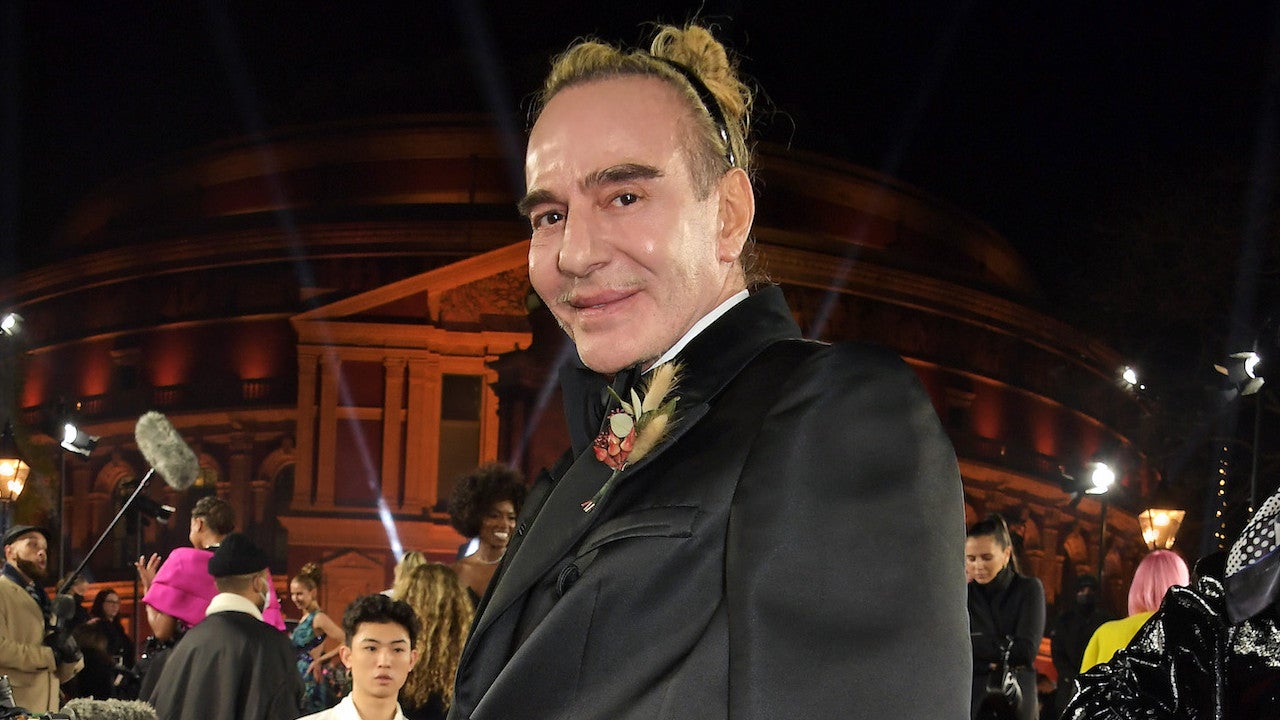
Canceling the John Galliano exhibition doesn’t resolve the bigger question it raised. Meanwhile, in L.A., Golden Age of Hollywood costume and fashion designer Adrian gets a show at the Museum at ASU FIDM. Plus, Rincon Rooms brings boutique lodging to gorgeous Carpinteria. And TheWrapBook: The Art of Television 2026 is here, just in time for Emmys Week. John Galliano and Anna Wintour at a cocktail reception ahead of The Fashion Awards 2021 at Royal Albert Hall on Nov. 29, 2021. Source: Getty John Galliano Bows Out Well, that didn’t last long. One month after the Metropolitan Museum of Art announced that its 2027 Costume Institute exhibition and Met Gala would be devoted to John Galliano, the museum has scrapped the plan following backlash over the designer’s history of antisemitic and racist remarks. The Met and Galliano announced jointly on Monday that “John Galliano: Horizons” will not proceed as planned. A replacement and new theme for the 2027 Met Gala will come later. When the exhibition was announced, I wrote about the complicated proposition of giving Galliano the Costume Institute treatment. His creative influence is difficult to dispute. Over four decades, at his own label and at Givenchy, Dior and Maison Margiela, he became one of fashion’s great storytellers and technicians, modernizing the bias cut, mixing historical periods and references with abandon and helping usher in the era of the fashion designer as global celebrity. His darkly romantic Spring 2024 Maison Margiela couture collection, staged under a bridge on the Seine, was among the best shows in recent memory. But the exhibition was never going to be only about clothes. In 2011, Galliano was fired from Dior after being caught on video making antisemitic remarks during a drunken tirade in a Paris bar; he was subsequently convicted of hate speech in a French court. In the 15 years since, he has maintained his sobriety, apologized and met regularly with Jewish leaders and rabbis, efforts that have been publicly recognized by the Anti-Defamation League. Though an allegation of more recent racist behavior has come to light, which the designer has denied. He also engineered a remarkable professional comeback, one supported over the years by Vogue’s Anna Wintour. Galliano has once again been embraced by Hollywood celebrities. As just one example, Kim Kardashian attended the 2024 Met Gala wearing a custom Maison Margiela design by Galliano, and the two were photographed together at the event. He also secured a deal for a Zara collection due out this fall (TBD if that still goes on). John Galliano and Kim Kardashian attend The 2024 Met Gala Celebrating Sleeping Beauties: Reawakening Fashion. Source: Getty The Met seemed prepared to confront his whole unvarnished history rather than sidestep it. Press materials said the exhibition would examine how “aesthetic achievement, ethical accountability and institutional recognition intersect.” That was an intriguing proposition to me at a moment when museums are increasingly reconsidering and recontextualizing how they present artists and objects with difficult histories. I also suggested that the exhibition should address Galliano’s ugly history of cultural appropriation, particularly in his Dior collections. Indeed, fashion should take more accountability for many things, including racism, sexism, sizeism and worker exploitation, even when it would prefer to gloss over them. But as the weeks passed, there was a contradiction to the whole idea that became harder to ignore. How could the Costume Institute critically interrogate Galliano while the Met Gala celebrated him at the same time? Criticism also intensified from Jewish leaders, deep-pocketed museum donors and New York officials, as reported by The New York Times. And Galliano ultimately bowed out, or at least that’s how it was positioned, saying that he remained accountable for the pain caused by his words, particularly to Jewish and Asian communities, and acknowledging that “an exhibition honouring my work would be painful for some.” Wintour, who is also a Met trustee, called his decision “very courageous” and said he had her full support, without acknowledging any responsibility for her part in the planning. Costume Institute curator Andrew Bolton also acknowledged “the pain and concern this exhibition has caused” and supported abandoning it. Still, canceling the exhibition doesn’t resolve the larger question it raised. Galliano is hardly the only fashion designer with a troubling personal history; Coco Chanel’s wartime activities are perhaps the most obvious example. Museums should be places where contradictions of beauty and horror can be examined. But perhaps the lesson is that examining them and celebrating them are two different things. Actress Jean Harlow in a scene from the 1933 film “Bombshell,” in a costume by Adrian. Source: Getty Adrian’s Hollywood Fashion Legacy Celebrated Few designers did more to invent the look of early Hollywood glamour and carry it from the screen into American closets than Gilbert Adrian. A new exhibition titled “Adrian: Designing Hollywood, Dressing America,” on view at the ASU FIDM Museum in Los Angeles through Dec. 12, brings together more than 50 rare garments and accessories to chart his trajectory from teenage prodigy to MGM costume chief to Beverly Hills couturier. While still a fashion student studying in Paris, Adrian was discovered by the great composer Irving Berlin, who persuaded him to come to New York, where he started designing for Broadway shows at the age of 19. Not long after, silent film star Rudolph Valentino and his wife, Natacha, noticed his genius and brought him to Hollywood. As head of costume design at MGM from 1928 to 1941, he created looks for more than 250 films and helped create the images of some of the era’s greatest stars. For Joan Crawford, he exaggerated her shoulders and sharpened her silhouette, helping turn her into an emblem of modern female power. For Jean Harlow, one of the defining fashion figures of the 1930s, Adrian used bias-cut satins and shimmering fabrics to amplify her sensuality. “The Harlow dress in the exhibition defines 1930s Hollywood glamour–candlelight silk charmeuse, bias cut,” FIDM chief curator and exhibition creator Kevin Jones told WrapStyle. “She wore it in ‘Bombshell’ which gave her the nickname ‘the blonde bombshell.’” From the exhibition, an Adrian evening gown worn by Jean Harlow in “Bombshell.” Source: ASU FIDM Museum His credits ranged from dramas and comedies to musicals like “The Wizard of Oz,” and the simple screen credit “Gowns by Adrian” became its own mark of fantasy and glamour. Among the other costumes on display in the exhibition are gowns worn by Greta Garbo in “Queen Christina” and by Norma Shearer in “Marie Antoinette.” Adrian understood early that what audiences saw at the movies could influence what they wanted to wear in real life. Hundreds of thousands of copies of his frothy white “Letty Lynton” gown sold after Crawford appeared in the 1932 film, and soon after, Macy’s established “cinema shops” to sell film fashions. When he left MGM in 1941, he opened Adrian Ltd. on North Beverly Drive in Beverly Hills, where he translated the drama and precision of his screen work into couture and ready-to-wear, including sculptural evening wear, architectural tailoring and exuberant prints. From the exhibition, Adrian Ltd. 1945 Modern Museum evening gown. Source: ASU FIDM Museum His couture salon attracted a who’s who of Hollywood women, including Shearer, Greer Garson, Marlene Dietrich, Slim Keith and Adrian’s wife, actress Janet Gaynor. And his ready-to-wear was sold through some of the country’s most prestigious stores. “He was a master of proportion and fit onscreen and in real life,” said Jones. “The oversized drama of Joan Crawford onscreen would have looked ridiculous in real life, but he was able to bring that to his ready-to-wear clothes, which were so popular around the country that each city had an exclusive store for Adrian. In Dallas, it was Neiman Marcus and the suits were so popular, the buyers couldn’t keep them in stock. And they weren’t cheap; they started at $134 in the 1940s.” Adrian Ltd. 1945 wool broadcloth day suit. Gift of Jones Apparel Group. Source: ASU FIDM Museum Although Adrian never won an Oscar because the Academy Awards did not recognize costume design until 1948, he did earn the respect of the New York fashion establishment, winning the coveted Coty American Fashion Critics’ Award in 1945. When World War II shut down the Paris fashion salons, he became part of a new generation of designers creating an independent American fashion identity, a story showcased in the exhibition. “America was able to come to the fore without comparisons to Paris,” said Jones. The exhibition also has a sketch from Adrian’s final project, the 1960 original production of Lerner and Loewe’s “Camelot.” Before finishing the costumes, the designer died of a heart attack, and the work was completed by the legendary L.A. multimedia designer Tony Duquette. The two had worked together on the film “The Women,” and Duquette designed Adrian’s Beverly Hills couture salon, “changing out the decorations seasonally, to mimic the seasonality of the East Coast to influence people psychologically to buy,” said Jones. How fabulous! “Adrian: Designing Hollywood, Dressing America” through Dec. 12, ASU FIDM Museum, 919 S. Grand Ave., Los Angeles. Natalie Martin in front of Rincon Rooms. Source: Natalie Martin At Last, Boutique Lodging Arrives in Gorgeous Carpinteria Carpinteria is kind of the Goldilocks of SoCal beach towns: a just-right seaside spot that isn’t as overdeveloped or overcrowded as its neighbor Santa Barbara, 12 miles to the north, but still has an impressive assortment of places to eat, shop and explore — not to mention one of the best stretches of sandy beaches anywhere in the Golden State (that’d be Carpinteria City Beach). And now, thanks to the recently opened Rincon Rooms, it’s got a super-stylish lodging option to match. With just six boutique guest rooms and contactless entry, it feels tucked away but accessible. Located in an otherwise residential building just three blocks off Linden Avenue and under a mile from that top-notch beach, it’s not too far away from all the things that make Carpinteria fun to visit. And with chic amenities (Sferra linens and mattresses, bath products by Salt & Stone and candles by Flamingo Estate), you’ll feel like you’re sitting in the lap of luxury without exactly having to pay for it. (Midweek room rates start at $305.) In an era where the interior of every Airbnb, Vrbo and boutique hotel tends to suffer from a palpable same-same blandness, each of the individually appointed rooms has a warmth and California coziness that makes staying in just as enjoyable as exploring the environs. Room 5 at the Rincon Rooms in Carpinteria, Calif. Source: Rincon Rooms That’s the handiwork of interior designer Amanda Masters of Amanda Masters Design, whose work includes several Soho House pop-up Oscar villas in L.A., boundary-pushing displays at lingerie boutique Coco de Mer, and residential projects in Montecito, the Hollywood Hills and beyond. (The Rincon Rooms are the brainchild of Masters and her husband, Justin Klentner, the CEO of Western Built Construction.) Masters has filled the rooms with walnut doors and paneled walls, vintage brass and British-inspired antique fixtures, handmade ceramics and original artwork by local artists and friends. If you stay in Room 5, for example (as I did on a recent weekend getaway), you’ll gaze upon framed vintage topographical maps of the coast overprinted with the bright orange words “SURF” or “POLO” (the Santa Barbara Polo & Racquet Club is three miles up the road) by A&G Creative, and horsey framed photo prints by photographer Matt Albiani. If something in the room strikes your fancy — from the art on the walls and collected objects on the nightstand to the vintage furniture and furnishings themselves — you’re in luck, because most of it happens to be for sale. If you do escape the specific gravity of your Rincon Room, you can’t go wrong with Brass Bird Coffee just down the street for breakfast eats (during brunch recently, we spotted Conan O’Brien taking calls a few tables away) or Little Dom’s Seafood a little farther away on Linden (where the olive oil martini is a must-have). Rincon Rooms, 4745 Carpinteria Avenue, Carpinteria, Calif. TheWrapBook: The Art of Television 2026. Sarah Pidgeon wears dress by Alaia. All jewelry by Chanel. Source: Photo by Roman Koval TheWrapBook: The Art of Television 2026 Features Cover Star Sarah Pidgeon TheWrapBook: The Art of Television 2026 has landed just in time for Emmys week, featuring “Love Story,” “The Comeback,” “I Love LA” and more. “There was a time when cinema was our clearest reflection of the culture. Today, that conversation increasingly belongs to television,” co-editorial directors Andrew Wren and Michaela Dosamantes write in their introduction to the limited edition, bi-annual art book. “Perhaps it’s the rhythm of the medium itself. Television unfolds over weeks and months rather than hours, allowing characters to evolve with a complexity that mirrors our own lives. It has become the place where we wrestle with questions of identity, ambition, power, intimacy and belonging — not as fixed ideas, but as ongoing negotiations. The most memorable series of the past year don’t offer easy answers. Instead, they invite us to sit with contradiction.” Breakout “Love Story” star Sarah Pidgeon covers the issue as part of a “Faces of 2026” portfolio photographed by Roman Koval. She is pictured with Lamorne Morris (“Spider-Noir”), Justine Lupe (“Nobody Wants This”), Rhea Seehorn (“Pluribus”), Paul W. Downs (“Hacks”), Gerran Howell (“The Pitt”) and more. Pidgeon does double duty, also appearing in a glamorous layout alongside Paul Anthony Kelly, Grace Gummer and the rest of the cast of “Love Story.” Writer Kat Herriman considers the history of TV-centric contemporary art, from Lucio Fontana’s punch-hole paintings turned into a broadcast in 1952, to Nam June Paik using the screen itself as a material in 1963, to pioneering video artist Paul McCarthy subverting the medium starting in the 1970s and beyond. Meanwhile, Brian Grazer gives a tour of his art-filled home. Among the Richters, Warhols and a Murakami he bought over Instagram, the legendary Hollywood producer shares advice from Steve Martin that has guided his lifelong collecting: Buy what you love. After the final season of “The Comeback,” Lisa Kudrow reflects on how age has softened her character Valerie’s desperation and why saying goodbye might not really be goodbye at all. And L.A. artist Elmer Guevara, whose paintings return to the landscape of the city again and again, reinterprets the characters from HBO’s beloved satire “I Love LA” in his own hand. It’s a fun — and stylish — read. TheWrapBook: The Art of Television 2026 is available to order here. Forwarded this newsletter? Subscribe here to get WrapStyle directly every week! Have a news story for our readers? Please email booth.moore@thewrap.com Interested in partnership opportunities? Please email Alex.vonBargen@thewrap.com
The Met’s Galliano Cancellation Doesn’t Resolve the Bigger Question It Raised
Full Article
Original Source
Read the full article at Thewrap →KhanList aggregates and links to publicly available news content. We do not host full articles from third-party sources. Always verify important information with original sources.