
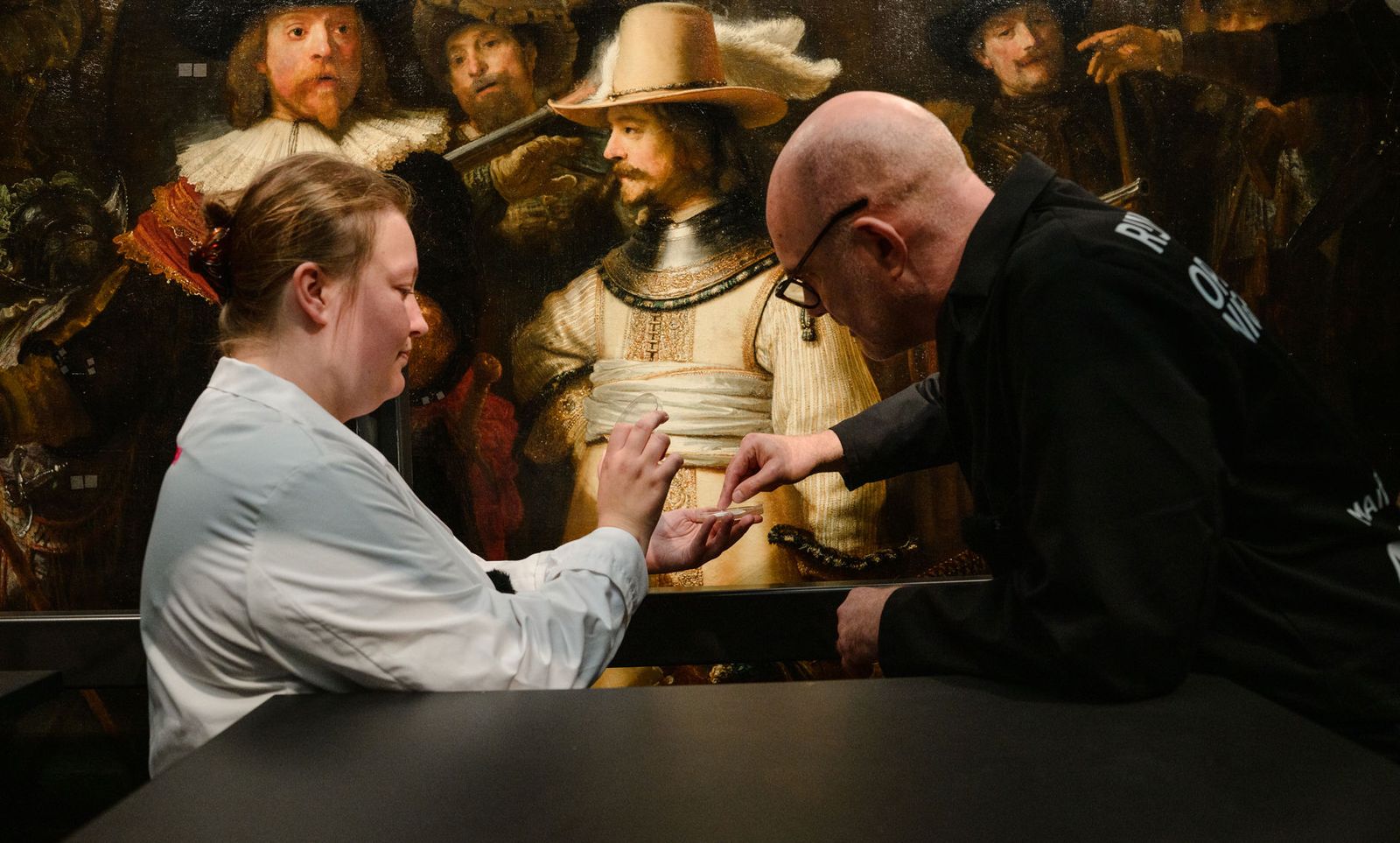
Samples swabbed from the 17th-century painting reveal myriad microorganisms, including one perplexing bacterium that was first discovered at a Japanese sugar refinery in 2013 November 20, 2026 2:21 p.m. ARTIS-Micropia microbiologist Eline van Bloois (left) and a Rijksmuseum conservator take samples from The Night Watch. ARTIS-Micropia For nearly four centuries, viewers have admired the bustling militia figures frozen in oil paint on Rembrandt van Rijn’s 1642 masterpiece, The Night Watch. Now, scientists in Amsterdam have revealed that the iconic canvas is teeming with an invisible, living world of its own. Researchers from the Rijksmuseum and ARTIS-Micropia (which claims to be the world’s only museum dedicated to microbes) are collecting 60 samples from 10 different areas of the painting to catalog its surface microbiome. Early laboratory cultures have turned up myriads of common bacteria and one puzzling outlier: Microbacterium saccharophilum, a bacterial species first identified in 2013 at a sugar refinery in Japan. “This is the first time The Night Watch, or any work of art, has been analyzed in this way, and we’ve found bacteria that appear on human skin and in soil, and are even associated with plants,” Eline van Bloois, a microbiologist at Artis-Micropia tells El País’ Isabel Ferrer. Rembrandt, The Night Watch, 1642 Public domain via Wikimedia Commons The ongoing investigation is featured in “The Night Watch Lives,” an exhibition at ARTIS-Micropia running through May 2027. Centered around a life-size reproduction of Rembrandt’s painting marked with numbered sampling dates, the display showcases living bacterial colonies growing inside glass-encased Petri dishes. “To get that close to the painting was very scary,” van Bloois tells Hyperallergic's Noëlle de Leeuw. “After all, it's a piece of art that is so well-known to so many people.” The microbial census forms a new chapter of “Operation Night Watch,” the Rijksmuseum’s sweeping research and conservation initiative launched in 2019. Inside a glass chamber in the museum’s Gallery of Honor, conservators are currently working in full view of visitors to painstakingly remove a yellowed layer of varnish applied in the 1970s. It’s a delicate process, using organic-fabric gauze, small tissues and tiny amounts of solvent that will take years to complete. Decades before Dutch microbiologist Antonie van Leeuwenhoek first described microorganisms in the 1670s, Rembrandt was already using chemistry to protect his work against microscopic threats. Previous Operation Night Watch analyses revealed that Rembrandt had applied a layer of lead-laden oil beneath the primer to shield the painting from moisture and mold in Amsterdam’s damp buildings. The canvas was later trimmed in 1715 to fit inside Amsterdam City Hall and has suffered numerous conservation treatments and deep cleanings roughly once every 50 years. Did you know? Operation Night Watch Since 2019, Operation Night Watch has made several other breakthroughs. Researchers restored the trimmed edges of the painting with artificial intelligence and discovered a hidden sketch beneath the paint with advanced X-ray imaging. “Thirty or 40 years ago, nobody could have imagined you’d be talking to a chemist or biologist about The Night Watch,” Rijksmuseum director Taco Dibbits said during a press conference, Hyperallergic reports. “And I think precisely because this research is broadening—the fact that the humanities and the exact sciences are collaborating—it also leads to it becoming more widely embraced.” To sample the 400-year-old surface safely, conservators and lab technicians gently pressed small, sterile cellulose discs against both varnished and unvarnished sections of the canvas. Those discs were transferred to Petri dishes and incubated in ARTIS-Micropia’s laboratory until invisible microbes multiplied into visible colonies, which an external lab then identified. The team has completed only half of its six planned sampling trips to the Rijksmuseum so far, with 20 identified microbes currently on display and another 10 still incubating. Researchers expect to collect all 60 samples by February. A researcher holds a Petri dish containing a sterile cellulose disc in front of The Night Watch at the Rijksmuseum. ARTIS-Micropia Among the familiar microbial residents detected so far are Staphylococcus epidermidis and Micrococcus luteus, harmless bacteria routinely found on human skin that help hydrate it and defend against pathogens, Amsterdamian’s Dana Marin reports. The team also isolated plant-root and soil species, including Kocuria palustris, Kocuria rhizophila and Lysinibacillus sphaericus, a resilient bacterium capable of surviving harsh environments rich in heavy metals. None of those, however, baffled scientists quite like Microbacterium saccharophilum, which turned up on a section where old varnish had already been stripped away. Originally isolated from soil at the Ensuiko Sugar Refining plant in Yokohama, Japan, the microbe has no obvious connection to a Dutch Golden Age canvas. “We’ve seen very little sugar in Rembrandt’s painting so far, and it’s best not to speculate, but it’s possible that the Saccharophilum isn’t as old as the canvas,” van Bloois tells El País, adding that scientists currently have no way to determine when any of the bacteria arrived. Museum visitors often wonder whether any microbes lingering on the paint might date back to Rembrandt himself. “Ideally, you want to have the bacteria of Rembrandt: this is the Holy Grail,” Katrien Keune, the Rijksmuseum’s head of science, tells the Art Newspaper’s Senay Boztas. Yet Keune tells Amsterdamian that centuries of restoration make finding traces of the master unlikely, noting that the surface largely reflects museum staff and visitors shedding skin cells and saliva droplets. Even without a direct biological link to Rembrandt, researchers hope the project helps rehabilitate the public image of microbes, pointing out that far less than 1 percent of known species cause disease in humans or animals. “It's good to give microbes some love as well,” van Bloois tells the Art Newspaper. “The Night Watch Lives” is on view at ARTIS-Micropia in Amsterdam through May 2027. You Might Also Like Get the latest stories in your inbox every weekday. More about: Art Art History Art Meets Science Bacteria Microbes, Bacteria, Viruses Netherlands New Research Painting Rembrandt
Rembrandt's 'Night Watch' Is Teeming With Life. Researchers Reveal a Hidden World of Microbes All Over the Masterpiece
Full Article
Original Source
Read the full article at Smithsonianmag →KhanList aggregates and links to publicly available news content. We do not host full articles from third-party sources. Always verify important information with original sources.