
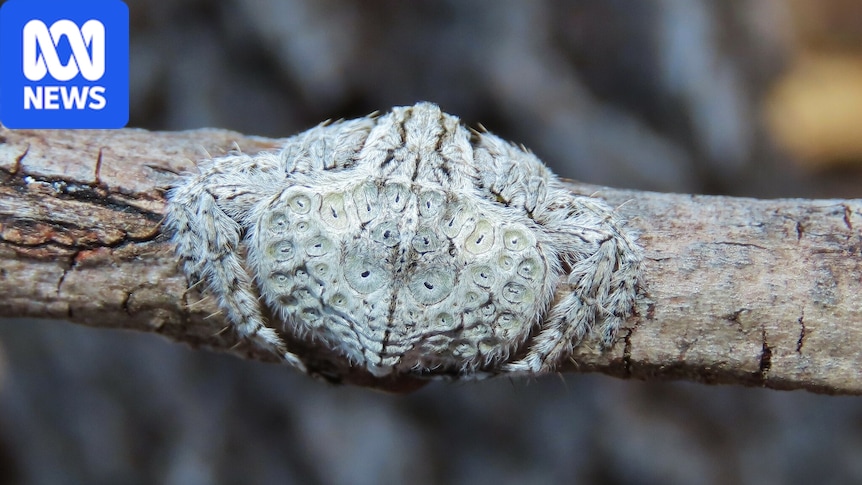
Deb Taylor was out for a walk on her property in regional New South Wales when she spotted a strange bug."We were just bumbling around. The dogs were swimming, the horses and the cows were grazing," she said."And I just saw it sitting on a leaf."The brown and black beetle wasn't particularly "pretty", but she didn't recognise it. So she snapped a few photos and uploaded them to online citizen science database iNaturalist.A biologist quickly identified the insect as Anastetha raripila and said, as far as he could tell, it was the only photograph of the bug alive in the wild."I was absolutely hooked," Ms Taylor said.Native bees are just some of the insects captured for Bugs In my Backyard Week. (iNaturalist: Thyreus nitidulus/debtaylor142/CC BY-NC 4.0)Citizen scientist snapshotsThis week, citizen scientists like Ms Taylor have been out in force for the second-ever Bugs in my Backyard Week.The initiative, run by citizen science group Bug Hunt, has Australians upload their insect finds to iNaturalist to capture a "springtime snapshot" of the nation's bugs.There have been almost 30,000 observations of insects submitted across Australia this week.Jess Ward-Jones, co-coordinator of Bug Hunt, said the project helps people connect with the outside world."Projects like this provide an opportunity for people to be curious and engage with the wildlife around them," Ms Ward-Jones said."It's super easy to take part. Just download iNaturalist, make an account and start snapping bugs."Deb Taylor has uploaded observations of thousands of insects and arachnids to iNaturalist. (Supplied: Alison Kuiter)Uploading insects and spiders to databases like iNaturalist is invaluable to scientists, who use the data for research like the spread of introduced pest species such as fire ants."Seventy per cent of fire ant records come from citizen scientists in the Brisbane area," Ms Ward-Jones said."Having people on the ground all over the place really adds that value to that constant monitoring."Spotting rare insectsThe project also provides scientists with evidence of extremely rare native insects."This project last year discovered a species of ant that we thought was extinct for decades on the Eyre Peninsula," Ms Ward-Jones said."Researchers from Adelaide got to go out there, and now we know a lot more about it."The photo of the critically endangered dinosaur ant (Nothomyrmecia macrops) in South Australia came as a surprise after scientists spent almost 50 years looking for it in Western Australia instead.The dinosaur ant (Nothomyrmecia macrops) is critically endangered. (iNaturalist: Dinosaur Ant/Angus Smith/CC BY NC)Many of the 4,500 spider and insect observations Ms Taylor has taken over the last few years were not just new to her, but potentially new to science."I've got a lot of insect observations where they're not identified to genus, let alone species, because they just haven't been described," she said."I think it's important that I go out there and document as much as possible."A wrap-around spider from the genus Dolophones, which Deb Taylor has not been able to identify. (Supplied: Deb Taylor)While it may take more work to find insects than other animals like birds, Ms Ward-Jones said the "inconspicuous" critters were worth looking a bit harder for."Invertebrates make up 95 per cent of our species diversity in Australia and provide ecosystem services all the time," she said."They keep our soils healthy, our water clean, our air clean. They keep plants healthy. They're just these little workers that we never see, working hard to keep everything functioning."Bogongs are bouncing backMs Ward-Jones said that the bogong moth has just overtaken the European honeybee as the most submitted species for this year's count.Documenting bogong moths marked with blue paint dots helps scientists track the species' migration. (Supplied: Western Sydney University)"It's not only a native, but also a threatened species," she said."Obviously, it might not have been ideal to have hundreds of bogong moths fly into your house, but the result is that people got to learn about this threatened species that went through a massive population decline."Ms Taylor has also noticed an increase in some other species that has surprised her."About the same time we had the great bogong moth migration come through … we started seeing a butterfly here that I had never seen before, a chequered swallowtail," she said."I'm thinking there has to be some correlation, like it can't be a coincidence."Deb Taylor has seen more lime swallowtails in her local area at the same time as the bogong moth. (iNaturalist: Lime Swallowtail/debtaylor142/CC BY-NC 4.0)Even after years of snapping photos, Ms Taylor is still spurred by the thought that new insects are out there to find."I actually saw my first green and gold carpenter bee today. I've never seen one before," she said."It constantly surprises me that I'm still finding so much."It's like real life Pokemon hunting!"
Citizen scientists are hunting for bugs in Australia's backyards
Full Article
Original Source
Read the full article at Abc →KhanList aggregates and links to publicly available news content. We do not host full articles from third-party sources. Always verify important information with original sources.