
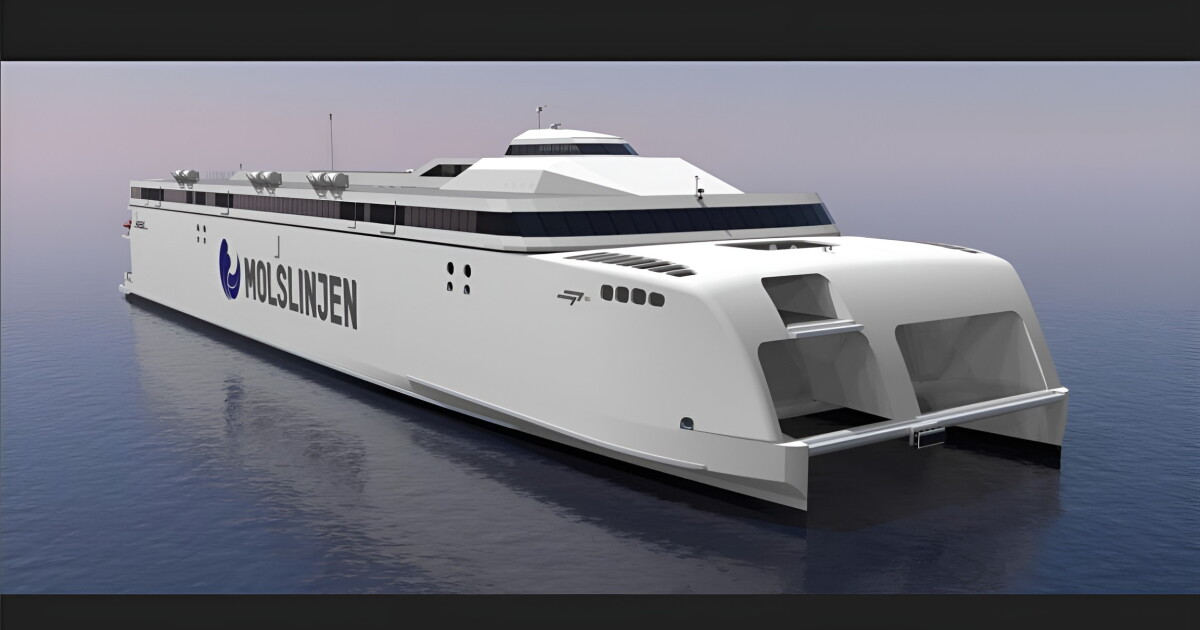
The Argentine-Uruguayan ferry China Zorrilla only started carrying passengers in October, and its battery record already has an expiration date. The same Tasmanian yard that built it is now working on three catamarans for Denmark's Molslinjen, each set to carry 55 MWh of batteries from Andorra-based AYK Energy, against the China Zorrilla's 43.Molslinjen wants them to carry up to 1,500 passengers and 500 vehicles across the Kattegat at up to 40 knots (46 mph or 74 km/h) on battery power alone, drawing on 165 MWh across the fleet. The first of these 423-ft (129-m) ferries is due to start sailing between Jutland and Zealand in the first quarter of 2028. The other two should follow in 2028 and 2029.Weight is a big deal on a fast ferry. The China Zorrilla's 43-MWh pack weighs roughly 286 tons, and the catamaran, originally meant to hit 37 knots, settled for a service speed of 25. Each 423-ft ferry is designed to cross the Kattegat at up to 40 knotsIncat It's also what decided Molslinjen's order. When the operator went shopping for batteries almost two years ago, AYK offered packs weighing more than 700 tonnes (772 US tons) per ship. The ones it will now deliver weigh less than 400 tonnes (441 US tons), according to AYK, although Molslinjen's own fact sheet puts the figure at about 406 tonnes."We are pushing the boundaries of technology here, and the combined weight of the vessel and its batteries will be crucial to operating such large vessels at high speed across the Kattegat," says Molslinjen CEO Carsten Jensen. "So when AYK managed to significantly reduce the weight of its batteries without compromising power, that tipped the balance."AYK claims it redesigned the pack from scratch, with new cells inspired by manufacturing techniques borrowed from the car industry and a lighter, stronger aluminum structure. It uses lithium iron phosphate (LFP) chemistry, which stores less energy per pound than the nickel-cobalt-aluminum (NCA) cells in the China Zorrilla, but copes much better with overheating, one of the biggest dangers of the technology. "This is not a car where the driver can simply step out onto the road if there is a fire," says AYK founder Chris Kruger. AYK Energy's battery racks on show, with the Molslinjen order on the wall behindAYK Energy There is a catch, though. Not all of those 55 MWh are usable. Molslinjen lists 46.5 MWh of usable energy per ship and expects each crossing to eat up 27 to 28 MWh.Charging the batteries is another headache. Each ferry is meant to top up in about half an hour between crossings, swallowing up to 54 MW. By Molslinjen's maths, that's 216 Teslas charging at 250 kW all at once. But the local grid can't take that hit every time a ferry docks, so Molslinjen is building two 118-MWh battery parks on shore, one in Aarhus and one at Sjællands Odde. They'll charge from the grid while the ferries are out at sea, then pour power into the ferries alongside the grid the moment they dock."We can't simply charge directly from the grid on every crossing," Jensen said in June, when the company hired BOS Power to build them. "In the batteries we can store three to four ferry crossings if the grid supply acts up."The first battery should reach Incat's yard in Tasmania around the turn of the year. After that, the first ferry still faces a voyage of almost 15,000 miles (24,000 km) to Denmark before it carries anyone across the Kattegat.Source: AYK Energy
Record ferry batteries shed nearly 300 tonnes to hit 40 knots
Full Article
Original Source
Read the full article at Newatlas →KhanList aggregates and links to publicly available news content. We do not host full articles from third-party sources. Always verify important information with original sources.