
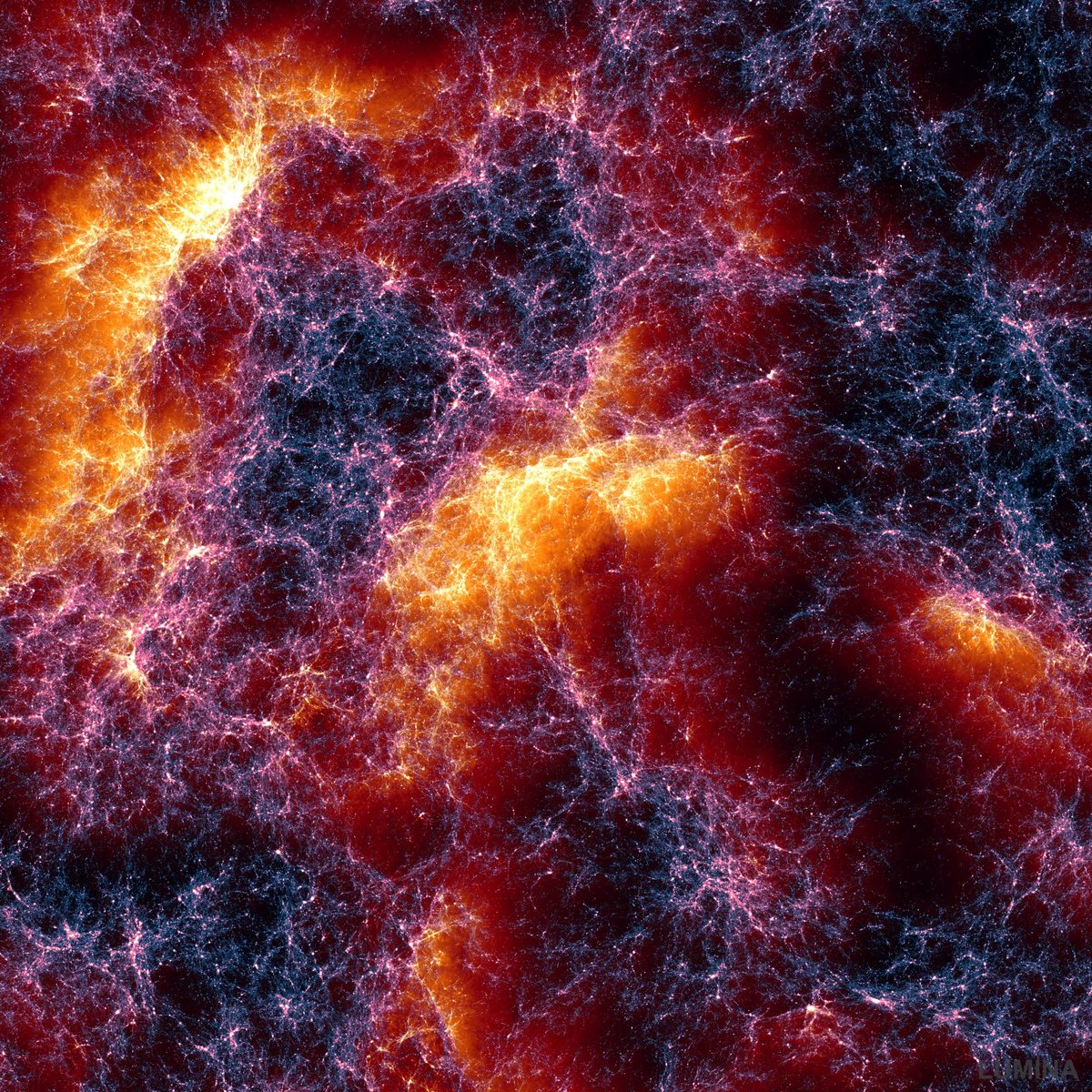
People sometimes fret that we might be living inside a computer simulation and that we’re all products of some gigantic godlike program created for reasons unknown. (This suspicion is so prevalent that it’s spawned its own joke among Star Trek fans: when things get really bad, just look up and firmly say, “Computer, end program,” in case we all happen to be in a holodeck.)I certainly can’t say whether this is true or not (or what difference it would make), but I do know that we humans are getting pretty good at simulating the universe ourselves—or at least the physics of it.For proof, look no further than Lumina, a new record-breaking simulation from a large international team of scientists. Lumina is the best-yet attempt to model the physics underpinning one of the most important events in cosmic history: reionization, which is the key to understanding critical energy sources in the early universe. The researchers published their initial results on October 26 in the Monthly Notices of the Royal Astronomical Society.On supporting science journalismIf you're enjoying this article, consider supporting our award-winning journalism by subscribing. By purchasing a subscription you are helping to ensure the future of impactful stories about the discoveries and ideas shaping our world today.To say the simulation is ambitious seriously undersells it. Lumina calculates the physical conditions in a volume of space more than 1.5 billion light-years wide—an immense distance—yet can also simulate what’s going on at scales of around only 1,400 light-years. It does this by dividing that volume over a staggering 432 billion individual sectors of space and keeping track of multiple physical parameters inside each as conditions change over time. This produces the most detailed simulation over the largest chunk of the universe ever created, revealing what happened over a two-billion-year stretch of time that reaches back to just 50 million years or so after the big bang.It was during this era that the first stars and galaxies themselves formed, yet we know very little about the physical conditions of the universe at that time—which is why simulations like Lumina can be so enlightening.A brief history of the universe:In the beginning, the cosmos was very hot and very dense. It expanded, and it cooled as it did so. For the first 380,000 years or so, it was opaque because it was filled with ionized gas—charged particles such as electrons and protons. At those extremely high densities, you couldn’t swing a photon without it hitting an ion and bouncing off in a random direction, so light couldn’t travel freely as it does today.Eventually the universe cooled enough that atomic nuclei and electrons could combine, and when they did, all that gas that was suffusing space very quickly became electrically neutral. Such material isn’t very good at absorbing light, so this made the universe transparent. Photons could fly freely, traveling long distances.As this was happening, gravity was starting to draw together vast expanses of cooling matter. Huge structures began forming—such as galaxies, clusters of galaxies and superclusters of galaxies. On a smaller scale, stars were starting to coalesce from the miasma as well—and supermassive black holes in the centers of galaxies were, too.Both stars and these monstrous black holes were sources of intense high-energy photons, including ultraviolet light. All that radiation zapped electrons off atoms once again, and over the course of time, this reionized the universe. By then, however, the universe had expanded so much that the density of all that gas had plummeted, so the cosmos stayed transparent. That’s pretty much the state of things today, some 13-billion-plus years later.But there are details we still don’t know that are difficult to deduce just from observations. When (and how suddenly) did reionization occur? What role did dark matter play, or the different elements churned out by stars? When exactly did large-scale structures form?This is where simulations come in. We understand, for example, gravity, the flow of photons through matter and the amount of radiation stars and galaxies emit. A computer model can take a small region of virtual space, add in hydrogen, helium, dark matter and radiation and then apply the laws of physics and see how it all changes over time. By doing this across thousands, millions or billions of these regions and letting them affect each other, you can try to reproduce how the universe works.But simulating the universe isn’t easy. You need to look at small scales to ensure you’re getting the physics of star formation right, but you also need to look at huge scales to allow things such as galaxies and galaxy clusters to form. And to see how all this structure changes, you have to do this over and over again as simulated time passes.Still, computers are pretty good these days, and scientists can code their sims to optimize for speed without (hopefully) sacrificing too much realism. So as our computers and code have improved, simulations have evolved over time to become more complex, much like the cosmos itself.Lumina is the latest step in this evolution. It looks at small regions of space but has so many of them—hundreds of billions—that it actually covers volumes big enough to see structures such as clusters. Also, importantly, the volume of space is so huge that relatively rare (but extremely influential) objects such as super-powerful, ionizing-radiation-spewing quasars can form as well, allowing their outsized effects to be included.Lumina also uses the most sophisticated physics ever done on this scale. The simulation keeps track of hydrogen, helium and dark matter, as well as ionizing radiation from various sources. (I’ll note it does not include the effects of magnetism, which are ridiculously complex and difficult to calculate.)The sim’s initial results are pretty interesting. Astronomers have argued for years over whether supermassive black holes or stars were primarily responsible for reionization. And Lumina indicates the answer is both! Stars were responsible for the ionization of hydrogen and for removing one electron off helium atoms, but it took the higher energy output from huge black holes in the centers of galaxies to completely ionize helium (which clutches its electrons more tightly than hydrogen does). This doesn’t really surprise me—in general, if there are two possible explanations for some effect, the real answer may be a mix of both—but it’s still helpful to clarify the roles these individual sources play.Among other results, the Lumina team finds that the reionization of hydrogen completed about 12.5 billion years ago. Total helium reionization (meaning both electrons are stripped) started around 12.8 billion years ago and finished about 1.2 billion years later. Other, more subtle, results will keep astronomers busy matching theory and observations for some time. In a sense, the Lumina results are much like the survey from, say, the Vera C. Rubin Observatory, which is taking observations of the actual universe with extraordinary resolution and depth; both present exquisite datasets that can be plumbed for treasures for years to come.A simulated universe can tell us a lot about the real one—assuming it is real. Either way, the ultimate goal is understanding it a little better, and that’s real enough for me.
Record-breaking simulation sheds light on cosmic ‘dark ages’
Full Article
Original Source
Read the full article at Scientificamerican →KhanList aggregates and links to publicly available news content. We do not host full articles from third-party sources. Always verify important information with original sources.