
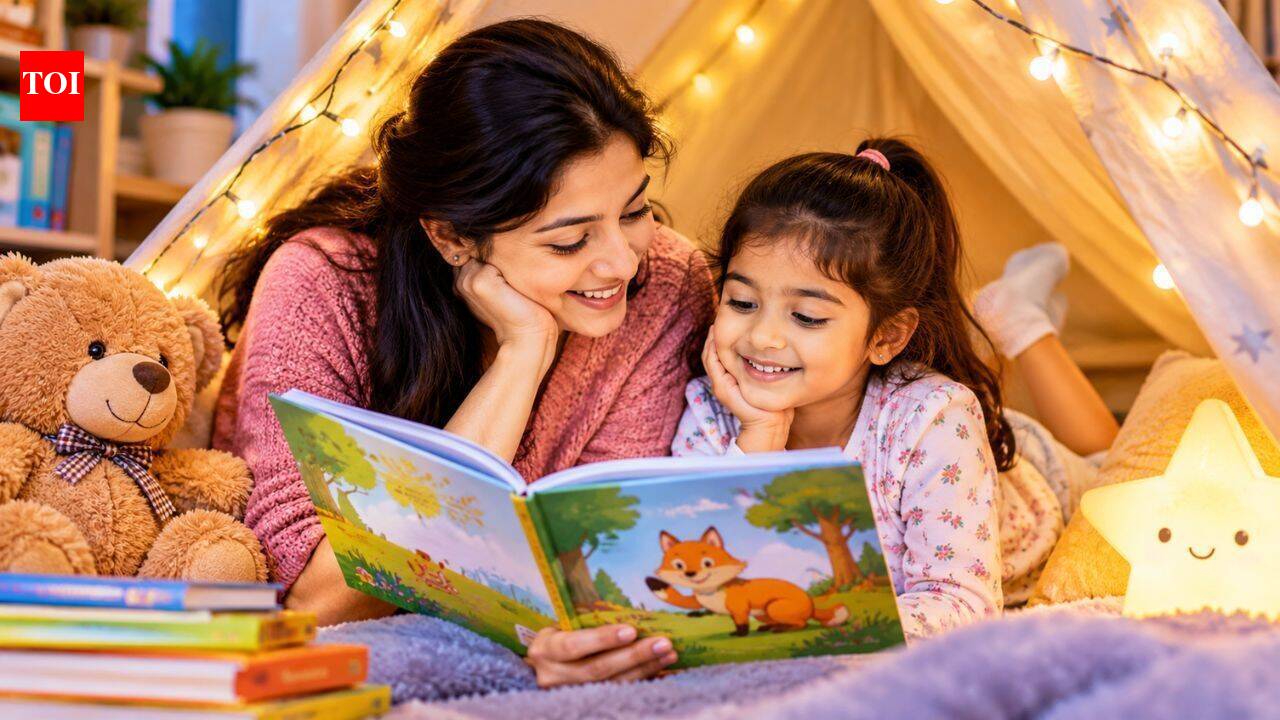
A bedtime story might seem like a small part of a parent's daily routine. But those few minutes spent turning colourful pages, describing pictures and reading aloud could make a significant difference to a child's early learning. Research from The Ohio State University suggests that children whose parents read them five books every day could hear approximately 1.4 million more words by the time they turn five than children who are never read to.The finding, described as the 'million word gap', highlights how something as accessible as sharing a story can influence a child's exposure to language before they even enter a classroom. The study does not suggest that children must memorise every word or that parents need to complete a reading target every day. Instead, it draws attention to how regular exposure to books can introduce young minds to vocabulary, ideas and expressions that may not naturally come up in everyday conversations.5 Oct 2026 | 12:06Parents, when your child refuses to greet relatives, do you make them say hello or respect their choice?The numbers behind the million-word gapPublished in 2019 in the Journal of Developmental & Behavioural Paediatrics, the study titled 'When Children Are Not Read to at Home: The Million Word Gap' was conducted by Jessica A R Logan and her colleagues. The researchers wanted to understand how much language children could be exposed to through books during their first five years, depending on how frequently parents or caregivers read to them.To estimate this, the team worked with the Columbus Metropolitan Library to identify 100 of its most circulated children's books, including board books for babies and picture books for older children. They randomly selected 30 books from each category and counted the words. Their analysis found that board books contained an average of 140 words, while picture books had approximately 228 words.Using these averages, the researchers calculated how many words children could hear at different reading frequencies between birth and their fifth birthday. They assumed that children would be read board books until age three, followed by picture books during the next two years. The results revealed a striking difference. Children who were read five books a day could hear an estimated 1,483,300 words by age five. Meanwhile, children who were never read to were estimated to hear just 4,662 words through books.One book a day can also make a differenceThe research also offers encouraging news for parents who cannot fit multiple reading sessions into their daily schedules. Children who were read one book every day were estimated to hear 296,660 words by their fifth birthday. That is nearly 290,000 more words than children who were never regularly read to. The researchers also calculated the exposure for children who were read stories less frequently.Those who heard books three to five times a week were estimated to encounter 169,520 words by age five. For children who were read to once or twice a week, the estimate was 63,570 words. Here is how the numbers compare:- Never read to 4,662 words- Once or twice a week: 63,570 words- Three to five times a week: 169,520 words- Once every day: 296,660 words- Five books a day: 1,483,300 wordsThese figures are estimates of words heard during shared reading, rather than the number of words children can independently understand or use.Why children's books offer something extraOne interesting aspect of the research is that books expose children to language they might not encounter during ordinary conversations at home. Parents naturally use familiar words while discussing meals, toys, daily activities and family routines. Children's books, however, can introduce entirely different subjects, settings and vocabulary. A story about penguins in Antarctica, for instance, could introduce a child to words associated with wildlife, geography, weather and unfamiliar environments.Jessica Logan explained that children who hear a wider range of vocabulary may be better prepared to recognise those words in print when they begin school. This exposure could also help them develop reading skills more easily. The researchers further pointed out that their estimates might be conservative. Parents often discuss illustrations, explain unfamiliar words, ask questions and talk about the story while reading. Such interactions can expose children to even more language than the printed words alone.It is not about finishing five books every nightPerhaps the most practical takeaway for parents is that building a reading habit does not have to involve expensive books, elaborate activities or a fixed number of pages. A short story before bedtime, a picture book after lunch or a few minutes spent describing illustrations can create opportunities for children to hear new words and engage with language.Parents can also encourage children to point at pictures, identify familiar objects, ask questions and guess what might happen next. These small conversations can make reading a shared experience rather than simply an adult reading aloud. The study ultimately highlights an important point: early learning does not begin on the first day of school. It develops through everyday experiences, including conversations, play and the stories children hear at home. And sometimes, giving a child a head start in language learning can begin with something as simple as opening a book together.
Reading five books daily gives children 1.4m-word head start by age 5: Study
Full Article
Original Source
Read the full article at Timesofindia →KhanList aggregates and links to publicly available news content. We do not host full articles from third-party sources. Always verify important information with original sources.