
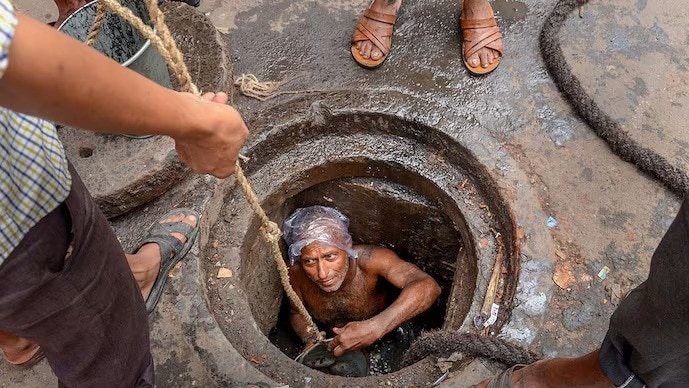
The Bombay High Court struck down Maharashtra's policymaking private employers directly liable for deaths during hazardous cleaning. It said the state government must first compensate families and then recover the amount, while condemning manual scavenging as caste-driven and inhuman.Entering a manhole or a sewer line is a centuries-old practice that has been decreed illegal in India through several Supreme Court judgments. (Photo: PTI)The Bombay High Court has struck down a Maharashtra government policy that made private employers and housing societies directly responsible for paying compensation to the families of workers who died during hazardous cleaning. It held that the state government must first make the payment and then recover the amount from those responsible.In a strong observation of manual scavenging, the court said that even as India speaks of major achievements, citizens are still being pushed into work that is "below human dignity" because of the continuing caste system.A division bench of Justices Bharati Dangre and Manjusha Deshpande, in an order passed last week, directed the state government to immediately compensate the dependants of the victims.It also asked the government to identify, within six months, all those who died while engaged in "hazardous cleaning" as defined under Section 2(d) of the Prohibition of Employment as Manual Scavengers and their Rehabilitation Act, 2013, and pay Rs 30 lakh to the dependants of each deceased person. The court passed the ruling on petitions filed by trade union Shramik Janata Sangh and others challenging Item 11 of government resolutions dated December 12, 2019 and April 30, 2025. The petitioners had sought to set aside the clause, saying it made private individuals liable for compensation in the event of the death of manual scavengers instead of the state or local authorities.The petitions said the state government and local authorities had failed to implement the provisions of the 2013 Act, which was adopted by Maharashtra to prohibit manual scavenging. In its order, the court said, "In the 21st century, we boast about reaching the other side of the moon, yet the hard reality that stares us in the face is that the social evil of the caste system is still followed in our country, which forces some of our citizens to do work that is below human dignity."It added that though the Constitution guarantees equality before the law, "even after 75 years of adopting the Constitution, our country is not free from the social evil that has haunted us for ages".The bench also said, "Manual scavenging is one such practice, which forces a particular class of community to undertake this inhumane practice for generations, despite prohibition imposed on it by various judicial pronouncements of the Supreme Court and statutes prohibiting such practice."The court said the 2013 law does not distinguish between workers engaged in hazardous cleaning on the basis of who employs them, and that the law is meant to eliminate the dehumanising practice of manual scavenging.Calling the policy "clearly violative" of the fundamental right to equality, the bench cancelled Item 11 in both resolutions and ordered the state government and local authorities to immediately disburse compensation to the families of deceased sanitation workers, whether they were employed in the public or private sector, with recovery from private employers to follow later.- EndsPublished By: India Today Web Desk Published On: Sep 5, 2026 09:42 IST
Reached Moon, but caste system persists: HC raps Maharashtra on manual scavenging
Full Article
Original Source
Read the full article at Indiatoday →KhanList aggregates and links to publicly available news content. We do not host full articles from third-party sources. Always verify important information with original sources.