
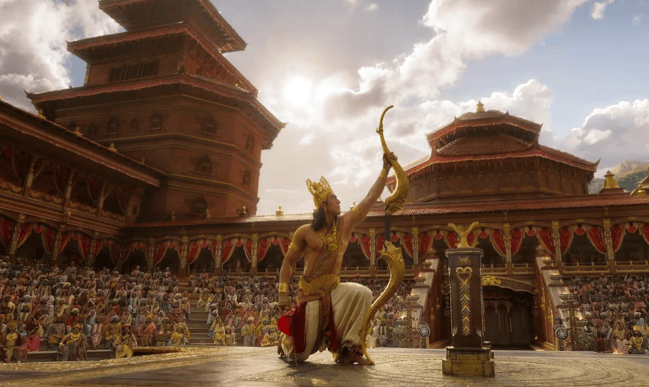
In the hours before the review embargo for “Ramayana: Rise of a Legend” lifts, Google should see a massive influx of searches for “synonyms for epic.” It’s a reductive label: if you’re even remotely interested in a three-hour movie that covers half of a 1,500 page book spanning decades of war, romance, revenge, and interactions with the gods themselves, you already know that it’s an epic. But it nevertheless bears repeating and underlining, or at least replacing with all the variations of “majestic” and “monumental” that a thesaurus can provide. It’s hard to overstate just how big Nitesh Tiwari’s adaptation of India’s national epic really is. This is a film where Brahma himself, the Creator of the entire universe, makes an onscreen acting appearance before the 10-minute mark. Every facet of India’s topography, from lush grasslands filled with antelopes to gnarled forests with tigers and evil spirits lurking around every corner, is on full display. There are enough wars, musical numbers, “Gladiator”-style arena contests, talking eagles, lavish Indian weddings, Shakespearean feuds, da Vinci-esque flying machines, and shape-shifting to satisfy even the most attention span-challenged viewers. There are moments when Christopher Nolan’s “The Odyssey” looks like “My Dinner with Andre” by comparison. In many ways, the bigness is the point. Along with the “Mahabharata,” the “Ramanyana” is one of two Sanskrit epics that all but define what it has traditionally meant to be Indian. The sprawling saga introduces many of the foundational tenets of Hindu spirituality and the storytelling principles that continue to inform all of Bollywood cinema. It might as well be Homer and the Bible all rolled into one, and Tiwari’s film adaptation takes that responsibility seriously. When adapting an epic of this scale, a filmmaker can typically make one of two choices: there’s the route that Nolan took with “The Odyssey” of finding a specific angle within such a massive piece of material that allows you to put a personal spin on it. Or you can take a more generalist approach that aims to place the entire text on screen, even if it means sacrificing some specificity. This take on the “Ramayana” takes the latter approach, as Tiwari appears primarily focused on dramatizing the classic epic with the highest level of production value that’s currently available. He undeniably achieves that goal, even if it means that the final product lacks some voice that would have made it more memorable on its own terms. The film opens with the world under siege by Ravana (played by Bollywood first-timer Yash), an evil king whose meditations were so intense that they threatened to destabilize the entire universe. To save everyone from imminent destruction, Brahma cuts a deal that grants Ravana immunity from any attack by humans, gods, or diseases. The caveat is that Ravana still isn’t guaranteed immortality, but it gives him a pretty big advantage over his enemies for the moment. He quickly takes over the world and introduces a dark age, prompting the god Vishnu to take on his seventh human incarnation as Rama (Ranbir Kapoor). Rama is destined to become the legend who will right all of the world’s cosmic wrongs, but along the way he has to learn how to fulfill his worldly dharma by paying the price for his father’s sins. He ends up accepting a 14-year exile in the wilderness, where he is accompanied by his semi-divine wife Sita (Sal Pallavi) and his loyal (if occasionally insecure) brother Lakshmana (Ravi Dubey). They live a simple, dutiful life while preparing for a return to royal life — but the outside world does not stop plotting against them. The intensity of those stakes, and what they mean to generations of Indians who grew up reading and hearing about Rama’s adventures, come through in every frame of the movie. “Ramayana” contains dozens of moments that would each be the climax of another film. It seems like every single scene features someone learning their destiny, meeting their true love, succumbing to their worst temptation, or winning their toughest battle. And each moment is scored with appropriate musical majesty by Hans Zimmer and A.R. Rahman, the former of which is lending his talents to an Indian film for the first time. The only problem is that when every scene feels like a climax, you never get a chance to understand why each one matters. As silly as it sounds to call a three-hour movie (and a Part 1 at that!) too short, each of these turning points would matter a lot more if we spent more time with these characters in quieter moments. Truly great climaxes pay off endless amounts of waiting and yearning, but this take on the “Ramayana” is so jammed with excitement that we never have a chance to do either. But perhaps that’s just a tradeoff that comes with being a legend. These characters have survived for centuries because they embody some of our greatest ideals and fears, and some of their immortality comes from our ability to see ourselves reflected back in two-dimensional characters. In moments when you struggle to invest in them, you can always sit back and enjoy the bright colors, swooping camera movements, and lavish orchestral score. Calling “Ramayana” epic may be a cliche, but there’s really no other word that would suffice. Grade: B Sony Pictures will release “Ramayana: Rise of a Legend” in U.S. theaters on Friday, November 5.
‘Ramayana: Rise of a Legend’ Review: India’s National Epic Gets a Fittingly Massive Cinematic Treatment
Full Article
Original Source
Read the full article at Indiewire →KhanList aggregates and links to publicly available news content. We do not host full articles from third-party sources. Always verify important information with original sources.