
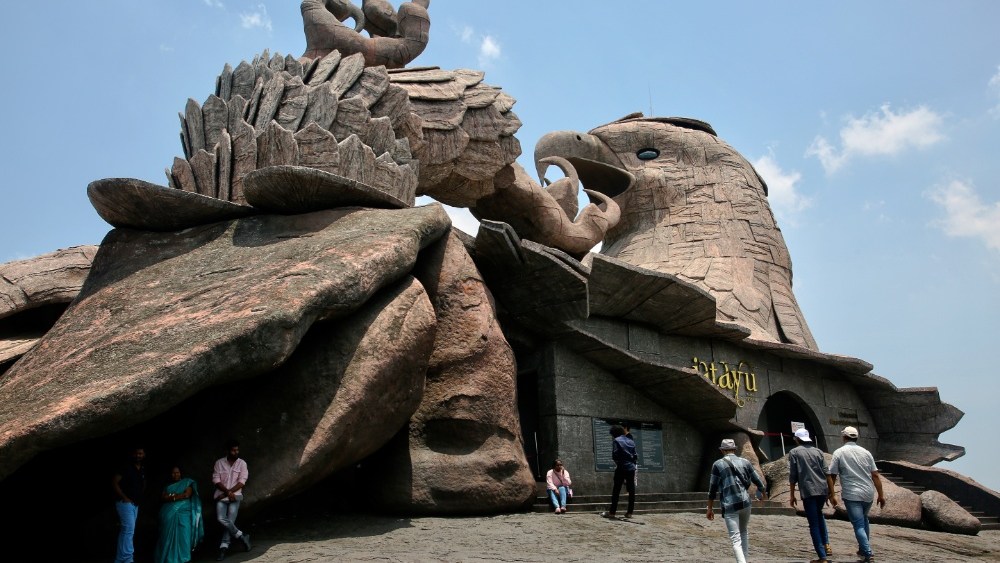
Nitesh Tiwari’s “Ramayana” has doubled visitor numbers at Kerala’s Jatayu Earth’s Center, known locally as Jatayu Rock, Ministry of Tourism joint secretary Harikishore S. told a WAVES Film Bazaar panel in Goa, where Indian officials pitched a single-window filming portal and state incentives to international producers. The site is traditionally held to be where the mythical bird Jatayu fell after battling Ravana, a fight the film depicts. Producers on the same stage said crew skill and speed give India an edge, though Sunita Ram of Rasika Pictures warned the country still lacks the studio space to keep its biggest shoots at home. The session, “Filming in India: India’s Rise as a Global Production Hub,” featured Prithul Kumar, joint secretary, broadcasting, at the Ministry of Information and Broadcasting; Harikishore; Alan McAlex, founder of Suitable Pictures (“Santosh,” “Sister Midnight”); and Ram, whose Rasika Pictures handles service production and co-productions (“A Suitable Boy,” “120 Bahadur”). Kumar said the India Cine Hub portal first went live at Film Bazaar on Nov. 21, 2015. At the time, it mainly handled film visas and permissions for foreign productions. In 2023, the ministry widened its scope after concluding that overseas producers also needed support on the ground and a way to find local resources. The portal now combines permission applications with directories of crew, equipment and services, an interactive location map, and information on state and central incentives. State governments, local administrations and central agencies including the Railways, the Archaeological Survey of India and the civil aviation authorities, which clear drone use, all sit behind the single window. Each state has a nodal officer who follows up on permissions in person, Kumar said. “It’s a hundred times more difficult than manufacturing or assembling a product because every step is a new one, and the filmmakers actually have to turn dreams into reality,” Kumar said of filmmaking. He clarified that the portal is a permissions tool rather than a networking one; collaboration between filmmakers and service providers happens on the separate WAVES Bazaar market platform. Kumar also said the Ministry of Tourism has signed a non-binding, non-commercial MoU with production houses including Netflix, Amazon and JioCinema to encourage more content about India, such as its food, rivers and forests, and to encourage them to shoot in a wider range of places. Kumar also asked filmmakers in the room to list themselves on India Cine Hub so producers anywhere in the world can find them. Harikishore said roughly 80% of what a producer needs comes from the states, with the central ministry handling the other 20%. He pointed to Madhya Pradesh, which he said pays back up to 75% of the cost of a film shot in the state. “And it is not a policy paper; they have given it to 50 people in the last two years,” Harikishore said. He said the jump in visitors at the site is set to last. In his view, what holds other locations back is a knowledge gap among state decision-makers about what productions actually want, and he proposed workshops in which producers brief officials. Kumar agreed, noting that states tend to upload only tourist landscapes to the portal. “Shooting happens in a village, it happens in a house,” Kumar said. The ministry has also asked states to pick 10 locations from past hit films and brand them, he added, citing Bekal Fort, where a song from “Bombay” was shot. Kumar said Jatayu Rock should likewise carry “Ramayana” branding. McAlex said India used to draw productions mainly when scripts had Indian stories or characters. “We had projects coming in to shoot American interiors because the actors had a very short window, so they didn’t have to go back to the U.S.,” McAlex said. He added that AI and volume stages are now opening the door to exterior work too, and that local crews and VFX facilities let productions keep everything in one place. As examples of Indian crews pulling off complex work, he cited a British Film Institute-funded project whose executives doubted a mid-day company move in Mumbai could be done. His team managed it. He also pointed to an American production on which only the director and DP flew in, and an all-Indian crew pulled off a stunt sequence on a fifth floor. Ram said international producers are now confident that Indian working standards match those of the U.K., Europe and the U.S., and that they no longer need to fly in large teams when they can mix in local crew. “Every day of shoot is like, you know, launching a rocket every day. But that’s world over, not just India,” Ram said. She tells anyone who doubts what’s possible in India that 24 hours there can equal three weeks of work elsewhere, because “we can turn things around here faster than anywhere else.” Ram added that she looks for new locations with every script. One recent project set in Mumbai ended up shooting in the small town of Karaikudi instead. “They’d never even heard of it, but it’s something you introduce, you know, with every film,” she said. WAVES Film Bazaar is the market component of the International Film Festival of India.
‘Ramayana’ Doubled Visitors at Kerala’s Jatayu Rock, Official Says as India Pitches Itself to Global Productions at WAVES Film Bazaar
Full Article
Original Source
Read the full article at Variety →KhanList aggregates and links to publicly available news content. We do not host full articles from third-party sources. Always verify important information with original sources.