
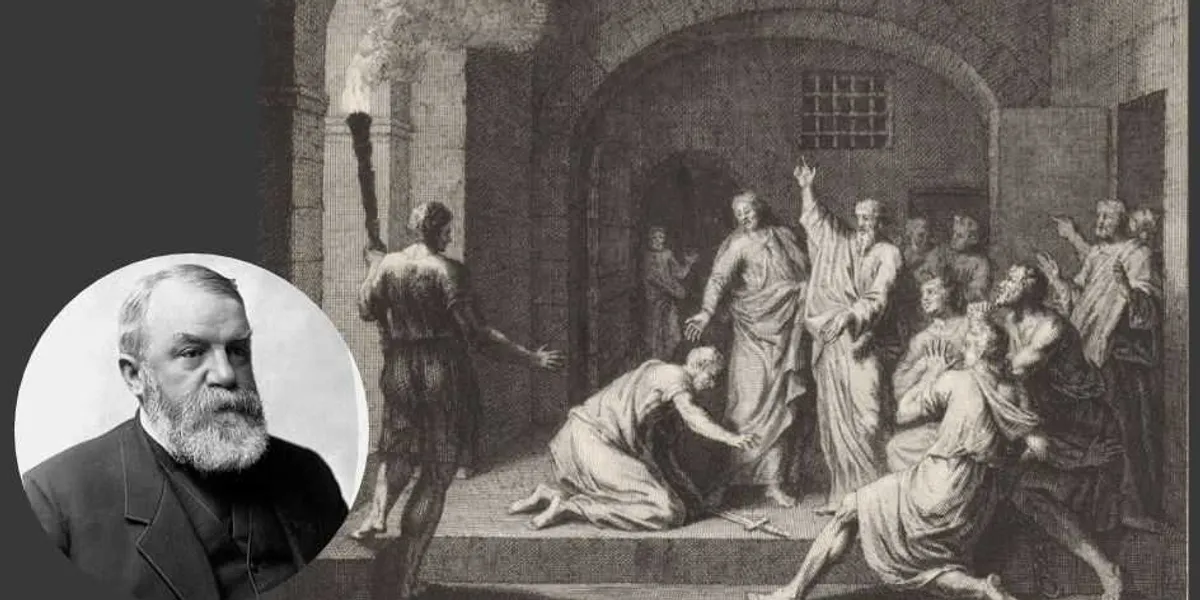
In 1884, American evangelist D.L. Moody published "Prevailing Prayer: What Hinders It?" This book examines the essential elements of Christian prayer. One chapter addressed a particularly neglected duty: giving thanks.Moody found his example in the apostle Paul, whose missionary work at Philippi established what is traditionally regarded as the first Christian church in Europe. His efforts also landed him in prison, beaten and shackled. Yet even there, Paul and his companion Silas sang hymns to God. Few could have imagined what would grow from that small congregation, as Christianity eventually transformed Europe. Years later, Paul would urge the Philippians to rejoice and give thanks even in suffering.The following is an abridged excerpt from that chapter.The next thing I would mention as an element of prayer is Thanksgiving.We ought to be more thankful for what we get from God. Perhaps some of you mothers have a child in your family who is constantly complaining — never thankful. You know that there is not much pleasure in doing anything for a child like that. If you meet with a beggar who is always grumbling, and never seems to be thankful for what you give, you very soon shut the door in his face altogether. Ingratitude is about the hardest thing we have to meet with.Remember what he suffered at Philippi; how they laid many stripes upon him, and cast him into prison. Yet every chapter in that Epistle speaks of rejoicing and giving thanks.The great English poet says:Blow, blow, thou winter wind—Thou art not so unkindAs man’s ingratitude;Thy tooth is not so keen,Because thou art not seen,Although thy breath be rude.We cannot speak too plainly of this evil, which so demeans those who are guilty of it. Even in Christians there is but too much of it to be seen. Here we are, getting blessings from God day after day; yet how little praise and thanksgiving there is in the Church of God!There is a great deal more said in the Bible about praise than prayer; yet how few praise-meetings there are! David, in his Psalms, always mixes praise with prayer.However great our difficulties, or deep even our sorrows, there is room for thankfulness.Thomas Adams has said: “Lay up in the ark of thy memory not only the pot of manna, the bread of life; but even Aaron’s rod, the very scourge of correction, wherewith thou hast been bettered. Blessed be the Lord, not only giving, but taking away, saith Job. God who sees there is no walking upon roses to heaven, puts His children into the way of discipline; and by the fire of correction eats out the rust of corruption.”Like the nightingale, we can sing in the night, and say with John Newton—Since all that I meet shall work for my good,The bitter is sweet, the medicine food;Though painful at present, ’twill cease before long,And then — oh, how pleasant! — the conqueror’s song.Among all the apostles none suffered so much as Paul; but none of them do we find so often giving thanks as he. Take his letter to the Philippians. Remember what he suffered at Philippi; how they laid many stripes upon him, and cast him into prison. Yet every chapter in that Epistle speaks of rejoicing and giving thanks.There is that well-known passage: “Be careful for nothing, but in everything, by prayer and supplication, with thanksgiving, let your requests be made known unto God.”As some one has said, there are here three precious ideas: “Careful for nothing; prayerful for everything; and thankful for anything.”We always get more by being thankful for what God has done for us. Paul says again: “We give thanks to God, the Father of our Lord Jesus Christ, praying always for you.” So he was constantly giving thanks. Take up any one of his Epistles, and you will find them full of praise to God.Even if nothing else called for thankfulness, it would always be an ample cause for it that Jesus Christ loved us, and gave Himself for us.A farmer was once found kneeling at a soldier’s grave near Nashville. Some one came to him and said: “Why do you pay so much attention to this grave? Was your son buried here?”“No,” he said. “During the war my family were all sick, I knew not how to leave them. I was drafted. One of my neighbors came over and said: ‘I will go for you; I have no family.’ He went off. He was wounded at Chickamauga. He was carried to the hospital, and there died. And, sir, I have come a great many miles, that I might write over his grave these words, ‘He died for me.’”This the believer can always say of his blessed Savior, and in the fact may well rejoice.“By Him therefore, let us offer the sacrifice of praise continually, that is, the fruit of our lips, giving thanks to His name.”
'He died for me': DL Moody on the true meaning of thanksgiving
Full Article
Original Source
Read the full article at Theblaze →KhanList aggregates and links to publicly available news content. We do not host full articles from third-party sources. Always verify important information with original sources.