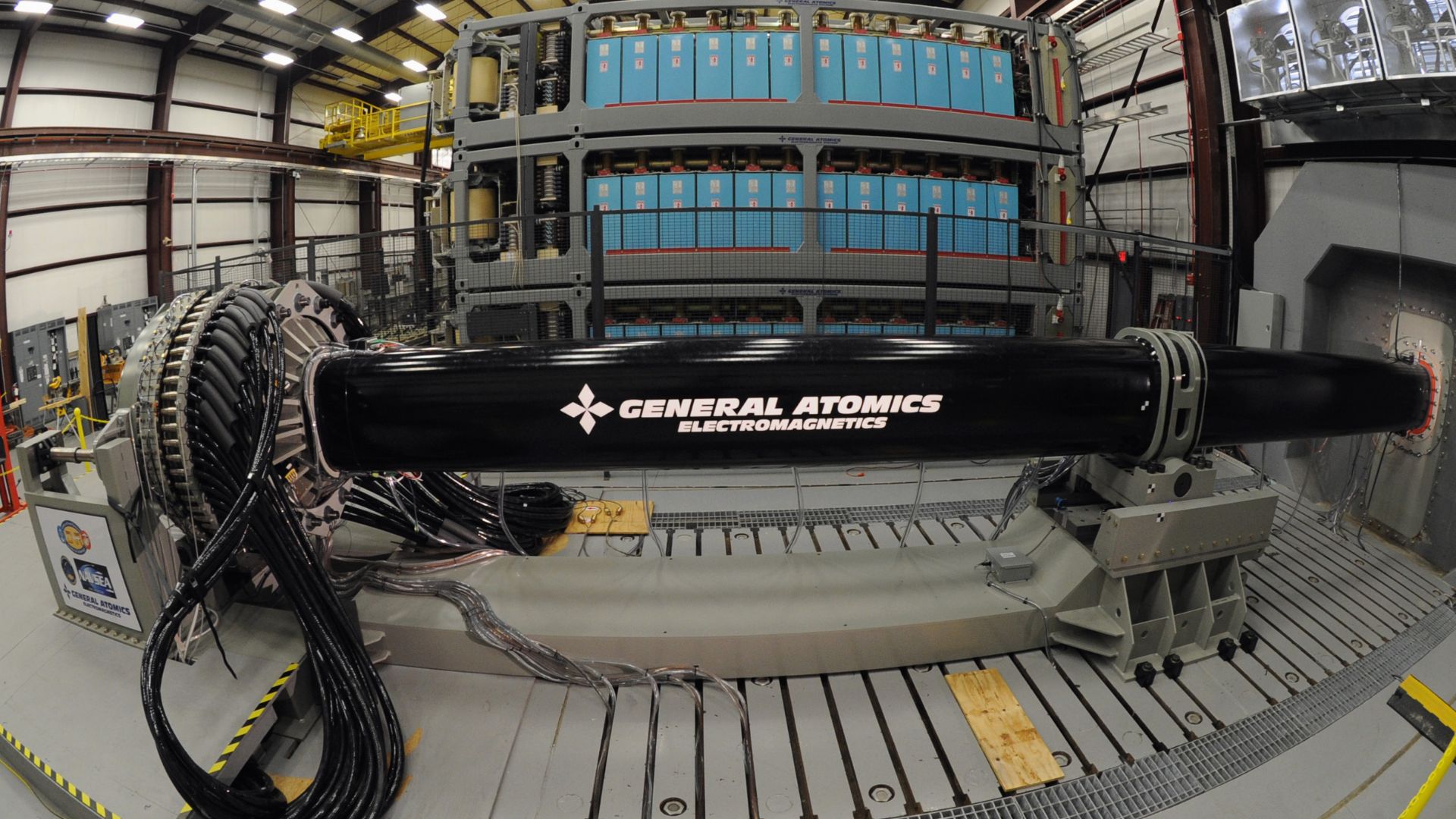
For much of the 2000s and 2010s, electromagnetic railguns were touted as the future of naval warfare. Instead of using gunpowder, these futuristic weapons would fire metal projectiles using powerful bursts of electricity, potentially reaching Mach 6-7, striking targets over 100 nautical miles (185 km) away, and doing so without carrying explosive warheads. They promised lower-cost ammunition, deep magazines, and enough kinetic energy to destroy ships, missiles, or land targets. So what happened? The answer is a mix of engineering challenges, changing military priorities, and the rapid rise of competing technologies. What is a railgun? A railgun uses electromagnetic force rather than chemical propellants to accelerate a projectile. Two parallel conductive rails carry millions of amps of electrical current, generating a powerful magnetic field that propels a metal projectile down the barrel at hypersonic speeds. Because the projectile relies almost entirely on its enormous kinetic energy instead of explosives, it can theoretically hit targets hundreds of kilometers away while reducing the amount of explosive ammunition carried aboard a warship. The U.S. Navy envisioned railguns supporting long-range naval fire support, anti-ship warfare, and eventually even missile defense. Why everyone was excited The concept appeared to solve several longstanding naval problems at once. First, cost. While a modern cruise or anti-ship missile can cost hundreds of thousands or even millions of dollars, a railgun projectile was expected to cost only tens of thousands of dollars because it contains no rocket motor or complex guidance package. Second was speed. Leaving the barrel at several times the speed of sound dramatically reduces the time defenders have to react. Finally, there was magazine depth. Since projectiles contain no explosives, ships could theoretically store far more ammunition with lower safety risks than conventional missile magazines. By the early 2010s, the Office of Naval Research had demonstrated prototypes capable of muzzle energies exceeding 30 megajoules, generating headlines around the world. The engineering turned out to be much harder As promising as the demonstrations were, turning a laboratory prototype into a reliable naval weapon proved extraordinarily difficult. The biggest issue was barrel wear. Each shot generated extreme heat, pressure, and electrical arcing that rapidly eroded the conductive rails. A practical naval weapon would need to fire repeatedly with consistent accuracy, but maintaining acceptable barrel life became one of the program’s most difficult engineering problems. Power was another major obstacle. A railgun requires enormous bursts of electrical energy delivered within milliseconds. While all-electric warships such as the Zumwalt-class destroyers were designed with sufficient electrical generation capacity in mind, integrating the weapon with the wider fleet would have required substantial modifications to existing ships. Heat management, pulsed-power storage, projectile guidance at hypersonic speeds, and maintenance requirements all added further complexity. Then the battlefield changed Perhaps the biggest reason railguns faded from the spotlight had little to do with physics. During the late 2010s and early 2020s, military priorities shifted dramatically toward hypersonic missiles, long-range precision strike weapons, autonomous systems, and directed-energy weapons. These technologies matured more quickly and addressed immediate operational requirements. At the same time, the U.S. Navy concluded that continuing to invest heavily in railguns offered less value than accelerating other next-generation weapons. After investing roughly $500 million over more than 15 years, the Navy ended dedicated funding for its electromagnetic railgun program in 2021. Is the railgun dead? Not entirely. Although the original U.S. Navy program ended, the underlying technology has not disappeared. General Atomics, one of the companies involved in earlier development, has continued refining elements of the technology and has suggested smaller railgun concepts for air and missile defense missions. Company officials have also indicated they are discussing possible future naval applications as new ship classes emerge. Meanwhile, other countries continue to pursue electromagnetic weapons. Japan has publicly demonstrated a ship-mounted railgun aboard the test ship JS Asuka, viewing the technology as a potential future countermeasure against hypersonic missiles and other advanced threats. China has also been linked to several railgun development efforts, although relatively little official information has been released. Lessons from the railgun The railgun’s story shows an important reality of military technology. Revolutionary ideas still have to compete with engineering constraints, budgets, and changing strategic priorities. Many of the technologies developed during the program, including advances in pulsed power systems, thermal management, electromagnetic launch technology, and hypersonic projectiles, continue to influence other defense programs even if the original weapon never entered operational service. Rather than becoming the dominant naval gun once envisioned, the railgun has become something different. A reminder that breakthrough concepts often take decades to mature. As electrical power generation, materials science, and energy storage continue to improve, electromagnetic weapons may yet return, but for now, missiles, lasers, and autonomous systems have largely taken the spotlight once reserved for the railgun. Recommended ArticlesKaif Shaikh is a journalist and writer passionate about turning complex information into clear, impactful stories. His writing covers technology, sustainability, geopolitics, and occasionally fiction. A graduate in Journalism and Mass Communication, his work has appeared in the Times of India and beyond. After a near-fatal experience, Kaif began seeing both stories and silences differently. Outside work, he juggles far too many projects and passions, but always makes time to read, reflect, and hold onto the thread of wonder.
Railgun: The naval weapon that’s yet to arrive
Full Article
Original Source
Read the full article at Interestingengineering →KhanList aggregates and links to publicly available news content. We do not host full articles from third-party sources. Always verify important information with original sources.