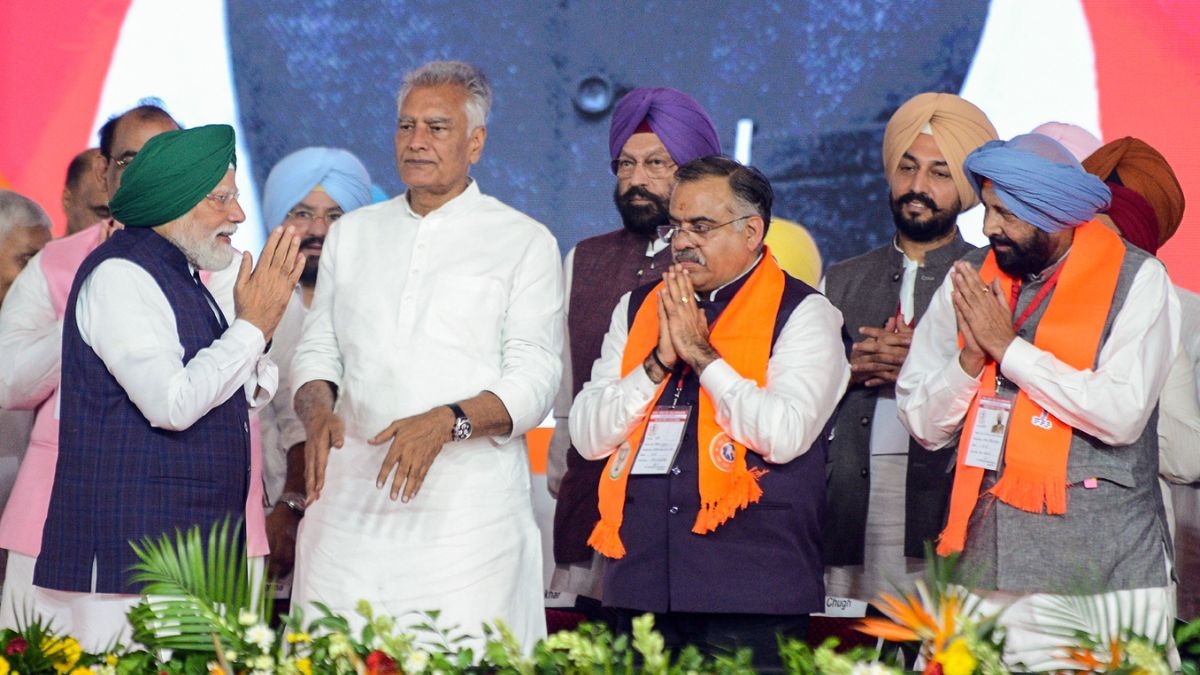
The Delhi leadership believes Punjab is the next breakthrough. The state unit's latest shake-up suggests the party may first have to rescue itselfThe BJP wanted to send a message that it was ready for the 2027 Punjab assembly elections. Instead, it ended up exposing how divided its own organisation has become.On August 3, the party unveiled a new Punjab team, appointing office-bearers across the state hierarchy, including six district presidents. Organisational reshuffles are rarely free of heartburn. But this one triggered something more serious.Within hours, senior leaders publicly questioned the appointments. Others chose to voice their discontent privately. Their target was not merely the composition of the team but the manner in which it had been put together.The criticism was directed squarely at the BJP's general secretary (organisation) Mantri Srinivaslulu, who has emerged as the principal organisational authority in Punjab. Within the state unit, leaders increasingly describe him as the man running the party's affairs. That perception has now become the source of a widening rebellion. For months, Punjab BJP's old guard has complained that loyalty no longer counts. Leaders who spent decades building the party when it remained confined largely to urban pockets say merit has given way to political expediency. Their grievance has been consistent: every round of appointments appears to favour political defectors over workers who stayed with the party through its lean years.Ironically, this time even many of those defectors are dissatisfied. The August 3 exercise was designed to accommodate the BJP's growing pool of leaders from the Congress, the Shiromani Akali Dal (SAD) and Aam Aadmi Party (AAP). Six of the party's 12 vice-presidents now come from rival parties. Yet the balancing act has pleased neither camp.The major complaint is of five crucial general secretaries. Three are from Ludhiana: Anil Sarin, Rajesh Dhiman and Parminder Brar (although his name is shown from Mohali, he concentrates on Ludhiana). The other two are Jiwan Garg (Sangrur) and Rakesh Bagha (Jalandhar). There is no representation from three Lok Sabha seats of Amritsar, Gurdaspur and Hoshiarpur, where the BJP has been contesting over the past 30 years.Veterans feel marginalised. Several recent entrants privately believe they have not been given positions commensurate with the political influence they brought into the BJP. Questions are also being raised over the lack of regional balance among key appointments, particularly the general secretaries, with leaders from different regions claiming they have been overlooked.The reshuffle was intended to consolidate the organisation. Instead, it has deepened existing fault lines. Ordinarily, such an organisational flare-up would remain a state-level story. Not in Punjab. The turmoil comes at a time when the BJP's central leadership has placed Punjab among its highest political priorities, followed by Tamil Nadu, Kerala, Telangana and Andhra Pradesh.The thinking in New Delhi is straightforward. The BJP believes Punjab's political landscape is more fluid today than at any point in the past two decades. The AAP government faces anti-incumbency. The Congress remains divided by factional rivalries. The SAD continues to struggle after the collapse of its long alliance with the BJP and the political fallout of the farmers' agitation. For the first time since the alliance broke in 2020, the BJP believes it has an opportunity to emerge as an independent pole in Punjab politics.The BJP has started realigning the formations. New state president Kewal Singh Dhillon, the first Jat Sikh to lead the party in the state, was appointed. Ravneet Singh Bittu (another Jat Sikh) didn’t get renewal of the Rajya Sabha seat. Upper caste leader Tarun Chugh was given Rajya Sabha berth from Madhya Pradesh. Party old-timer Harjit Singh Grewal was appointed chairperson of the National Commission for Minorities. The party is considering giving more space to state leaders in the national organisational set-up and berth in the Union cabinet. The idea is to lift the stature of the state unit and energise the cadre.That explains the extraordinary attention the state has received from the central leadership in recent months. Prime Minister Narendra Modi has intensified his political outreach in Punjab, including a major public rally in Jalandhar last month. Before that, BJP national general secretary (organisation) B.L. Santhosh convened a detailed organisational review of Punjab at his New Delhi residence. The meeting was attended by Union home minister Amit Shah and BJP national president Nitin Nabin, underlining how closely the party's top leadership is monitoring developments.The message from Delhi has become increasingly clear. The BJP no longer wishes to project itself as a party waiting for a reunion with the Sukhbir Singh Badal-led SAD. Instead, it wants to fight for power on its own strength. The strategy extends beyond organisation. Over the past year, the BJP has systematically expanded its social coalition in Punjab by inducting leaders from almost every major political formation. Its biggest coup came with the defection of seven of AAP’s 10 Rajya Sabha MPs, including leaders associated with the party's organisational architecture and campaign strategy. The BJP sees such acquisitions not merely as additions to its ranks but as a way of weakening its principal rivals from within.The electoral numbers also encourage optimism in Delhi. In the 2024 Lok Sabha election, the BJP secured nearly 19 per cent of the vote in Punjab, its highest independent vote share in the state after the break with SAD. More significantly, the party led in 23 assembly segments and finished second in another 12, demonstrating that its support is no longer confined to a handful of urban constituencies.While those numbers were far from enough to win parliamentary seats, the central leadership views them as evidence of an emerging political base that can be expanded over the next two years. That assessment is shaped by another experience. The assembly polls are run more on the strength of the organisation and control on the narrative, not merely on the national leadership's popularity.Inside the BJP, there is a belief that Punjab today resembles West Bengal a decade ago. There too, the party first built a respectable vote share, steadily expanded its organisation and eventually displaced older political forces to become the principal challenger and then wrest power. Punjab, many in the central leadership believe, could follow a similar trajectory.But political trajectories are rarely transferable. West Bengal offered the BJP a rapidly expanding cadre and an increasingly cohesive organisation before electoral success arrived. Punjab presents the opposite picture. The party may have discovered political opportunity, but it has yet to build organisational cohesion. That contradiction is becoming increasingly visible.Every major organisational exercise now generates fresh resentment. The old guard feels abandoned. Political entrants expect faster elevation. District leaders complain of centralised decision-making. Questions are raised over representation, regional balance and consultation. Increasingly, the debate inside Punjab BJP is not about defeating the AAP, Congress or Akali Dal. It is about who controls the organisation.The BJP for years had greater penetration among Hindus and relied on SAD to bring in the Sikh votes. The cadre was also built from the catchment areas. Now, as the party expands, pain points are emerging from the strongholds. The major pain point is that within two weeks, the party has replaced five district chiefs. The organisational churn did not end with the July 18 appointments.On August 3, even as the BJP unveiled its new state executive, it quietly issued another notification altering several district appointments. Faridkot district president Gaurav Kakkar was replaced by Sandeep Singh Brar, Hoshiarpur Rural chief Yogesh Sapra by Sanjeev Manhas, Hoshiarpur Urban president Satish Thakur ‘Bawa’ by Niten Gupta ‘Nannu’, Muktsar chief Satish Asija by Kuldeep Singh Bhangewala, and Sangrur-I president Matinder Singh by Sarjiwan Jindal. Hoshiarpur is a BJP bastion where the major revolt happened.The party also appointed Anoop Sharma as the district president for the newly created or newly filled Khanna organisational district. The changes, coming barely days after the first list of district chiefs, reinforced the perception that the Punjab BJP's organisational restructuring remains a work in progress rather than a settled exercise, lending further ammunition to critics who accuse the leadership of ad hoc decision-making.Former minister Tikshan Sud openly expressed anguish over the replacement of party’s district (urban) president Satish Bawa barely two weeks after his appointment. Bawa, considered close to Sud and former Union minister Som Parkash, has been replaced with Nitin Gupta ‘Nannu’, who is said to be the right-hand man of former state BJP chief Vijay Sampla. In Faridkot, Brar, an erstwhile close associate of Captain Amarinder Singh, replaced Kakkar.That is not merely an internal management problem. Punjab is unlike many other states where the BJP has expanded largely on the popularity of Modi and unapologetic Hindutva. The party leadership understands that local leadership, community networks, caste equations and organisational credibility continue to matter disproportionately in Punjab. Elections in the state have repeatedly rewarded parties that appear rooted in the state's social fabric rather than those driven solely by national narratives. BJP leaders in New Delhi understand this. That is precisely why the party has invested so heavily in social engineering, inducting Sikh leaders, expanding beyond its traditional urban Hindu base and recruiting influential faces from rival parties.Yet social engineering cannot substitute organisational stability. A party that seeks to become the principal alternative in Punjab cannot afford to spend its political capital firefighting internal disputes every time it announces a new team. The irony is striking. Delhi believes Punjab represents the BJP's next great expansion story. The Punjab BJP increasingly looks like an organisation still searching for itself.There is little doubt that the state's political landscape is changing. The traditional bipolar contest has weakened. Every major player carries baggage into the next election. Opportunities undoubtedly exist. But opportunities alone do not produce political breakthroughs. Organisations do. That is where the BJP's biggest challenge lies. Its national leadership appears convinced that Punjab is ready for the party. The events following the August 3 reshuffle suggest the party may not yet be ready for Punjab.Subscribe to India Today Magazine- EndsPublished By: Akshita JollyPublished On: Aug 4, 2026 18:45 IST
Punjab: Decoding the great BJP disconnect
Full Article
Original Source
Read the full article at Indiatoday →KhanList aggregates and links to publicly available news content. We do not host full articles from third-party sources. Always verify important information with original sources.