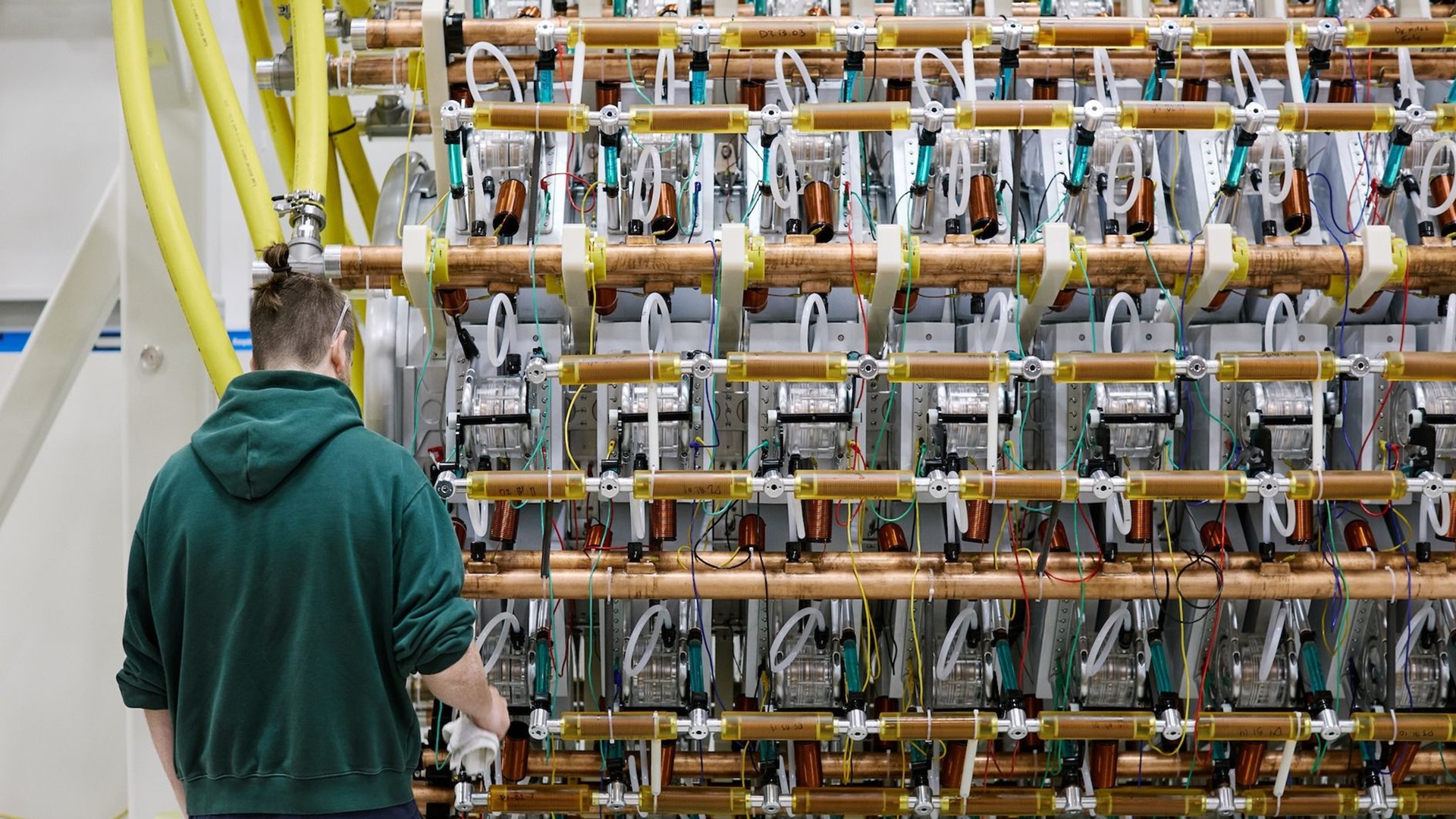
A pulsed-power prototype developed at Lawrence Livermore National Laboratory (LLNL) has completed more than 3,000 test shots, marking a key milestone for Pacific Fusion as it scales the technology for future fusion energy systems. The prototype, called Sirius, was built at LLNL under a Cooperative Research and Development Agreement with Pacific Fusion. It uses an impedance-matched Marx generator (IMG), a pulsed-power architecture designed to deliver short, high-power electrical pulses efficiently and repeatedly. According to the company, the testing campaign validated the system’s reliability over thousands of repeated shots while generating performance data that has already been used to design larger pulsed-power systems. Pacific Fusion says the milestone strengthens confidence in the technology as it works toward building a fusion system capable of achieving net facility gain by 2030. The company also plans to begin construction of its Demonstration System in Albuquerque, New Mexico, later this summer. Power pulses scale Pulsed-power systems briefly store electricity before releasing it in an intense burst lasting about 100 nanoseconds. Those pulses create the extreme conditions needed to compress fusion fuel, while also supporting high-energy-density physics experiments used in materials research, radioisotope production and national security. Unlike conventional Marx generators that stack voltages through multiple pulse-compression stages, the impedance-matched Marx generator stacks electrical waves by charging capacitors in parallel before discharging them through carefully timed stages onto a common transmission line. The company said the four-stage Sirius prototype delivered 60 gigawatts of power to a resistive load in a 100-nanosecond pulse while reaching 95% energy efficiency. Researchers at LLNL have also highlighted the design’s simpler architecture compared with conventional pulsed-power machines, which typically require multiple pulse-compression stages that add complexity and maintenance requirements. Fusion plans expand The 3,000-shot campaign primarily evaluated component lifetime and long-term reliability, producing operational data that Pacific Fusion says has guided the design of its larger pulsed-power platforms. “This is a concrete example of what government-industry collaboration can deliver when both sides are committed,” said Keith LeChien, Co-founder and Chief Technology Officer of Pacific Fusion. “We are taking innovation from the lab and moving quickly to build and scale systems that serve America’s needs. The result is a credible shot at high-yield, high-gain fusion this decade.” Pacific Fusion said it expanded the Sirius platform by roughly 11 times in a newer prototype unveiled in June. According to the company, that system delivered about 440 gigawatts of peak output power and 1.1 million volts in an 80-nanosecond pulse, making it the highest-power single-step pulsed-power driver demonstrated so far. The company is now working on a system approximately 40 times larger than Sirius. It has raised more than $1 billion in private funding and says its planned Demonstration System is designed to produce fusion bursts exceeding 100 megajoules while achieving net facility gain, meaning the fusion energy produced exceeds the stored energy used to drive the reaction. “China is moving aggressively to build the next generation of fusion infrastructure, pouring billions into new facilities,” LeChien said. “The U.S. invented many of the breakthroughs that made this moment possible here and abroad, but to win we have to build.”Recommended ArticlesGet the latest in engineering, tech, space & science - delivered daily to your inbox.With over a decade-long career in journalism, Neetika Walter has worked with The Economic Times, ANI, and Hindustan Times, covering politics, business, technology, and the clean energy sector. Passionate about contemporary culture, books, poetry, and storytelling, she brings depth and insight to her writing. When she isn’t chasing stories, she’s likely lost in a book or enjoying the company of her dogs.
Pulsed-power prototype completes 3,000 tests at 95% efficiency for future fusion plants
Full Article
Original Source
Read the full article at Interestingengineering →KhanList aggregates and links to publicly available news content. We do not host full articles from third-party sources. Always verify important information with original sources.