
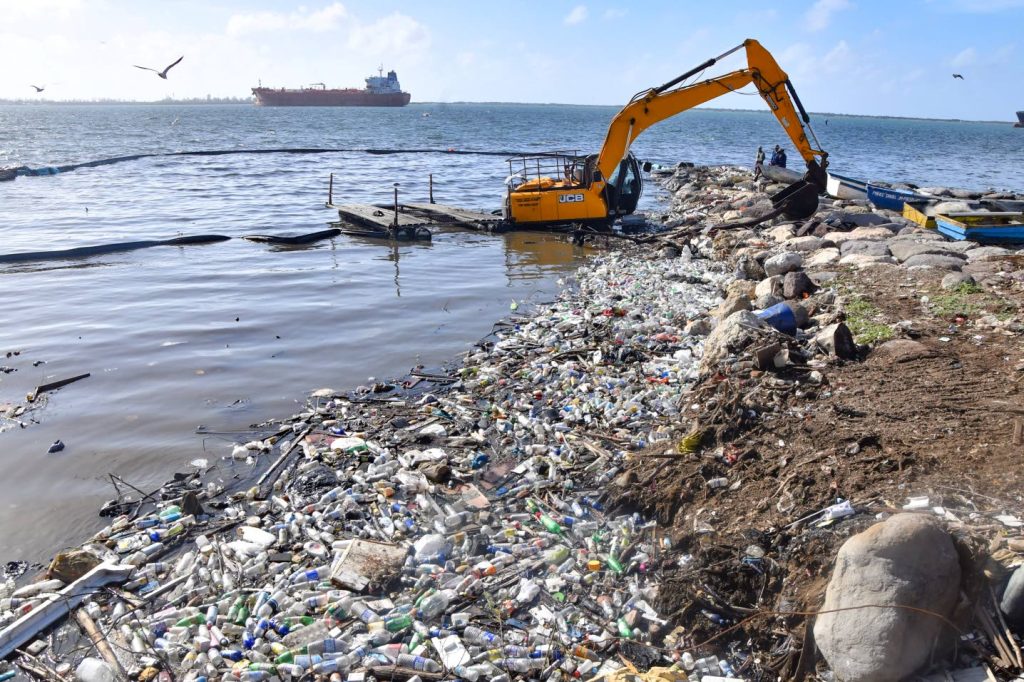
Scores of plastic bottles and other waste prevented from entering the Kingston Harbour through a private sector led-initiative. (Photo: Naphtali Junior) PRIME Minister Dr Andrew Holness has expressed pleasure at the success of an ongoing project to prevent millions of kilogrammes of plastic and other solid waste from entering Kingston Harbour over the past six years. According to Holness, this fits well with the Government’s plans for the redevelopment of downtown Kingston. The prime minister was taken on a tour of sections of the Kingston Harbour on Thursday, and was briefed on the work of the project that — since it was launched four years ago — has prevented some eight million kilogrammes or 8,000 metric tonnes of waste from entering the harbour. The forces behind the Kingston Harbour Clean-up Project — which has cost more than $1 billion since its launch — include non-profit organisations the Ocean Clean-Up, GraceKennedy Foundation, and Clean Harbours Jamaica. The project has accomplished the commendable feat by setting up unique barriers at strategic locations where discharge from drains and gullies would enter the harbour. These barriers trap the waste, then special teams using boats and other units remove the garbage, which is then taken to land where it is sorted and disposed of. Barriers have been placed at the mouths of nine gullies which drain into the harbour — Sandy, Shoemaker, Mountain View, D’Aguilar, Tivoli, Balmagie, Rae Town, Barnes, and the Kingston Pen. “There is a plan to redevelop the waterfront of the Kingston Harbour. The plan is very ambitious. It involves a harbour walk, which starts just at almost where the craft market is, coming all the way around to where the airport is. We intend to create a walkable and runnable harbour, a linear garden, open spaces, and public spaces for the citizens to be able to interface, interact, recreate, conduct business meetings and gatherings on the waterfront,” said Holness as he indicated how a cleaner harbour will interact with the downtown Kingston redevelopment plans which have been many years in the making. Prime Minister Dr Andrew Holness (fourth right) and Minister of Environment Matthew Samuda (third right) point to tonnes of garbage which have been prevented from entering the Kingston Harbour during a tour on Thursday. They are joined by representatives of the entities which are carrying out the Kingston Harbour Clean-up Project. (Photo: Naphtali Junior) Holness commended the entities leading the project for seeing the importance of a clean harbour and taking steps to fix the problem of pollution. “The funding is largely private, and that ought to be noted, but the effort of Government in the facilitation of, and in the support, has an economic value to make the project effective. All partners share the concern about non-degradable and some degradable waste entering the harbour. This project, taking out eight million kilogrammes of waste out of the harbour is a significant impact,” the prime minister added. Minister of Water, Environment, and Climate Change Matthew Samuda pointed out that as a result of the project, and other initiatives that are to come, “We are well on the way to making Kingston Harbour blue again.” Samuda pointed to a lecture that was given recently by Professor Mona Webber, which zoomed in on the impact that non-degradable waste, especially, has on mangroves. He noted that the work to remove waste from the harbour has already started producing measureable results. “It’s the first time we have had the level of growth and survival rate that we are seeing with the new mangroves that are being planted along the coastal area for protection. It is a measurable impact that even the UN Marine Biology Department is seeing,” said Samuda. Meanwhile, Nisha Bakker, director of partnerships at Ocean Clean-Up, said the results of the studies and surveys being done to see the full extent of the positive impact of the clean-up are not yet available. Garbage, garbage and more garbage is seen in the basket at the mouth of Sandy Gully in recent days. (Photo: Naphtali Junior) However, she pointed out that there are some obvious and very positive effects on fish populations. “We’re seeing mangrove restoration and improved biodiversity. We hope by the longer term that this will also be positive for real estate value and economic growth,” she said. Frank James, chief executive officer of GraceKennedy Group, described the project as one of the greatest examples of public-private partnership. “That beautiful harbour that we are looking at has eight million kilogrammes less waste than it would have without this project,” said James as he expressed gratitude to numerous government agencies which have facilitated the mission. He underscored that outside of the fact that GraceKennedy sees the national good in having its foundation partner on such a project, he couldn’t help but acknowledge that the harbour is basically the company’s backyard. “As you know, the Kingston Harbour is really our backyard, so it is very personal for us as well. But, importantly, we recognise that the harbour is bigger than us. You will note the name of the project does not have GraceKennedy in it. It is the Kingston Harbour Clean-up Project. We are very happy to have the Ocean Clean-Up, who have been really tremendous in the amount of funding and expertise that they have brought to the table and also Clean Harbours Jamaica, the people who make it happen every day on the ground. “The project directly impacts, livelihoods of people. We are talking about the fisheries industry, which is a key part of it. We are talking about marine life, the mangroves. We need nothing more than Hurricane Melissa to demonstrate the importance of the mangroves in protecting the seashore and making sure we are able to protect the land and also that we build a marine biodiversity,” added James.
Project blue for Kingston Harbour
Full Article
Original Source
Read the full article at Jamaicaobserver →KhanList aggregates and links to publicly available news content. We do not host full articles from third-party sources. Always verify important information with original sources.