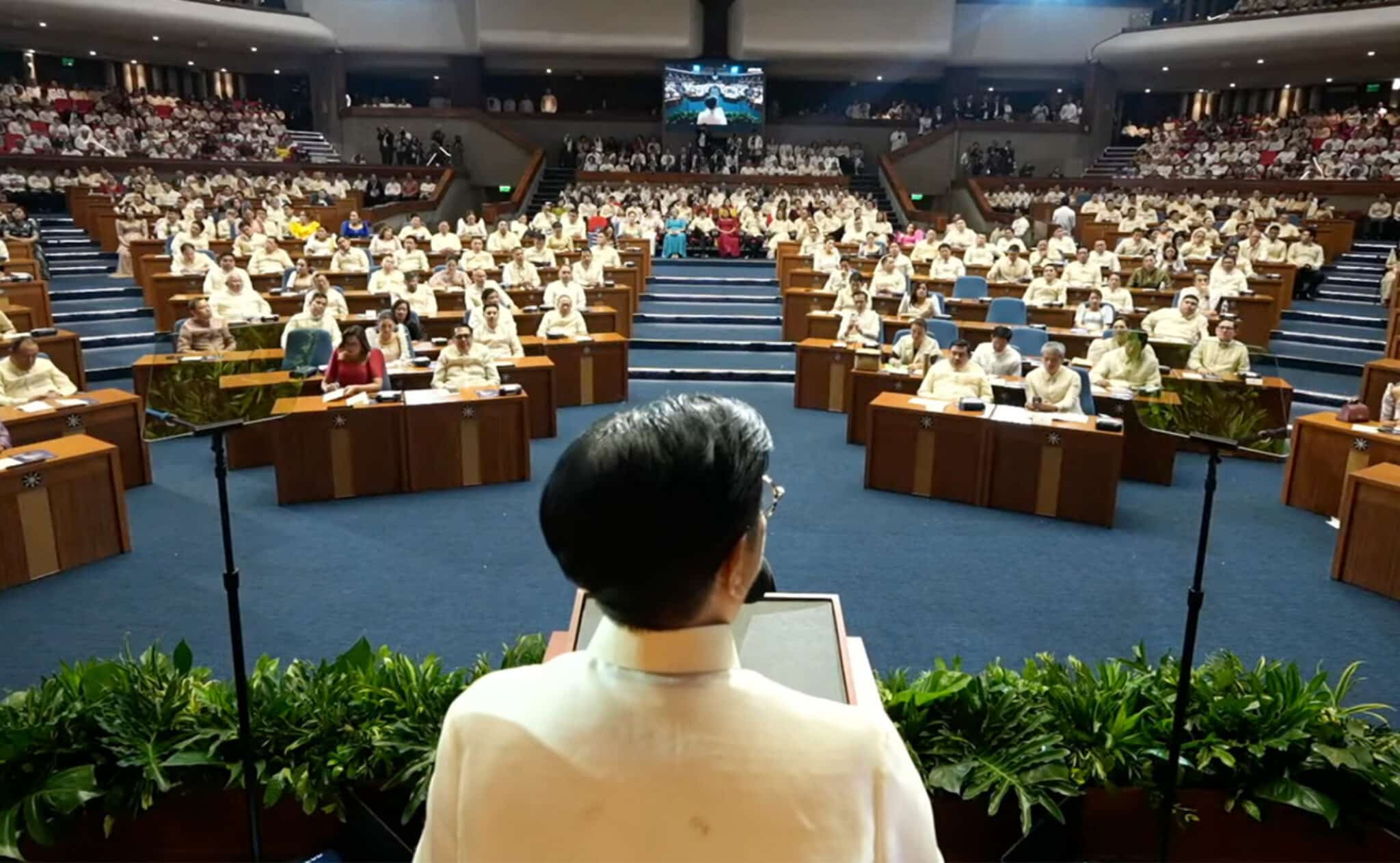
President Ferdinand Marcos Jr. delivers his fourth State of the Nation Address on July 28, 2025 at the House of Representatives. (Screengrab from RTVM Malacañang) MANILA, Philippines — The language Philippine presidents use in their State of the Nation Addresses (Sona) has shifted over the decades, with Filipino playing a much larger role in speeches once delivered overwhelmingly in English, according to an analysis by a University of the Philippines Diliman data scientist. Dr. Rogelio Alicor Panao, who is also an Inquirer data scientist, found that before the 1986 Edsa People Power Revolution, English accounted for roughly 95 percent of the classified words used in presidential Sonas. Filipino appeared only sparingly, largely for emphasis or ceremonial purposes. Article continues after this advertisement Four decades later, however, code-switching has become a regular feature of the annual address, with presidents increasingly using Filipino alongside English. The findings come ahead of President Ferdinand Marcos Jr.’s fifth Sona, scheduled for July 27, when he is expected to present his administration’s accomplishments, priorities and legislative agenda before a joint session of Congress. READ: Marcos’ 5th Sona to be ‘simple yet dignified,’ says Palace Panao said the evolution of language reflects broader changes in the role of the Sona itself. “State of the Nation Addresses have always been political. Increasingly, however, they have also become more Filipino,” he said in the analysis. Article continues after this advertisement From English to code-switching According to Panao, presidential Sonas before 1986 were delivered almost entirely in English. “Before the 1986 Edsa People Power Revolution, English accounted for roughly 95 percent of the classified words in presidential Sonas. Filipino appeared only occasionally, largely for emphasis or ceremonial effect,” he said. Article continues after this advertisement The transition unfolded gradually over successive administrations. Panao’s analysis showed that former President Gloria Macapagal Arroyo’s final four Sonas, from 2006 to 2009, averaged 26.6 percent Filipino, helping normalize code-switching in what had long been an English-dominated format. Former President Benigno Aquino III then delivered his first two Sonas predominantly in Filipino. Filipino accounted for 90.6 percent of the classified words in 2010 and 91.8 percent in 2011. READ: Figures of (that) speech: Some Sona trivia According to Panao, this reinforced Aquino’s “Daang Matuwid” message that he was speaking directly to “ang mga boss ko” — “my bosses” — referring to the Filipino people as the government’s ultimate authority. Former President Rodrigo Duterte, meanwhile, adopted a more balanced mix of English and conversational Filipino. Filipino accounted for 30.1 percent of his 2016 Sona, 23.3 percent in 2017, 6.6 percent in 2018, 21 percent in 2019, 15.9 percent in 2020 and 24.7 percent in 2021. His speeches also frequently included Cebuano expressions. For Marcos, the share of Filipino in his Sonas rose from 26.7 percent in 2022 to 28.9 percent in 2023 and 37.4 percent in 2024 before reaching 85.1 percent in 2025, according to the analysis. More than a linguistic shift Panao said the figures illustrate how the annual presidential address has evolved. “These shifts mirror the changing role of the Sona itself. Once primarily a constitutional report to Congress, it has become a nationally televised address aimed as much at the electorate as at legislators,” he said. He said the trend is also consistent with theories of populist communication. “Consistent with theories of populist communication, code-switching narrows the symbolic distance between leaders and ‘the people.’ English continues to signal technocratic authority, while Filipino — and in Duterte’s case, occasional Cebuano — projects familiarity and shared identity,” Panao said. He added that the trend should be viewed as part of a broader evolution in political communication rather than simply as a change in language preference. “The growing prominence of Filipino in presidential Sonas therefore reflects not merely a linguistic shift, but a broader transformation in how Philippine presidents perform political representation.” The analysis aligns with the language Marcos used in his Sona last year. READ: Full transcript: Marcos’ fourth State of the Nation Address, July 28, 2025 After opening with the greeting, “Mga kababayan, magandang hapon po sa inyong lahat” — “My fellow countrymen, good afternoon to you all” — the President delivered much of his speech in Filipino. He discussed issues ranging from the economy and agriculture to education, health care, infrastructure and governance. English appeared primarily in portions addressing international relations, investment promotion and selected policy statements. Among the English passages were his message to investors — “The Philippines is ready. Invest in the Filipino” — and his foreign policy statement: “The Philippines is a friend to all. The Philippines is an enemy to none.” Ahead of the fifth Sona Marcos is expected to deliver his fifth Sona before a joint session of Congress at the House of Representatives on Monday, July 27. Preparations for this year’s address have been intentionally understated. Palace Press Officer Claire Castro said there would be no celebrity directors or “big A-listers” performing during the program, describing it as “simple but dignified.” House Secretary General Cheloy Garafil likewise said organizers were keeping preparations “simple but dignified,” with no red carpet and guests encouraged to wear modest clothing “in keeping with the times.” READ: Simplicity to define Marcos’ 5th Sona as House kicks off preparations Your subscription could not be saved. Please try again. Your subscription has been successful. As Marcos prepares to deliver his fifth Sona, Panao’s analysis documents how the language used in presidential addresses has changed across administrations. The analysis argues that these shifts parallel the Sona’s evolution from a constitutional report to Congress into a nationally televised address aimed at both lawmakers and the broader public. /dm Visit our Sona 2025 live coverage to stay updated with the latest #SONA2025 news and stories.
Presidential Sonas shift from English to more Filipino – analyst
Full Article
Original Source
Read the full article at Newsinfo →KhanList aggregates and links to publicly available news content. We do not host full articles from third-party sources. Always verify important information with original sources.