
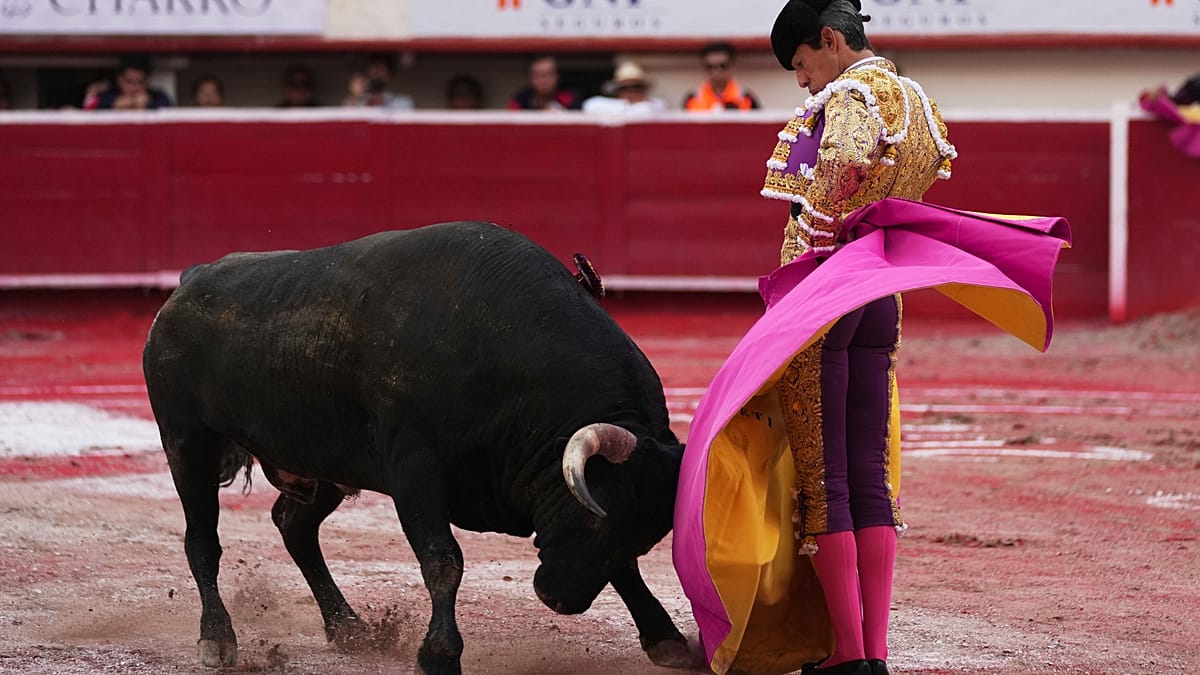
Bullfights are set to return to Portuguese television in 2027, after a six-year absence from the schedule of public broadcaster RTP. Like bullfighting itself, the decision approved by parliament is far from consensual and is being widely challenged, with a petition already gathering more than 86,000 signatures against forcing bullfights into the channel's television programming. ADVERTISEMENT ADVERTISEMENT At the root of the backlash is a proposal from the far-right Chega party requiring public broadcaster RTP to ensure the broadcast of bullfighting events. The proposal was approved during the line-by-line votes on the State Budget for 2027, with votes in favour from the centre-right Social Democratic Party (PSD), the conservative CDS-PP and Chega, with the Socialist Party (PS) initially abstaining. The PS later switched to voting against when the measure was taken to the plenary at the request of People-Animals-Nature (PAN), but the majority confirmed the proposal, despite the other opposition parties voting against. The same PSD, CDS-PP and Chega majority had already lowered VAT on bullfight tickets from 23% to 6% in the State Budget for 2025. The Chega initiative now approved stipulates that, during 2027, RTP "shall ensure, in fulfilment of the public service obligations incumbent on it under the concession contract in force, the broadcast of bullfighting events on its television programme services, as part of the heritage of Portuguese popular culture". The proposal also stipulates that it is for RTP, in exercising its editorial autonomy and safeguarding the independence laid down in the Constitution, to choose which events to broadcast, as well as which programme services to use and the time slots for their transmission. The measure must be implemented at no additional cost to the State Budget, and RTP will have to inform parliament, by 31 January 2028, of the events broadcast and their audience figures. The parliamentary decision has triggered a strong internal reaction at RTP. In comments to Portuguese radio station TSF (source in Portuguese), Nicolau Santos, chair of RTP's board of directors, described the measure as a violation of the Television Law, saying it was an attempt to interfere with the channel's editorial autonomy. "After consulting our legal department, this guidance violates the provisions of the Television Law," said Santos, referring to article 26 of the legislation in question. "Except in the cases provided for in this law, the activity of television and on-demand audiovisual services is based on freedom of programming, and the public administration or any security body, with the exception of the courts, cannot prevent, condition or impose the broadcasting of any programmes," Santos said, quoting the law. In light of that provision, he argued that "this decision requires a change to the Television Law, which is currently in force, and in that sense MPs will also have to work to amend the Television Law". Speaking to TSF, Santos also said that RTP will defend its editorial autonomy, both in news and in programming. He indicated that the channel's concession contract, which defends animal welfare, will also have to be amended before public television can broadcast bullfights again. "This seems extremely serious to me. It opens a Pandora's box and I think that, surely, there will be very deep reflection on this measure," he said. The reaction from RTP's Workers' Committee and the Porto Workers' Subcommittee went even further, saying the proposal constitutes an "attack on the company's autonomy" and a "dangerous and outdated intrusion of political power" into the editorial decisions of a media outlet. "It is yet another episode in the context of the suffocation to which the public media service in Portugal has been subjected (...) Today it is bullfights. Tomorrow it could be any other content that a given party believes should be part of RTP's programming," they warned in a statement quoted by the Portuguese news agency Lusa. For the workers, the proposal in question clashes with the Television Law, which establishes freedom of programming and safeguards that no sovereign body can prevent or impose the broadcasting of particular programmes. The statement also notes that RTP's concession contract enshrines independence and autonomy in setting programming. Added to this is the evolution of the legal framework on animal protection. In addition, RTP's Workers' Committee warns that individual rights are also at stake, given that the Constitution enshrines the inviolability of freedom of conscience and the Labour Code recognises that employers and workers have the right to their physical and moral integrity. "A parliamentary imposition does not remove the rights of those who work at RTP, nor does it exempt the company from listening to and considering its professionals' concerns," they stressed in a statement, adding that "RTP cannot have its content scheduled according to parliamentary majorities". The protests also extend to a public petition (source in Portuguese) against the mandatory broadcasting of bullfights on RTP, which has already passed 86,000 signatures and continues to gain signatories at a rapid pace. In the text of the petition, the organisers emphasise that the debate is not about "removing the individual freedom of those who enjoy or wish to watch" bullfighting shows, but rather "questioning whether the State should compel the public television service to broadcast them, regardless of their relevance to the public service mission and the wishes of a significant part of the population". "Bullfighting is a controversial practice that involves animal suffering and whose television broadcasting should not be imposed by political decision, much less through an obligation placed on a public operator funded by taxpayers," the petition organisers argue. They also contend that RTP "should have editorial autonomy to decide the content it broadcasts, in line with its programming criteria and public responsibility, without political impositions of this kind". "A tradition, however old it may be, is not above democratic debate, evolving social values and concern for the suffering of animals," they stress. ERC says broadcasting is an editorial decision Although parliament has approved Chega's proposal to ensure that RTP broadcasts bullfights, the media regulator, the Entidade Reguladora para a Comunicação Social (ERC), believes that the decision to broadcast them falls within RTP's editorial freedom and freedom of programming. In a reply to Lusa, ERC reiterates that article 26 of the Television Law "enshrines the principle of freedom of programming, establishing that, except in the cases provided for in the law itself, no sovereign body, with the exception of the courts, may prevent, condition or impose the broadcasting of any programmes". The body recalls that "prior to approval of the proposal from Chega's parliamentary group, in response to requests for information on the issue, the regulatory council expressed the view that neither the LTSAP nor the Public Media Service Concession Contract sets out any specific obligation regarding the broadcasting of bullfighting events". The LTSAP is the Law on Television and On-Demand Audiovisual Services. The ERC concluded that broadcasting bullfights is therefore an editorial decision for RTP to make. For that reason, ERC states that it "will follow the conclusion of the legislative process under way and, in due course, will assess the issue in light of the powers conferred on it by law". Last live bullfight in 2020 According to data from Portugal's Inspectorate General for Cultural Activities, 147 bullfighting events (source in Portuguese) were held in mainland Portugal in 2025, more than half of them in Alentejo, in the south of the country. RTP stopped broadcasting bullfights after the 2020 season. In that year, marked by the COVID-19 pandemic, it broadcast only two bullfights (source in Portuguese): one at the Monforte bullring on 28 August, and the Harvest Bullfight at the Almeirim Arena on 11 September. In 2021, the public broadcaster dropped bullfighting from its schedule altogether, in line with other public service broadcasters abroad. The Spanish public broadcaster RTVE had already taken a similar decision several years earlier, although it carried out occasional broadcasts during the process that led to these programmes being removed from the broadcaster's schedule. From 2006 onwards, RTVE stopped regular broadcasts of bullfights because of the high cost of television rights, low audience figures and clashes with the time slot reserved for protecting children. Then, in 2011, the broadcaster published a new stylebook (source in Spanish) that expressly excluded bullfight broadcasts because they involve violence against animals and clash with the protection of minors. Between 2012 and 2016, after a change in legislation and management (source in Spanish), RTVE broadcast a handful of bullfights, including in Valladolid, Spain, in September 2012, in Cáceres in 2015, and a charity bullfight for Asprona in Albacete. It has had no regular bullfight broadcasts since, although it still shows the encierros (bull runs) during the San Fermín festival in Pamplona. Today, bullfights are broadcast via specialist platforms and pay services. Even so, bullfighting still has an occasional presence on the public television channels of five Spanish regions (autonomous communities) (source in Spanish), as well as on private broadcaster Castilla y León TV. Bullfights are shown on Telemadrid, Canal Sur, Castilla-La Mancha Media, Aragón TV and Canal Extremadura.
Portugal's parliament orders public TV to air bullfights again, sparking 86,000-name petition
Full Article
Original Source
Read the full article at Euronews →KhanList aggregates and links to publicly available news content. We do not host full articles from third-party sources. Always verify important information with original sources.