
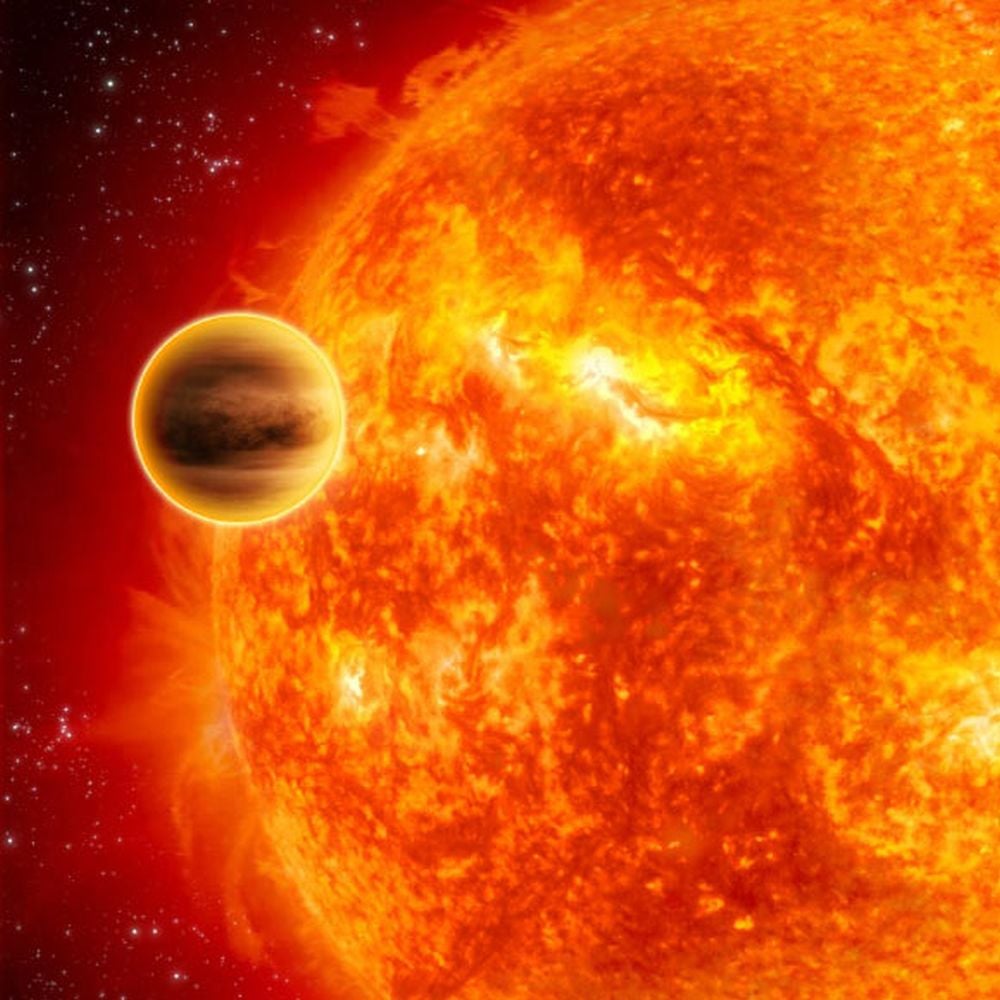
NASA's TESS mission was a success by almost any measure. So far, as of mid-October 2026, it's identified more than 8,100 candidate exoplanets, and just over 1,000 of them have been confirmed. The mission is still ongoing, and astronomers are also finding more exoplanets in its archival data with new machine learning techniques. TESS was primarily aimed at finding smaller super-Earths and sub-Neptunes, but it also found many hot-Jupiters during its mission. One of them, about 1,000 light years away, is a hot Jupiter named TOI-2535b and it exhibited some strange behaviour. TESS observed multiple transits by TOI-2535b over seven years, then the planet seemed to just disappear. Planets can't just disappear, unless the Death Star is nearby, and astronomers have wondered what's behind the hot Jupiter's disappearing act. New research in The Astrophysical Journal Letters has a natural explanation for the vanished star. It's titled "A TESS Disappearing Act: The Vanishing Transits of TOI-2535 b," and the corresponding author is Samuel Yee, a postdoctoral fellow at UCLA. "Planetary transits require a fortuitous alignment between a planet’s orbit and our line of sight, but dynamical interactions can render this geometric coincidence only temporary," the authors write in their research letter. "We report the discovery of the hot Jupiter TOI-2535b, the first confirmed planet orbiting a single star whose transits have been directly observed to disappear." Detecting planets via the transit method only works if everything lines up, as the authors explain. But everything doesn't necessarily stay lined up. Dynamical interactions abound in solar systems, as we know from our own Solar System's history. Giant planets have migrated, ending old, stable orbital patterns and heralding new ones. Interactions can scatter smaller objects, and even send comets careening into the inner Solar System. But a massive shift isn't required to upset the finely-tuned line of sight that allows us to see distant exoplanets as they transit their stars. "Because a planet is only observed to transit when its orbit normal is within a few degrees of the sky plane, even small changes in a planet’s orbital inclination can result in measurable changes in its transit shape," the authors explain. "For sufficiently large inclination changes, a planet may only have the correct transit geometry for a fraction of its dynamical evolution." Here's the kicker: "If the variation is fast enough and we are lucky to catch the planet in the right phase of its inclination evolution, we may see its transits appear or disappear," the researchers write. This figure presents some of the research's findings. The first panel shows TESS transits from sectors 10, 63, and 90. Sectors are rectangular strips of the sky that TESS observes. The second panel shows the movement of the transit chord across the stellar disk. The dark circle shows TOI-2535b's size relative to its star. Image Credit: Samuel W. Yee et al 2026 ApJL 1011 L60 That's what happened with TOI-2535b, according to this work, and it's probably because of another exoplanet interacting with the hot Jupiter. By watching it over several years, astronomers observed TOI-2535b's orbit in detail. It didn't just suddenly disappear. Both the timing and the shape of the transit slowly changed. This can happen with circumbinary exoplanets, those that orbit a binary star. "Circumbinary planets frequently exhibit rapid changes in their transit impact parameters," the authors write. "As a result, even a small misalignment between the two orbits leads to intervals when the planet may transit both, one, or neither of its host stars." But TOI-2535b orbits a single star, making its disappearance extremely unusual. "Around single stars, inclination variations of planets are typically less dramatic and appear to be relatively rare," the researchers explain. But that's what seems to be happening here due to the influence of another exoplanet. “We think of the universe as resembling clockwork, where everything is regular, but that’s not true. If there are multiple planets in a system, they can affect each other’s orbits. We know of a few systems that are like this,” said Yee. “This is the most extreme example we’ve seen because the two planets are interacting so strongly. The planet’s orbit is tilting so quickly that its transit disappeared while we were watching.” This work rests partly on what are called Transit Duration Variations (TDV). These are small yet measurable and periodic changes in the amount of time it takes for an exoplanet to complete a transit in front of its star. TOI-2535b's TDVs are unusual, according to the authors, and so are the changes in its orbital inclination. "The TOI-2535 system is an unusual and exceptional system in many ways. Observationally, it has the largest TDVs and inclination change ever observed for a planet orbiting a single star, with a precession period of decades, shorter than other known systems," the authors explain. The system also has some of the largest Transit Timing Variations (TTVs) ever detected, and they're definitely the largest ever detected for a hot Jupiter. The researchers say that another, neighbouring exoplanet of Saturn-mass or greater is tugging on the exoplanet's orbit, making it "disappear." This is surprising, since hot Jupiter's aren't expected to have any close neighbours. In the rare cases where they do have neighbours, the neighbours are quite a bit less massive. "This makes TOI-2535b one of only a handful of hot Jupiters known to have a close-by planetary companion. Furthermore, the companion to TOI-2535b is likely a second short-period giant planet. This differs from all but one of the currently known hot Jupiters with a nearby companion, in which the companions are sub-Neptunes or super-Earths," the authors write. A pair of massive gas giants orbiting one system in resonance with each other isn't something planet-formation models predict. The authors rule out high-eccentricity migration as a cause. "Such systems could not have formed through high-eccentricity migration, which has been posited to be responsible for most other hot Jupiters," the authors write. But there are two other migration possibilities. In one, the planet is pulled into an eccentric orbit by a powerful interaction of some sort, possibly a near collision with another object, and then the star's gravity pulls it in, where it takes up residence as a hot Jupiter. The second scenario sees the planet pulled into the inner solar system with other planets inside the protoplanetary disk. But that counterindicates the observed orbital tilts. "However, the protoplanetary disk would also quickly damp the inclinations of the two planets, requiring some later excitation to explain the nonzero inclination required by the TDVs," the authors write. An illustration of a protoplanetary disk. It's possible that the planet was pulled into the inner system with other planets inside the protoplanetary disk. But disks tend to flatten orbital inclinations. So something else would've had to happen to explain the exoplanet inclinations. Image Credit: NASA/JPL-Caltech/T. Pyle (SSC) - February, 2005 There are other possibilities, but they're outliers that "only operate in specific regions of the space of possible planetary orbital parameters," and only an accurate understanding of the system's overall architecture could confirm any of them. The researchers don't have that yet. These are the types of solar system architectures that intrigue astronomers because they hint at new processes. Somehow, components of the system have interacted in ways that have produced a very unusual situation: a pair of massive planets close to their star. Not only that, but we can watch their interactions play out over only a few years, which is very rare. "Our dynamical modeling reveals that the perturber is likely of Saturn-mass or greater and in a mean-motion resonance with TOI-2535b, making this an unusual system that contains two short-period giant planets," the authors write. "The TDVs measured for TOI-2535b represent one of the most extreme examples of planet–planet interactions driving orbital evolution on human timescales." If there were only a single close-in planet, a more ready explanation would offer itself. But because there's a pair, the researchers have to reach further for an explanation. “Because TOI-2535 b has a close neighbor, it probably migrated by slowly spiraling in instead of getting flung in,” Yee said. “We may be seeing a formation channel that doesn’t happen very often but is very interesting.”
Planets Don't Just Disappear, But They Can Wobble Out of Sight if Their Neighbour is Close Enough
Full Article
Original Source
Read the full article at Universetoday →KhanList aggregates and links to publicly available news content. We do not host full articles from third-party sources. Always verify important information with original sources.