
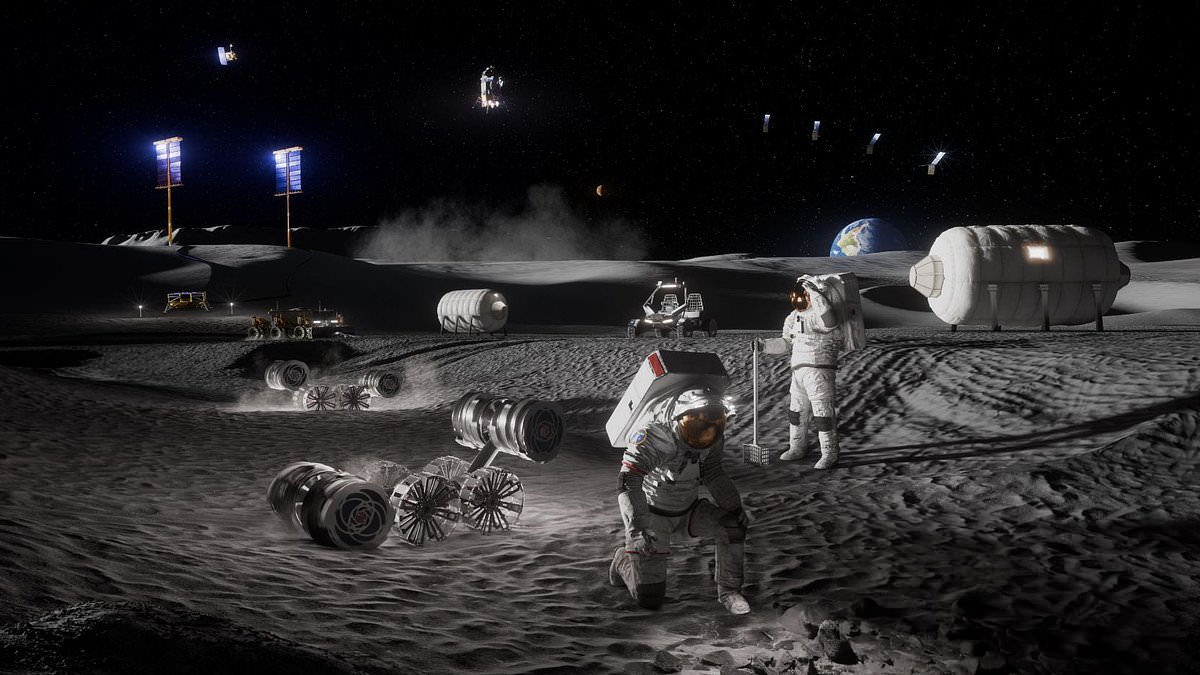
NASA has unveiled ambitious plans to build a base on the moon by 2032, where astronauts will be able to live and work for an 'extended period'.The space agency revealed a swath of new contracts at its Max Power event at the Kennedy Space Center in Florida, its first-ever aerospace technology expo.The biggest announcements included advancements in robotic deliveries, a nuclear-powered lunar rover, and the first steps towards building infrastructure for the moon's surface.All of that will be supported by huge investments in 'long-distance freight trucks' for space to haul heavy cargo out to lunar orbit.NASA's goal is now to have all the raw materials and equipment waiting in place by the time that humans start establishing a permanent presence on our lunar satellite.However, with the next Artemis mission currently scheduled for 2027 and a moon landing in 2028, NASA has set itself an extremely tight deadline.To meet the 2032 target, initially set by the Ignition Initiative in March, the agency will rely heavily on commercial aerospace companies to provide everything from rockets to landers.NASA administrator Jared Isaacman said at the Max Power event: 'When our astronauts return to the Moon, they will arrive with the first elements of the Moon Base already waiting for them on the surface.' NASA's current goal is to have all the cargo and equipment needed already waiting on the lunar surface by the time humans arrive in the 2030s. Pictured: Artist's impression of a lunar base Eight months ago, NASA launched Ignition and brought in a dramatic change to its plans for a lunar outpost.The space agency officially abandoned the long-imperilled lunar orbiter, Lunar Gateway, in favour of going straight to the moon's surface.The new moon mission was slated to take place in three phases over the coming years.Phase one would be to replace one-off launches with a 'templated approach' to speed up mission development, and start exploring the moon with robotic missions.Phase two would be to create a 'semi-habitable infrastructure' on the lunar surface, while phase three expands that infrastructure into a permanent moon base.At the time, NASA's timeline for these missions was vague and little detail was given on how they would be established.But now, NASA is putting significant investment behind commercial companies to start delivering real progress towards an American base on the moon.The agency has made deals with numerous companies, including Blue Origin, SpaceX, Northrop Grumman, Lockheed Martin, Intuitive Machines, Firefly Aerospace, Voyager Technologies, and ispace-US. NASA has unveiled ambitious plans to build a base on the moon by 2032, where astronauts will be able to live and work for an 'extended period' (artist's impression) NASA administrator Jared Isaacman (pictured) says that the space ageny's astronauts will 'arrive with the first elements of the Moon Base already waiting for them on the surface'Carlos García-Galán, manager of NASA's Moon Base Programme, says: 'We've consolidated numerous efforts into a streamlined program, evolving our human exploration architecture into an iterative and sustained campaign for Moon Base technology development and implementation.'Most importantly, we've taken action, awarding new contracts and forging new partnerships to accelerate development.'The biggest of those is a 10-year, multiple-award contract with a combined value of $10billion (£7.5billion) to provide lunar deliveries, including managing, building and operating landers.This contract, dubbed CLPS 2, is the next phase of the Commercial Lunar Payload Services (CLPS).NASA has also expanded the original CLPS contract, CLPS 1.0, from $2.6billion (£1.95billion) to $4.2billion (£3.15billion) to support Phase One moon missions.The agency is also planning how to explore more of the lunar surface with a nuclear-powered rover called the Polar Rover for Observation, Mapping and In-Situ Exploration, or Promise.Unlike solar-powered rovers, Promise will be able to survive the two-week lunar night and explore the permanently shadowed regions of the deepest craters, which could be filled with vital water ice.Promise will carry a drill to extract dust and ice from up to three feet (one metre) beneath the lunar surface, as well as spectrometers, temperature and radiation sensors, and a camera. To help astronauts explore, NASA has awarded a contract to develop and launch a new nuclear-powered rover called Promise (pictured) While the rover will be built by NASA's Jet Propulsion Laboratory out of spare flight components and test models for the Curiosity and Perseverance rovers, Blue Origin has been awarded a $94million (£70.55million) contract for the mission, plus a bonus of $140million (£105million) if they can deliver it to the moon's South Pole.Meanwhile, NASA has also awarded contracts for energy storage and transmission infrastructure to Honeybee Robotics, a Blue Origin company, and Yank Technologies.These companies will create solar arrays, batteries and wireless power hardware to create a Mini-Communications and Solar Tower that will be deployed to the moon.Getting that infrastructure onto the lunar surface will require a robotic transportation network of landers capable of ferrying payloads from orbit to the surface.However, the space agency also needs a way of getting those landers to the moon in the first place.For this, NASA announced contracts with Blue Origin, Arrow Science and Technology and Impulse Space to create Orbital Transfer Vehicles to carry heavy loads from Earth. To meet the 2032 target, initially set by the Ignition Initiative in March, the agency will rely heavily on commercial aerospace companies to provide everything from rockets to landers (artist's impression)The agency says these would be developed across three flight missions to get the moon ready for human habitation, with a combined cost of approximately $1.3billion (£975million).The first mission will test that communication and navigation methods work correctly on the journey to the moon, delivering the CAPSTONE 02 spacecraft to deep space for testing.The second will explore the South Pole using the hopping MoonFall drones to scout for the best spot for a moon base.Finally, the third mission will test the infrastructure in various lunar orbits to help maximise the amount of cargo that future missions can deliver.Mr Isaacman says: 'We are building the Moon Base mission by mission.'Today's announcements expand nearly every part of that campaign, using the playbook that carried NASA through its greatest eras: fly often, learn, apply those lessons, and get more better and more capable with every mission.'WHAT WAS THE APOLLO PROGRAMME? This NASA photo taken on July 16, 1969 shows the huge, 363ft tall Apollo 11 rocket launched from pad 39A at Kennedy Space CenterApollo was the NASA programme that launched in 1961 and got the first man on the moon eight years later.The first four flights tested the equipment for the Apollo Program and six of the other seven flights managed to land on the moon.The first manned mission to the moon was Apollo 8 which circled around it on Christmas Eve in 1968 but did not land.The crew of Apollo 9 spent ten days orbiting Earth and completed the first manned flight of the lunar module – the section of the Apollo rocket that would later land Neil Armstrong on the moon. The Apollo 11 mission was the first one to land on the lunar surface on July 20, 1969.The capsule landed on the Sea of Tranquillity, carrying mission commander Armstrong and pilot Buzz Aldrin.Armstrong and Aldrin walked on the lunar surface while Michael Collins remained in orbit around the moon. When Armstrong became the first person to walk on the moon, he said, 'That's one small step for (a) man; one giant leap for mankind.'Apollo 12 landed later that year on November 19 on the Ocean of Storms.Apollo 13 was to be the third mission to land on the moon, but just under 56 hours into flight, an oxygen tank explosion forced the crew to cancel the lunar landing and move into the Aquarius lunar module to return back to Earth. Apollo 15 was the ninth manned lunar mission in the Apollo space program, and considered at the time the most successful manned space flight up to that moment because of its long duration and greater emphasis on scientific exploration than had been possible on previous missions. The last Apollo moon landing happened in 1972 after a total of 12 astronauts had touched down on the lunar surface. Astronaut Edwin 'Buzz' Aldrin is pictured unpacking experiments from the lunar module on the moon during the Apollo 11 mission. He was photographed by Apollo 11 commander Neil Armstrong on July 20, 1969
NASA unveils plan to build a city on the MOON in just six years where astronauts can live and work for 'extended periods'
Full Article
Original Source
Read the full article at Dailymail →KhanList aggregates and links to publicly available news content. We do not host full articles from third-party sources. Always verify important information with original sources.