
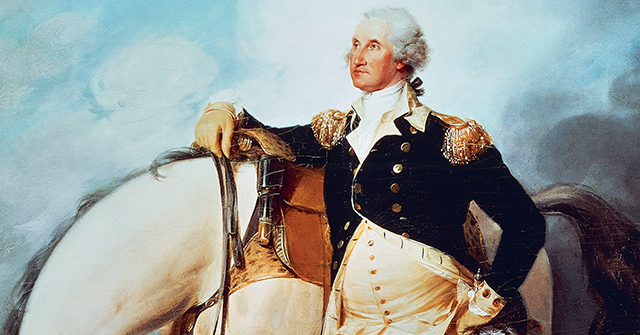
On Thanksgiving Day, 2026, as we count our blessings—and many of us lick our political wounds from the recent elections—we might learn from the original presidential proclamation for Thanksgiving, issued by President George Washington in 1789. That document is not only snapshot of Washington’s thinking, it’s a window into the world back then—a world of solemn humility before God. Maybe we need more of that today. The first president’s proclamation begins: “I do recommend and assign Thursday the 26th day of November next to be devoted by the People of these States to the service of that great and glorious Being, who is the beneficent Author of all the good that was, that is, or that will be.” Itemizing some of the good, Washington cited the establishment of the United States. For which he expressed “sincere and humble thanks” to God “for His kind care and protection of the People of this Country.” Washington further thanked the Almighty “for the great degree of tranquillity, union, and plenty, which we have since enjoyed—for the peaceable and rational manner, in which we have been enabled to establish constitutions of government for our safety and happiness.” So while Washington the politician was thankful for the republic he led the fight to create, he was fully mindful that were God angered, He could take it all away: So we “unite in most humbly offering our prayers and supplications to the great Lord and Ruler of Nations and beseech him to pardon our national and other transgressions.” George Washington’s original 1789 proclamation establishing the first Thanksgiving Day is seen on display at Christie’s New York on October 3, 2013. (TIMOTHY CLARY/AFP via Getty Images) George Washington was a proud man, with much to be proud about, and yet before God, he was humble. We should bear in mind that Thanksgiving originated with the Pilgrims and the related Puritans—the first Thanksgiving was celebrated in Massachusetts in 1621. (Others, elsewhere among the colonies on the east coast, had the same idea of giving thanks to God, and yet the New England tradition proved predominant.) And so while George Washington himself was an Anglican, he, and all Americans back then, were greatly influenced by the Puritans. It was Massachusetts men, after all, who had spearheaded the Revolution, starting the actual fighting at Lexington and Concord. In his classic Democracy in America, the French visitor Alexis de Tocqueville wrote, “When I reflect upon [the young republic’s unique success] I see the destiny of America embodied in the first Puritan who landed on those shores.” In Tocqueville’s reckoning, these Puritans brought with them from England “the best elements of order and morality . . . their object was the triumph of an idea.” That idea was Christian uplift, even utopianism. The pluperfect expression of this impulse comes in John Winthrop’s “City on a Hill” sermon from 1630, which laid out the stakes—the world, as well as God, was watching, and so the Puritans must not falter: We shall be as a city upon a hill. The eyes of all people are upon us. So that if we shall deal falsely with our God in this work we have undertaken, and so cause Him to withdraw His present help from us, we shall be made a story and a by-word through the world. We shall open the mouths of enemies to speak evil of the ways of God. Winthrop’s words proved so compelling that three centuries later, both John F. Kennedy and Ronald Reagan quoted them many times. And yet Winthrop was more than a phrase-maker; he and his fellows had a thoroughgoing worldview, which guided both theological and political action. In The New England Mind (1939), Harvard’s Perry Miller wrote: “Puritan thought incarnates a double-edged paradox: the abasement of man points to a supreme ideal of perfection.” The Christian belief that people are born sinful goes back to the fall of Adam and Eve, and yet the Puritans turned it up a notch. That is, we are so naturally wicked and depraved that only the most zealous and public devotion can convince God not to send us to Hell. Such piety—“a supreme idea of perfection”—soon turns into activism; all that energy sparked both the American Revolution and the U.S. Civil War. (And today, in lamentably mutated form, the same fervent high-mindedness helps explains why New England has gone woke.) Returning to U.S. presidents and their proclamations, the most Puritan-influenced of them, John Adams, issued this in 1798: “A DAY OF FASTING & HUMILIATION (NOT THANKSGIVING!)” That was his heading, his capitalization, and his punctuation. And his recommendation of fasting, as opposed to feasting. In his text, Adams pointed to “the just judgments of God against prevalent iniquity,” adding that America’s troubles—we were then in a quasi-war with France—“are a loud call to repentance and reformation; and as the United States of America are at present placed in a hazardous and afflictive situation.” And in 1863, President Abraham Lincoln issued a Thanksgiving proclamation in which he called for “humble penitence for our national perverseness and disobedience.” Washington, Adams, and Lincoln knew that the Bible is studded with hazardous and afflictive situations, each revealing perverseness and disobedience. The Old Testament makes seven references to, literally, fire and brimstone, as when the Israelites forsake the Lord and suffer as a result. And the New Testament, too, is replete with dire warnings and outcomes. In light of such hazards, the early presidents had their answer: Stay humble. Yet in the 20th century, U.S. presidents began to evince a different tone: more confident. For instance, by Thanksgiving 1943, Franklin D. Roosevelt could write, God’s help to us has been great in this year of march towards world-wide liberty. In brotherhood with warriors of other United Nations our gallant men have won victories, have freed our homes from fear, have made tyranny tremble, and have laid the foundation for freedom of life in a world which will be free. Yes, World War Two was still raging, and victory was far from certain, and yet FDR spoke of bigger and better: Our forges and hearths and mills have wrought well; and our weapons have not failed. Our farmers, victory gardeners, and crop volunteers have gathered and stored a heavy harvest in the barns and bins and cellars. Our total food production for the year is the greatest in the annals of our country. It’s hard to argue against presidential optimism in a time of collective crisis, and yet those earlier presidents might have advised FDR: Save the material optimism about Americans’ production of plenty for the other 364 days of the year. Make this one day, Thanksgiving, a day of humble thanks to God. Yet this newer presidential style has continued, even accelerated: In 2024, Joe Biden’s ghostwriter didn’t even mention God in his White House’s Thanksgiving statement. As for Donald Trump’s 2025 proclamation, while rightfully acknowledging God, it nonetheless reads mostly like a campaign riff: “The American economy is roaring back, we are making progress on lowering the cost of living, a new era of peace is sweeping around the world.” So now, here we are in 2026, and a paradox of our own: The economy is, indeed, strong, even as prices and peace are problematic. And so the electoral result for Republicans this year was bad. In the words of Sean Trende, “There’s no mincing words, rationalizing, second-guessing, or beating around the bush . . . It’s the worst election for a party at least since 1974.” Were the results unfair to Republicans? Perhaps. But the Puritans would remind us of what every Christian knows: God has His ways, and mere humans can’t know them. But we can know ourselves, and we can cleanse our hearts. Indeed for the sake of salvation, we must. As Jesus says in Luke 13:3, “Unless you repent, you will all likewise perish.” Of course, there’s still a need for community—for collective, as well as individual action. As we are told in Psalm 100:3-4, “Enter his gates with thanksgiving, and his courts with praise! Give thanks to him; bless his name! For the Lord is good; his steadfast love endures forever, and his faithfulness to all generations.” So on Thanksgiving, Christians—and others, too, if they are so inclined—should study their sacred texts and do as instructed. Give thanks to Him, and leave it at that. Such pious humility may, in fact, prove to be the best politics.
Pinkerton: Learning from George Washington’s Thanksgiving
Full Article
Original Source
Read the full article at Breitbart →KhanList aggregates and links to publicly available news content. We do not host full articles from third-party sources. Always verify important information with original sources.