
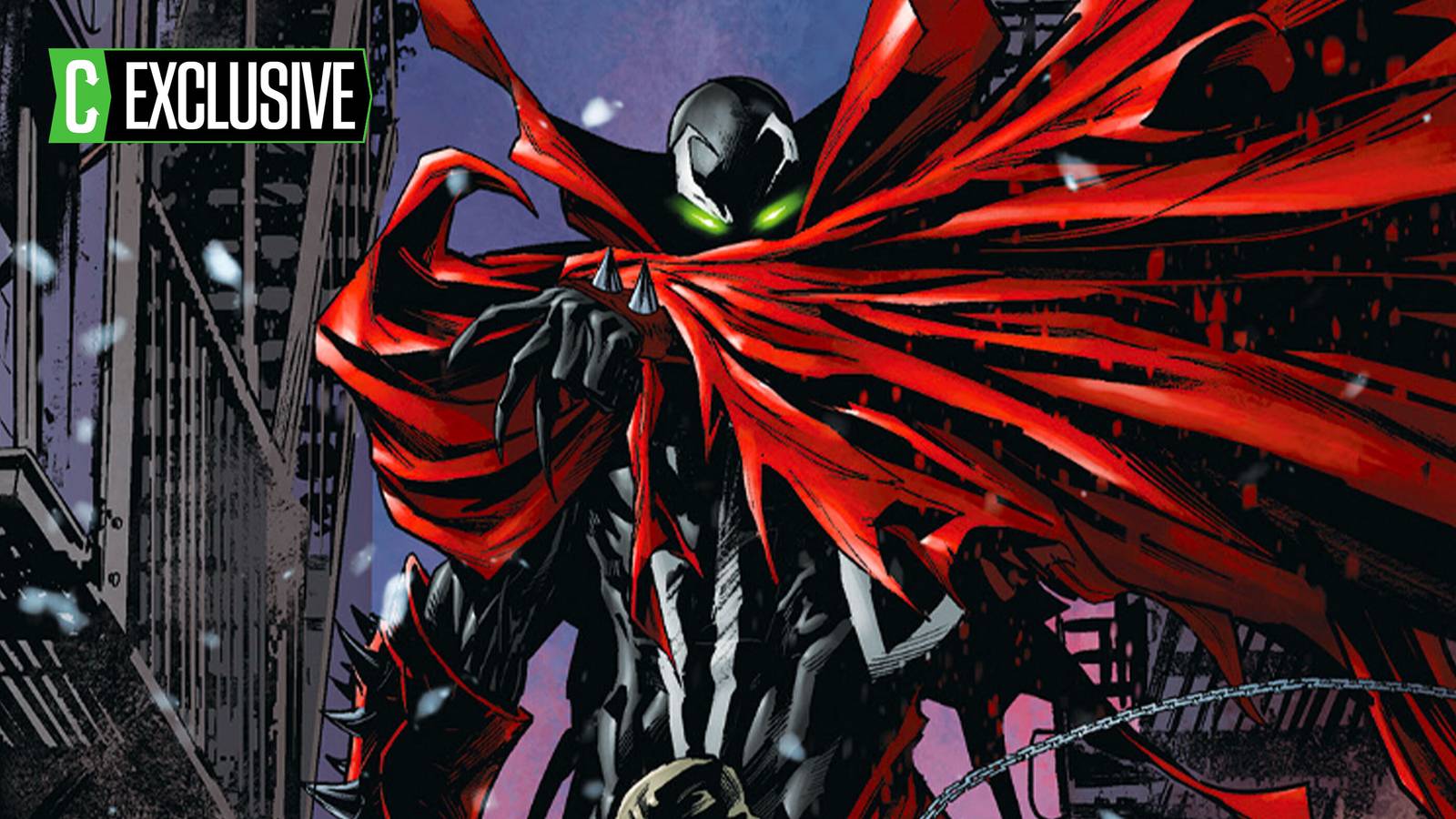
Image via Image Comics Published Nov 26, 2026, 4:00 PM EST Hannah covers horror, sci-fi, and games at Collider, where she writes news and features, reviews new releases, and interviews the people who make them. She’s helping build out Collider’s gaming coverage, with Pokémon as one of her specialties. If she isn’t writing about a monster, she’s probably watching one on a tape from her VHS collection. Sign in to your Collider account Of all the things I expected to worry about while reading a Christmas slasher set in the Spawn Universe, whether Santa Claus could get a 911 dispatcher to stay on the phone was pretty far down the list. In I Saw Santa, Nicholas finds the Anderson family murdered on Christmas Eve and calls for help. When the dispatcher asks him to say something if he can hear her, he tries to give her the family’s name. From her end, the line is quiet. From his, he gets to hear a perfectly reasonable woman explain why she’s about to hang up on him. It’s a hell of a thing to do to a guy who still has four time zones’ worth of presents to deliver. When I spoke with Todd McFarlane, Chris Killian, and Andrew Sanders for Collider about I Saw Santa and its sequel, I Saw Spawn #1, Killian explained that the call came out of a question he and Sanders had to answer. “If he knows who the killer is, why is he not warning anybody through all this?” Nicholas does warn people. He writes to the local authorities, contacts Interpol, and even tries the Vatican. His problem is that most adults know exactly what to do with a letter to Santa and have every reason to be suspicious of one that comes from him. Getting on the phone ought to improve his chances, except Killian and Sanders took one familiar piece of Christmas lore at its word. As Killian put it, “If you don’t believe in him, you can’t see him, you can’t hear him. And how horrifying is that for him?” Santa Claus Has a Laurie Strode Problem What gives the 911 call its bite is that the dispatcher is probably pretty good at her job, but the Andersons are no closer to getting help. Artist Thomas Nachlik lets us follow both sides of the conversation on the page: we can read the name Santa gives her, so when she asks him to speak up, there’s a moment where it feels as though all he has to do is say it again. That little bit of hope is worth preserving for as long as she stays on the line. McFarlane brought up John Carpenter’s The Thing when he described how a horror story can make even the prospect of rescue work against its characters. Sometimes, he said, “the cavalry is not coming.” "Or if it is, it’s a half an hour away.” McFarlane points out that most horror stories tell out that half an hour. Here, Santa gets the length of a phone call, and that was where McFarlane saw another Carpenter movie in Nicholas’ predicament. Killian and Sanders had found something that “basically isolates this horror and puts Santa on his own,” he explained. Once that happens, “now he just becomes Jamie Lee Curtis. Now what do I do?” It’s a fair question to ask of a man whose job requires him to keep visiting houses on the very night a killer knows where to find him. When I suggested they’d made Santa the final girl, Killian laughed: “That was exactly what we did.” The nastiest part of the entire thing is that Charlie Kohl is one of the few people (who isn't a child) that still believes. He stayed up hoping to catch Santa coming down the chimney and saved everything Nicholas ever brought him. Unfortunately for Santa, what he brought Charlie was coal, and the boy has been looking forward to giving every piece of it back. Killian described the coal as something Nicholas hopes will “help bad children sort of find their way out of the dark.” But this case and probably several others those intentions have been misinterpreted, and Charlie has had years to sit with the knowledge that somebody saw what he did, judged him for it, and would be back at his house next Christmas Eve. Of all the people Santa needs to convince he exists, the one who's kept the receipts is the one he has reason to fear. Collider Exclusive · 8 Questions · 2 Minutes What Is Your Biggest Horror Nightmare? Elm Street · Chucky · Scream · The Conjuring Four horror franchises. Four completely different ways of scaring you. One waits until you fall asleep. One makes sure nobody believes you. One is already in your group of friends. And one is in the house with your family. Answer eight quick questions about how you actually watch horror, and find out which nightmare was built for you. 😴Elm Street(Freddy Krueger) 🧸Chucky(Child's Play) 📞Scream(Ghostface) 🕯️The Conjuring(The Warren Files) FIND YOUR NIGHTMARE → 01 Which horror scene makes you cover your eyes? Four classic images. One of them is worse than the others for you. ASomebody falling asleep when they really should not. BA toy that has moved, and nobody touched it. CA phone ringing in an empty house. DA child talking to somebody who is not there. NEXT QUESTION → 02 You are home alone and you hear a noise. First thought? Everybody has one. It arrives before you have decided anything. AI am exhausted and my mind is playing tricks on me. BSomething in this room is not where I left it. CSomebody is in here with me. DThis house has never felt entirely right. NEXT QUESTION → 03 Which horror movie rule would you break first? Everybody thinks they would survive. Almost nobody actually does. ANever fall asleep. BNever leave it out of your sight. CNever answer the phone. DNever go down to the basement. NEXT QUESTION → 04 Something genuinely frightening happens. What do you do? Not in a film. In your actual living room, tonight. AConvince myself I imagined the whole thing. BTell someone, and brace for them not believing me. CWork out which person I know could be behind it. DGet everybody in the house into one room. NEXT QUESTION → 05 How do you actually watch a horror film? Be honest about this one. Nobody is checking. AFine during. Wide awake at two in the morning. BShouting at the screen that nobody is listening. CCalling the twist out loud before it lands. DThrough my fingers, holding on to something. NEXT QUESTION → 06 Somebody offers you serious money. Which do you still refuse? The amount does not matter. There is one on this list you are not doing. AFall asleep in a room I have never been in before. BKeep an old doll on the shelf facing my bed. CAnswer every unknown number that calls after midnight. DSpend one night alone in a house with a history. NEXT QUESTION → 07 Which feeling stays with you a week after the film? Good horror does not stop when the credits do. ANot wanting to turn the bedroom light off. BNot trusting one particular object in my house. CLooking twice at people I have known for years. DFeeling like something came home with me. NEXT QUESTION → 08 Something wakes you at 3am. What is the worst possibility? Eight questions in, this is the one that decides your nightmare. AThat I am still asleep, and it knows it. BThat the thing nobody believed me about is here. CThat somebody with a key is downstairs. DThat something is in the doorway, watching us sleep. REVEAL MY NIGHTMARE → The Lights Just Went Out Your Nightmare Is…Four franchises, four completely different ways of getting underneath your skin. This is the one built out of your particular fear, why it works so well on you, and what it would leave behind. Elm StreetYour nightmare does not wait outside the door. It waits for you to close your eyes, which you are going to have to do eventually, because nobody has ever won that particular argument. Freddy is horror's cruellest idea: a threat that lives in the one place you cannot guard, cannot lock, and cannot avoid forever. You are the one who is fine during the film and wide awake at two in the morning. Your own head is where this does its damage. These films understood exhaustion as a horror engine. The kids on Elm Street do not lose because they are weak. They lose because they are tired. You can lock every door in the house. You still have to sleep. ChuckyYour nightmare is not really the doll. It is the face of the person you tell, and the way they decide, very kindly, that you have imagined all of it. Chucky works precisely because he is absurd. That is the trap: the more accurately you describe him, the less anybody is going to believe you. You are the one shouting at the screen because the characters are not listening. You know that feeling from real life too. The franchise is at its best when the adults in the room are the real obstacle, and you have met those adults. By the time somebody finally believes you, you will have handled most of it on your own. ScreamYour nightmare has your number, knows your name, and has almost certainly been inside your house before. The worst part is that you already know them. Scream is the only one of these where the killer takes the mask off and turns out to be somebody who was at the party. You are the person who calls the twist out loud before it lands. You watch people the same way you watch films. The franchise made the rules of horror part of the plot, which means the survivors are the ones paying attention. You would be paying attention. Everybody is a suspect, including the person who just offered to walk you home. The ConjuringYour nightmare is not really about you. It is about the people asleep down the hall, and the feeling that whatever is here is not interested in leaving. The Conjuring films are domestic horror. The house, the family, the perfectly ordinary room that quietly stops feeling ordinary. Your instinct is to get everybody into one room. Your fear is protective rather than personal, which is rarer than it sounds. This is the one franchise where belief is the weapon. The people who come through it are the ones who are not alone and refuse to be. Whatever is here did not come for you. It came for the household, and you are the one standing in the hallway. ↻ RETAKE THE QUIZ ‘I Saw Spawn’ Gives Krampus a Good Reason To Be Mad at His Brother Krampus has always been more my speed at Christmas, so one of the pleasures of I Saw Spawn is discovering that he has apparently spent years nursing a grievance over the direction of the family business. In Killian and Sanders’ version of Christmas, Krampus and Santa are brothers, and Nicholas made a fairly consequential decision about what the holiday ought to look like without securing his brother’s vote. As Killian put it, “I think Krampus is actually a little hurt by it," which is understandable considering he's been locked away while his brother went on to become one of the most beloved figures in the world. What sells their falling-out is that I Saw Santa has already given Krampus an infuriatingly good example to cite. Nicholas spent years leaving coal for Charlie Kohl in the hope that the boy would turn his life around: imagine how that looks to the brother who used to be in charge of dealing with naughty children. Killian had a pretty good handle on the argument Krampus would make in his own defense. “'Because if I’d been around, you know, eating naughty kids, then this maybe wouldn’t have been a problem.'” Somewhere in the middle of a perfectly reasonable objection to eating children, Santa now has to concede that his brother has a point about Charlie. That’s a far better use of Krampus than bringing him out at Christmas to give somebody a scare, and it’s also where I Saw Spawn feels most like a sequel worth picking up on its own. The first comic lets us see why Nicholas keeps giving Charlie another chance, and the second gives us somebody who’s known Nicholas long enough to be thoroughly unimpressed by that quality in him. Even the sight of the brothers together raises a question about who got to tell the family story. Killian liked that “Santa looks like a normal guy, and then Krampus is this big giant,” because “there’s something else going on here if these two are related.” That sent me down a rabbit hole during the interview. If these two share a family resemblance, who decided Santa was the normal-looking one? Presumably the same brother who got to keep the holiday, but exploring that is for another series. Even Spawn Has a Good Reason to Ignore Santa’s Letter Image via Image Comics By the time Nicholas sends Alberich to find Al Simmons in I Saw Spawn, the elf is following up on a letter Spawn has already read and dismissed. From Santa’s end, he recognizes that now somebody has to deliver the message in person, which is how a centuries-old elf ends up clinging to Spawn’s cape on a rooftop in Rat City. Al’s first reaction, as McFarlane put it, is “Is this a con? Is this a trick? Who’s trying to get me?” Given how often somebody from Hell actually is trying to get him, Al has probably saved his own skin a few times by asking those very questions. But here, it's him who needs to do the saving. Asked what makes Spawn the man to call when Christmas is in trouble, Killian’s first answer was “the last resort.” Then he added something considerably more tender: “Santa knows all the children.” That includes Al Simmons, a boy Nicholas can remember and a grown man who could introduce himself on the street and be told to his face that Al Simmons is dead. McFarlane saw the appeal for Santa immediately. “That dude understands people not trusting the truth, right?” He also saw the catch: “The problem is he’s now not gonna trust me.” That’s my favorite reason to put these two on a rooftop together, even if Santa has to send an elf in his place. Nicholas has spent Christmas Eve asking people to believe something extraordinary about him. With Al, he can finally return the favor. Long before there was a Hellspawn in Rat City, there was a kid whose house Santa knew how to find. After spending an entire comic hoping somebody would pick up the phone for Santa Claus, I’ve rarely wanted a man to open his mail so badly. I Saw Spawn #1 is available now, while #2 arrives December 16 from Image Comics. Writers Todd McFarlane Franchise(s) Spawn Cast
The Best Part of Spawn’s Christmas Thriller Is Letting Santa Be the Final Girl
Full Article
Original Source
Read the full article at Collider →KhanList aggregates and links to publicly available news content. We do not host full articles from third-party sources. Always verify important information with original sources.