
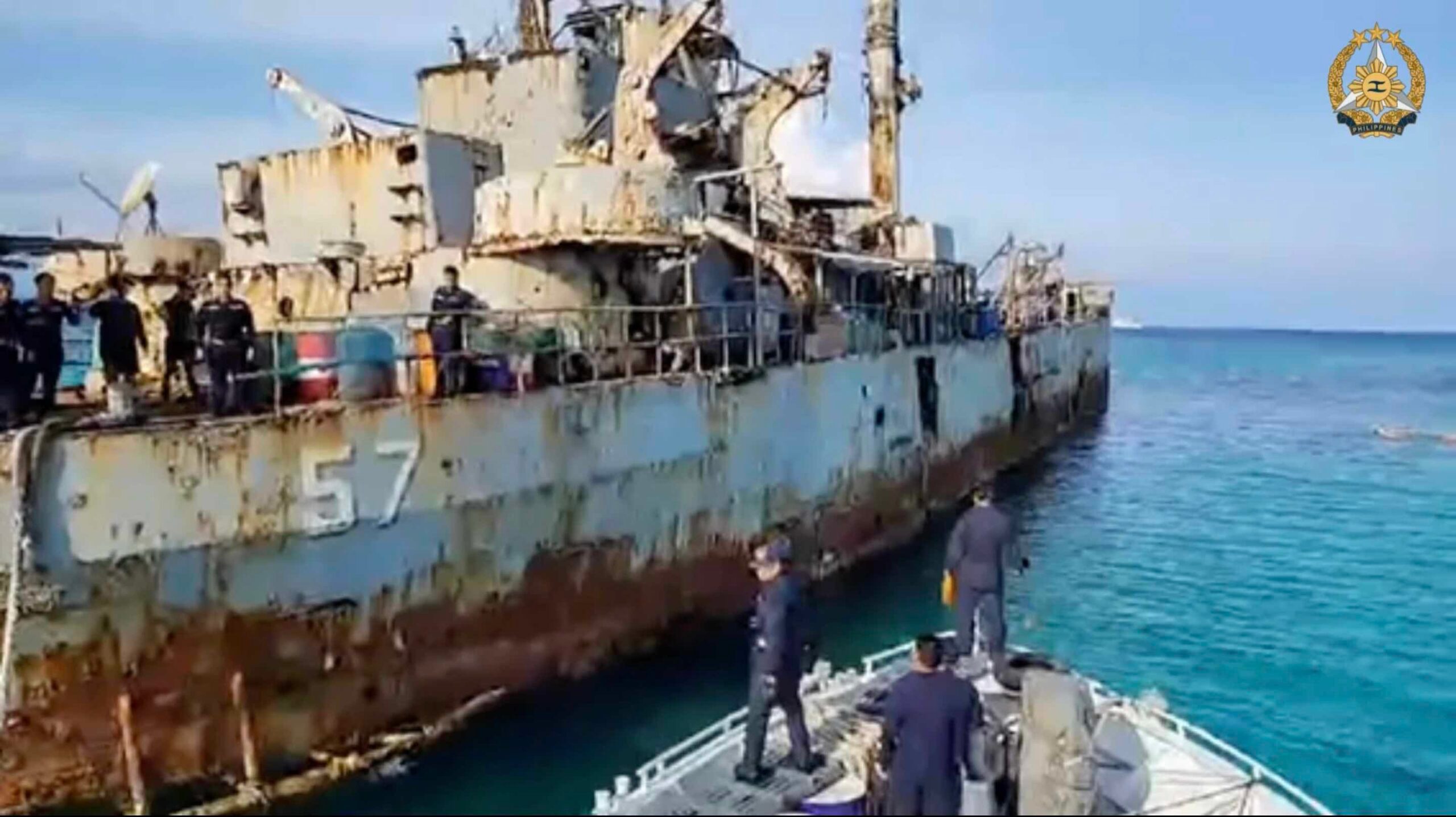
AYUNGIN MISSION. The MV Lapu-Lapu approaches the BRP Sierra Madre during a September 26 RORE mission to Ayungin Shoal. AFP ‘Transparency must support diplomacy rather than displace, constrain or collide with it,’ says the DFA, exposing what many observers and analysts have long pointed out — incongruence between the DFA and the country’s maritime frontline agencies The Department of Foreign Affairs emphasized the need for government officials to align with the President's policies and warned against public statements that undermine diplomatic efforts. The exchange highlights internal divisions within the Philippine government regarding foreign policy, particularly towards China and the West Philippine Sea, which could be exploited by external parties. This is AI-generated. Read the article for full context. Report any errors. In a long statement late Sunday, November 8, the Department of Foreign Affairs (DFA) issued a reminder that “all government officials, both civilian and uniformed, are expected to align with the President’s policy directions” and that “while the national security establishment and the uniformed services provide indispensable operational assessments and document developments on the ground, civilian authority directs the country’s international relations.” “Professional advice belongs in appropriate internal channels,” said the department. “Portraying diplomatic dialogue as inadequate, counterproductive or secondary to public exposure creates a false choice between diplomacy and transparency. Public statements that undermine the government’s diplomatic approach do more than complicate the work of our diplomats. They risk eroding the country’s credibility in international affairs and project an image of internal division that external parties can exploit. Such actions can ultimately weaken the Philippines’ negotiating position,” the department added. The missive was pointed in its defense of the department but bereft of specifics. Just who exactly was the DFA defending itself against? The statement seems to have been a response — a barely-veiled one, at that, to Vice Admiral Jay Tarriela, spokesperson of the Philippine Coast Guard (PCG) for the West Philippine Sea. Tarriela, over the weekend, had published an opinion piece in the Inquirer. He advocated for his brainchild, the Philippines’ transparency initiative, in dissecting Foreign Affairs Secretary Ma. Theresa Lazaro’s recent phone call with Chinese Foreign Minister Wang Yi. State news agency Xinhua said that Wang claimed that “China-Philippines relations are facing malicious interference at present” and that “a few Philippine politicians, out of political prejudice and self-interest, have repeatedly attacked and smeared China,” an allusion to Defense Secretary Gilberto Teodoro Jr., whom Beijing sanctioned in mid-2026. The DFA characterized the call as “frank, pragmatic, and constructive” where the two talked about “the state of bilateral ties at length.” The phone call — both Manila and Beijing claimed the other made the first overturns — came just before the Philippines hosts the Association of Southeast Asian Nations (ASEAN) Summit and China hosts the Asia-Pacific Economic Cooperation (APEC) Economic Leaders’ Meeting just days after in mid-November. Tarriela prefaced his showcase of the transparency initiative by asserting: “Beijing just asked our government to muzzle its own people, specifically those who show the public what happens in the West Philippine Sea.” The DFA said in their statement: “It is therefore regrettable that recent public commentary made by certain government officials have incorrectly merged three distinct elements: documentary evidence, public rhetoric and official diplomatic messaging…. Yet transparency cannot substitute for statecraft. Releasing footage or shaping an online narrative does not, by itself, act as a physical deterrent at sea or a legal strategy.” It’s a very public exchange that does not merely “project an image of internal division that external parties can exploit,” as the DFA says; it practically confirms it. That there is disagreement over policy and even personalities in the different agencies — from the uniformed, the diplomatic, the civilian, and even the political — is nothing new. Nor should it be really surprising. The strangeness, perhaps, is on how outward it can be. During the 10th anniversary of the 2016 Arbitral Award, experts and analysts publicly wondered why the DFA and defense community didn’t commemorate the landmark ruling jointly, or at least shared spaces in the same room. Both sectors downplayed the painfully obvious elephant in the room. Both defense and foreign affairs officials, in varying degrees, have had to downplay or dodge talks about dissonance not just in the approach to China, but, in some cases, the West Philippine Sea, too. External parties will undoubtedly try to exploit any division within the government. They — whoever they are — would be foolish not to do so. But even more foolish are those within who let that division fester. – Rappler.com How does this make you feel? Loading
Philippines’ West PH Sea, China discord seeps through fissures
Full Article
Original Source
Read the full article at Rappler →KhanList aggregates and links to publicly available news content. We do not host full articles from third-party sources. Always verify important information with original sources.