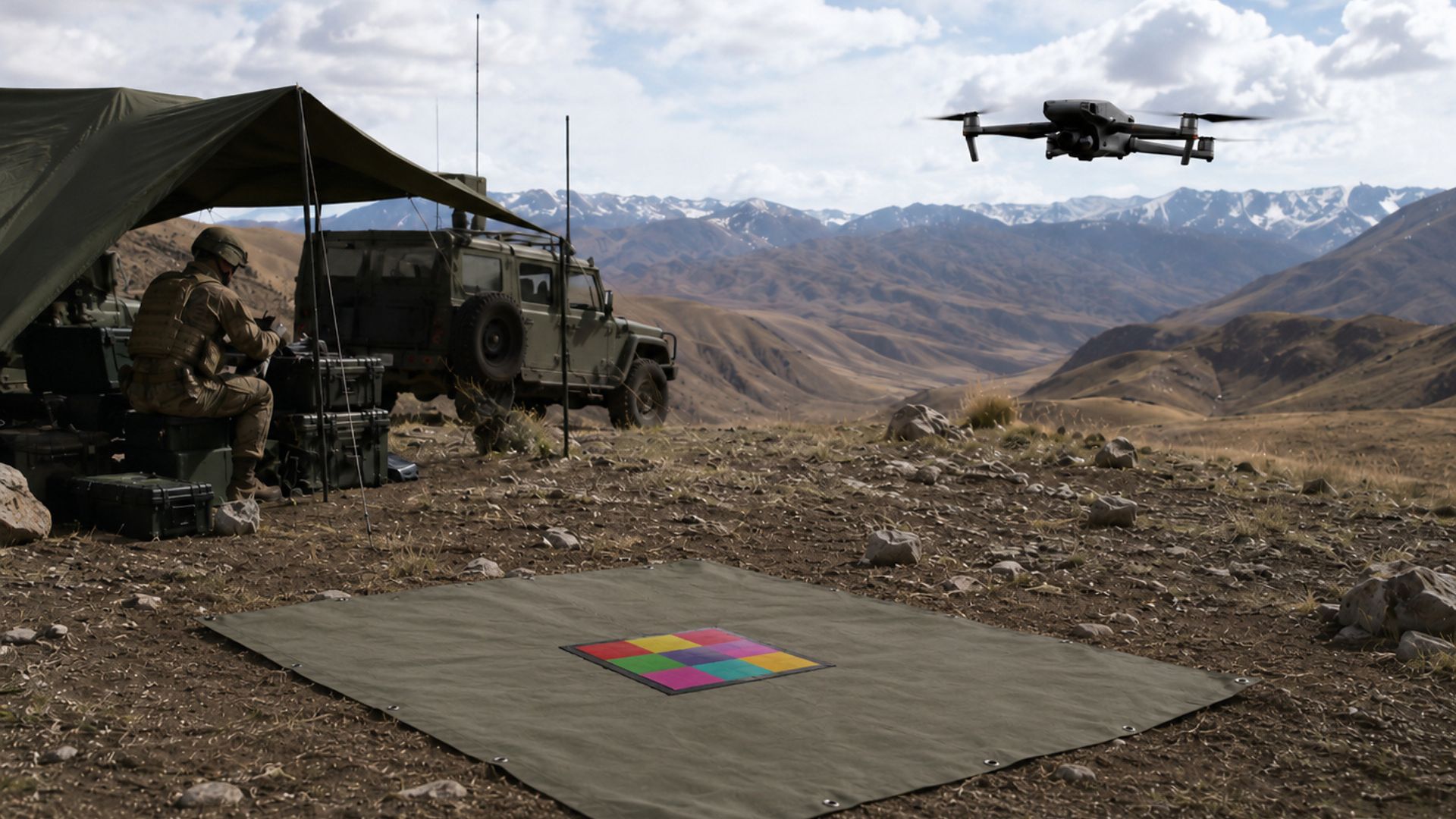
Autonomous drones can recognize objects with increasing accuracy, but confirming exactly what they are looking at remains difficult. Sodyo Ltd. says its new RangeMark technology aims to solve that problem. The Tel Aviv-based company says the system identifies passive visual markers from as far as 0.6 miles (one kilometer) away using only a standard camera, eliminating the need for GPS, radio frequency links, cellular connectivity, or external networks. Unlike conventional AI vision systems that classify objects based on probability, RangeMark verifies the identity of a marked object through a machine-readable visual code. Sodyo says the approach gives drones deterministic confirmation instead of relying on image recognition alone, a capability that could support defense, infrastructure inspection, emergency response, and industrial automation. Moving beyond AI vision Modern computer vision allows drones to recognize vehicles, buildings, and people with impressive accuracy. Even so, those systems still infer identity from visual characteristics, leaving room for uncertainty in complex environments. RangeMark approaches the problem differently. Operators place a printed, battery-free marker on an object or location. When that marker enters the camera’s field of view, the software detects and decodes it into a unique identity, even at extended distances. Commercial application of RangeMark tech. Credit – Sodyo According to Sodyo, the system works without emitting signals or requiring onboard communications equipment. That makes it suitable for environments where GPS signals are unavailable, or radio transmissions are restricted. Alon Raz, CEO of Sodyo, said the challenge has never been teaching autonomous systems to see. “Knowing is,” he said. Raz added that RangeMark transforms a printed marker into “a point of certainty” from distances of up to one kilometer using only a camera. He said that confidence allows autonomous machines to make decisions without depending on external infrastructure. Flight tests and applications Sodyo says it has validated the technology during multiple flight scenarios, including hovering, transit, and search-pattern missions at speeds reaching 20 meters per second. During testing, drones detected a one-meter marker from up to 500 meters away. Smaller 50-centimeter markers remained detectable at distances of 250 meters. The company also says a single camera view can scan an area of roughly 20 hectares, or about 49 acres, while searching for markers. RangeMark supports two marker formats today. The Color Code version targets visible-light applications and stores high-density information. The Carbon Code uses a duo-tone design intended for environments where visibility is more challenging. Additional formats for other parts of the electromagnetic spectrum are under development. The technology portfolio includes more than 35 global patents, with intellectual property dating back to 2012. Licensing strategy targets OEMs Instead of selling complete drone systems, Sodyo plans to license RangeMark to drone manufacturers, autonomy platform developers, camera suppliers, and system integrators. The company expects partners to embed the technology into existing and future autonomous platforms. Sodyo will publicly showcase RangeMark during Commercial UAV Expo Americas 2026, scheduled for Sept. 1-3 at Caesars Forum in Las Vegas. The event will mark the technology’s commercial debut as the company seeks partners across defense and commercial drone markets.Recommended ArticlesGet the latest in engineering, tech, space & science - delivered daily to your inbox.Aamir is a seasoned tech journalist with experience at Exhibit Magazine, Republic World, and PR Newswire. With a deep love for all things tech and science, he has spent years decoding the latest innovations and exploring how they shape industries, lifestyles, and the future of humanity.
Patented machine vision brings automatic target recognition to drones without GPS
Full Article
Original Source
Read the full article at Interestingengineering →KhanList aggregates and links to publicly available news content. We do not host full articles from third-party sources. Always verify important information with original sources.