
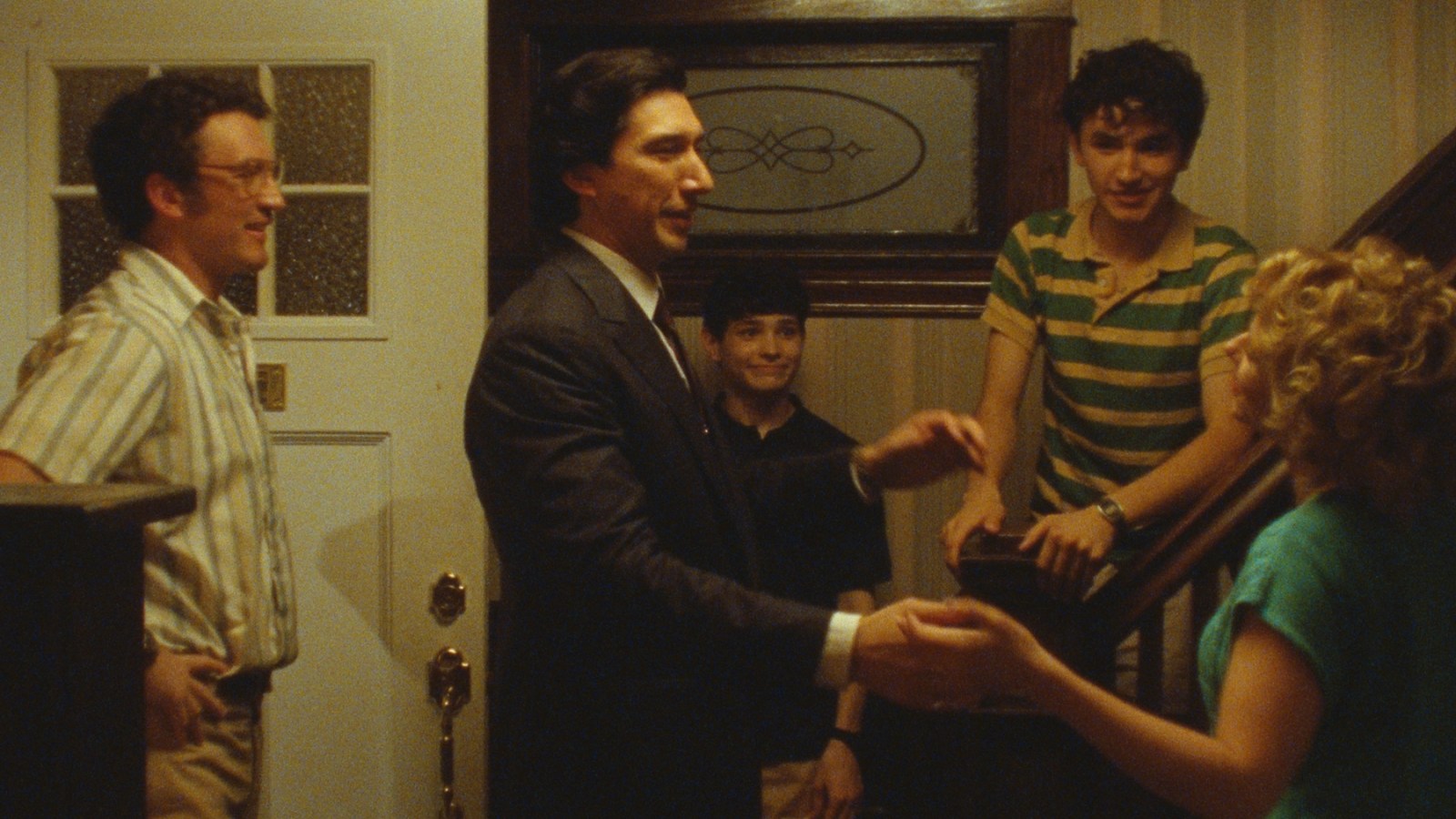
Filmmaker James Gray returns with this semi-autobiographical tale of two brothers from Queens, the Russian Mob, and the slow death of the American dream Cain had Abel, Biff Loman had Happy, and Michael Corleone had Fredo. For Irwin Pearl, the everyman hero of writer-director James Gray’s Paper Tiger, there is his older brother, Gary. Make no mistake: Irwin (Miles Teller) loves his older sibling Gary (Adam Driver). You can tell by the way they tease each other, talk to each other, and trade inside jokes that the affection is mutual. And yet this solidly lower-middle-class engineer, who dreams of getting out of Queens and being somebody that his family can look up to, lives in the ever-looming shadow of his sibling. Once upon a time — specifically, the 1970s and early 1980s — Gary was a New York City cop. He had connections, made moves, busted skulls, commanded respect. Then he quit the force, started and sold a business, made a fortune. Now Gary sports expensive Italian suits, drives a Mercedes and, per the words of Irwin’s wife Hester (Scarlett Johansson), “has more money than God.” He’s the life of the party and the beloved cool uncle, happy to entertain his teenage nephews Scott (Gavin Goudey) and Benjamin (Roman Engel) by showing off the revolver in his ankle holster in between goofing around on the piano. If Gary’s going to show up at the last minute for dinner at Irwin’s place, he’s going to get Peter Luger’s steakhouse to cater it. There’s a secondary agenda to the impromptu drop-in, however. The era of the Italian mafiosi keeping Brooklyn under it’s red-sauce–stained thumb are fading, and now the Russians are coming, the Russians are coming. The area around the Gowanus canal had long been a no-man’s-land because of all of the pollution in the water. But the new mob in town want to develop the neighborhood. Gary smells opportunity. The man wears his streetwise bona fides like a badge of pride, so he’s going to broker deals between these immigrants with criminal-capitalistic aspirations and the bureaucratic powers that be. He wants Irwin to come on board as a “consultant” for cleaning up the area to code standards. Both of the Pearl brothers have dollar signs in their eyes. When it comes to this new breed of gangsters, however, the old rules — the ones that Gary is fluent in, and takes for granted — no longer apply. Editor’s picks James Gray has made movies set everywhere from the Amazon rain forests (The Lost City of Z) to outer space (Ad Astra), but it’s the concrete jungles of New York that he tends to thrive in, storytelling-wise. Crime and the city, along with family, are constants; so are compromised moralities and a throwback sense of New Hollywood grittiness. The Queens-bred writer-director specializes a sense of regional authenticity, and with his previous — and arguably best — film Armageddon Time (2022), he’s added autobiographical strains of his own Gotham adolescence into the soup. With this scuffed-up gem of a film, Gray mixes both his crime-thriller obsessions and his memories into one spiked brew, using a tale of two brothers caught up in the greed-is-good mentality of the go-go 1980s to fashion nothing less than a Greek tragedy with an outer-borough accent. The tension of his earlier work is there in abundance, especially when Irwin decides, in a misguided fit of pride, to take his sons to his new workplace in Carroll Gardens late one night. He wants to impress his boys: Dad may not have a Mercedes like Uncle Gary, but they’re all going to be on easy street soon enough! It turns out that his Eastern European clients aren’t keen on after-hours visits. Things go south. Gary got to clean up his brother’s mess with the new boss in town. Let’s just say that goes south pretty quickly as well. You don’t need to know that Irwin and Hester are based on Gray’s parents, the encounter with thugs comes from a real-life incident, or that Gary is a composite of both the filmmaker’s uncle and a business partner of his dad’s. All you need to understand Paper Tiger — the title comes from Gary’s assumption that these Russian mobsters merely talk a big game, a call that will prove to have serious consequences — is that blood runs thicker than water. It also has a nasty tendency to get spilled when the talking stops and the guns get pulled. Or, in Gary’s case, the belt comes off; a scene in which the ex-cop whips the crap out of a trio of hoodlums with a clothing accessory reminds you that he’s not playing around, either. This veteran of the force thinks he’s untouchable. Spoiler: No, he isn’t. Related Content It’s worth noting that the movie’s ensemble is airtight, and gives you the sense that you’re witnessing an actual family dynamic at work, from hard-earned teenage eyerolls to Hester’s authoritative henpecking. Teller’s way of underplaying panic while still leaning into a sense of in-over-his-head helplessness suits him. Johansson handles a third act pivot to melodrama (this element is also pulled from the filmmaker’s direct experiences) with deftness, and anyone suggesting her New Yawk accent is better suited for selling chandeliers than channeling pathos has clearly never spent time in Flushing. Trending Stories Adam Driver in ‘Paper Tiger.’ NEON It’s Driver, however, who gets the meatiest role, and he understands exactly where to pitch Gary’s combination of Teflon swagger and swinging-dick entitlement. Crown or no crown, he thinks of himself as a prince of the city, someone who still believes his mere presence is the equivalent of flashing a badge. There’s an early scene in which Gary takes his brother out for a meal at an Italian restaurant, “the last holdout of the Genovese family.” Despite the fact he was apparently one of the few non-corrupt cops on the force (something which never sat well with his fellow brothers in blue, and comes back to haunt him), Gary moves at ease in the environment. The Mafia is the devil he knows. His underestimating of the next generation of string-pullers is his fatal flaw. Driver lets you see the awe this character inspires in others, and the shock when he unexpectedly finds himself in a situation when he can’t charm or cold-cock his way out. That he also gets a standout shootout in the tall grass near LaGuardia airport is simply a bonus. But the hulking actor also shows the love between this alpha and his beta brother that circumstances will rend asunder, and this is where the power of Paper Tiger really rests. Like we said, it’s a Greek tragedy that just happens to carbon-date to the Reagan era and feature kids playing a Ms. Pac Man machine at Lum’s. But it’s also an American tragedy, one borne of the relentless drive and ambition and grass-is-always-greener greed that’s made this country and continually threatens to break it into tiny shards. Not even a loving family like the Pearls and their kin are immune to the fallout. Gray has said that he wanted to revisit this time in his life, when he felt like the American Dream was driving a wedge into his relations, because he wanted to say that a moral compass still matters in this world. He’s given us a movie brimming not only with sympathy but with the clarity that time allows. It’s not a look back in anger. Just a look back in sorrow.
‘Paper Tiger’ Is a Greek Tragedy With a Thick New York Accent
Full Article
Original Source
Read the full article at Rollingstone →KhanList aggregates and links to publicly available news content. We do not host full articles from third-party sources. Always verify important information with original sources.