
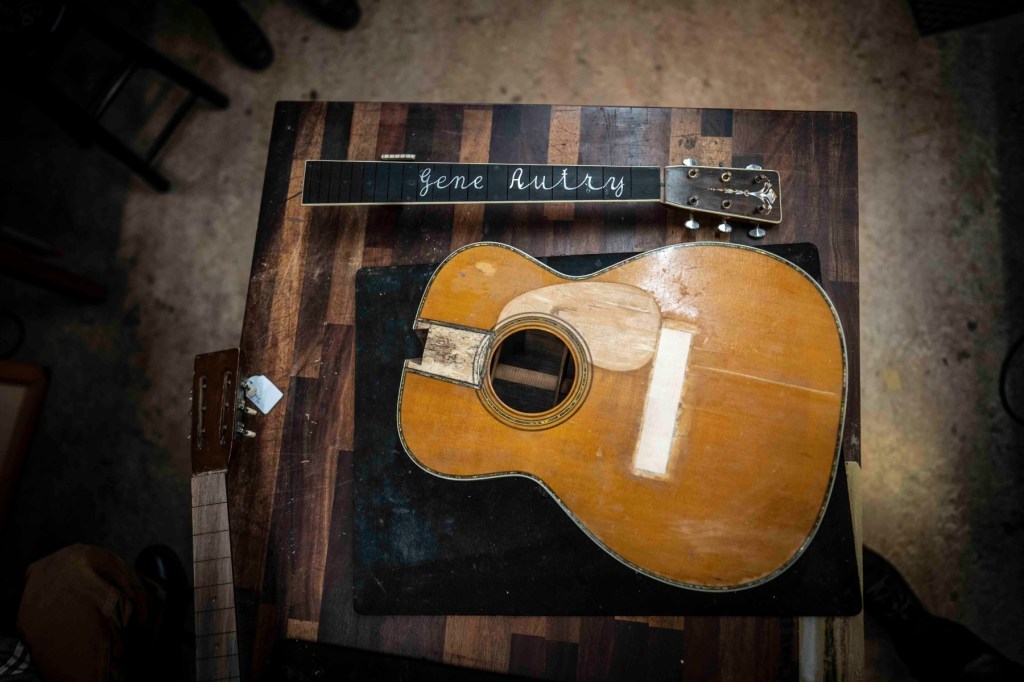
A rare Martin OM-45 guitar, likely owned by Autry at one point, was found in a Swedish farmhouse. A rare Martin OM-45 guitar, likely owned by Autry at one point, was found in a Swedish farmhouse. Olof Ohlsson / Courtesy Göteborgs-Posten As programmers prepare Christmas playlists, the Gene Autry recordings “Rudolph, the Red-Nosed Reindeer” and “Here Comes Santa Claus (Down Santa Claus Lane)” are currently top of mind. Explore See latest videos, charts and news But a 1931 Autry recording – “That Silver-Haired Daddy of Mine,” which charted on Billboard’s all-genre hit parade in 1935 – is suddenly timely, as well, in a real-life detective story that’s erupted into a trans-Atlantic legal tiff. A rare Martin OM-45 guitar, one of only 50 produced in the early-1930s, was found in a Swedish farmhouse among the inheritance a father left to his daughter when he died in February 2021. The guitar, it turns out, was likely owned by Autry and stolen from him in 1932. The exact journey the instrument took cannot be fully traced, but steps were taken somewhere in the past 90 years to conceal its identity. The process of uncovering the guitar’s authenticity and tracing its original ownership back to Autry, a Country Music Hall of Fame member who was an iconic singing cowboy during much of the 20th century, reads like a C.S.I. forensics drama, laid out in a four-part series by Swedish newspaper Göteborgs-Posten. Autry’s widow, Jackie Autry, is now embroiled in a tug of war over the instrument, which she believes should be returned to the Autry Museum of the American West, a Los Angeles institution that documents cowboy and Native American history. “I don’t have any of Gene’s guitars anymore,” Jackie told Göteborgs-Posten. “They’re all at the museum now because that’s where it belongs. It belongs to the public, not to me, not to her.” “Her” would be the daughter of Owe Jakobsson, a Swedish woman named Sandra who was left in charge of her daddy’s estate after his death. Owe had inherited the instrument from his father, Gunnar, who was an inventive repairman. The original guitar had amateur-grade modifications made to the neck and bridge, and Sandra received a $7,000 offer for the Martin when she was selling off pieces of the estate. Another potential buyer tipped her off that it was likely worth far more, and they discovered that even a modern replica is worth about $12,000. This guitar, which had all the earmarks of being an original, could be worth six figures. Sandra took the instrument to a Stockholm guitar shop for restoration, and there, Leif Lundbäck discovered a name, Gene Autry, that had been covered with black paint. He also found a serial number when he detached the neck. The Martin company, they would discover, has documentation from several letters that Gene wrote in early 1932 that verify a connection. The singer’s 1932 tax return, produced by the estate, indicates that a Martin guitar had been stolen from him in the fall, roughly nine months after his correspondence with Martin. Autry’s widow, Jackie, offered $20,000 for the instrument after she was contacted. Sandra declined that figure, holding that the guitar has sentimental value because she had inherited it from her father. The two sides are at a stalemate – Autry has not increased her offer and told Göteborgs-Posten, “I don’t pay money to blackmailers.” Sandra has been advised that the guitar is worth far more, and that Autry’s estate can afford it. The case is complicated by differing nuances in the laws of Sweden and the United States. “I’m the one who inherited it,” Sandra told Göteborgs-Posten. “So, with that said, I don’t think I’m being dishonest by wanting to keep it. Go here to read the full, four-part series. Get weekly rundowns straight to your inbox Sign Up
Gene Autry’s Guitar in Global Dispute
Full Article
Original Source
Read the full article at Billboard →KhanList aggregates and links to publicly available news content. We do not host full articles from third-party sources. Always verify important information with original sources.