
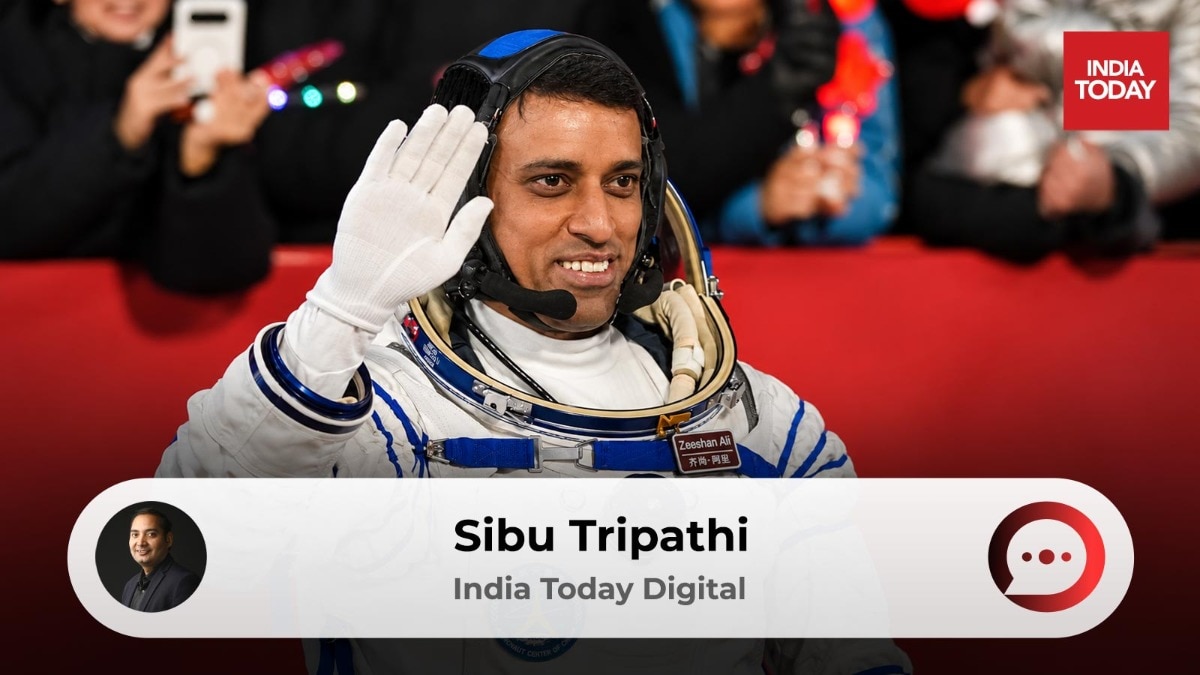
Pakistan has entered an exclusive club of nations with a citizen in space. Muhammad Zeeshan Ali's journey aboard China's Shenzhou-24 spacecraft to the Tiangong space station is undoubtedly a historic moment for the country's scientific community.But beyond the national celebrations and symbolism, a larger question remains: does Pakistan have the ambition, financial appetite and technological capability to turn this one-off achievement into a sustained human spaceflight programme?For now, the answer remains uncertain.Ali's mission is the outcome of an agreement signed between Pakistan's Space and Upper Atmosphere Research Commission (Suparco) and the China Manned Space Agency in February 2025. He has joined two Chinese astronauts as a payload specialist, conducting scientific experiments during a short-duration stay of over a week in orbit. Pakistani astronaut on the Chinese space station. (Photo: CMSA) The achievement is significant, particularly because Pakistan has struggled to build an independent space programme despite establishing its space agency in 1961, eight years before the Indian Space Research Organisation (ISRO) was formally established in 1969.Yet, the two countries have followed dramatically different trajectories.PAKISTAN'S SPACE PROGRAMME: A LONG WAY BEHIND Suparco's early establishment gave Pakistan a head start on paper. However, decades later, the country remains heavily dependent on foreign partners, particularly China, for satellite launches, spacecraft technology and access to human spaceflight.Pakistan does not currently operate an independent orbital launch vehicle capable of placing its satellites into orbit. Its satellite programme has largely relied on Chinese launch services, while its ambitions in human spaceflight are similarly tied to Beijing.Short stay, but Astronaut Muhammad Zeeshan Ali is the clear star of this joint crew. https://t.co/YO5sAQmWlH— CNSPACE (@CNSpaceflight) November 25, 2026More importantly, there is little publicly established evidence of a sustained, independently funded Pakistani human spaceflight programme that could eventually develop into long-duration missions, independent astronaut training or a domestic crewed spacecraft.That raises an important question: is Pakistan investing in the capabilities required to send more astronauts into space, or is the Shenzhou-24 mission primarily a diplomatic and scientific opportunity facilitated by China?ISRO TOOK A DIFFERENT ROUTE TO GO TO SPACEIndia's own human spaceflight journey offers an interesting contrast. It too depended on foreign partners to send its astronauts into space. Rakesh Sharma travelled aboard a Soviet Soyuz spacecraft in 1984, while Group Captain Shubhanshu Shukla flew to the International Space Station aboard SpaceX's Dragon spacecraft during the Axiom-4 mission in 2025.But India used these opportunities as stepping stones towards developing its own human spaceflight capabilities.The Axiom-4 mission, for instance, was not merely about sending an Indian astronaut to space. Shukla conducted seven experiments developed by Indian research institutions, while ISRO gained valuable experience in astronaut training, microgravity research and international human spaceflight operations. Shenzhou-24 docking with the Chinese Space Station. (Photo: CMSA) More importantly, India has an active roadmap for Gaganyaan, its maiden indigenous human spaceflight programme.ISRO is developing a human-rated LVM3 rocket, crew escape systems, an environmental control and life-support system, and an orbital module designed to carry Indian astronauts into low Earth orbit.The government has also approved the development of the first module of the Bharatiya Antariksh Station, targeted for 2035. India's first crewed Gaganyaan mission is targeted for 2027, following uncrewed test missions.This is the critical difference. India is translating international experience into indigenous technology, research and industrial capabilities. It is not simply purchasing a seat aboard another country's spacecraft.A BEGINNING FOR PAKISTAN'S SCIENTIFIC COMMUNITYThat, however, does not take away from what Zeeshan Ali's mission means for Pakistan.For a country's scientific community, having an astronaut conducting experiments aboard an operational space station is a major achievement. Pakistan also has a second trained astronaut candidate, Khurram Daud, who was selected alongside Ali for the Chinese training programme.This creates an initial pool of human spaceflight experience that could potentially help train future Pakistani astronauts. Astronaut Zeeshan Ali's mission is the outcome of an agreement signed between Pakistan's Suparco and the China Manned Space Agency in February 2025. (Photo: AP) The four scientific experiments selected for Ali's mission, involving materials science, self-healing composites, quinoa seeds and photosynthetic microorganisms, also offer Pakistani researchers an opportunity to study how biological and material systems behave in microgravity.BUT WHAT HAPPENS AFTER THE PAKISTANI ASTRONAUT RETURNS?Will Pakistan send another astronaut? Will it continue investing in microgravity research? Will Suparco develop a dedicated astronaut training programme, expand its scientific infrastructure and establish a sustained human spaceflight collaboration with China?These are questions that remain unanswered by the current mission agreement, which provides for two Pakistani candidates to train and one to fly.There is also the question of money. Human spaceflight is an expensive, long-term commitment. It requires sustained government funding, research institutions, specialised infrastructure and a pipeline of scientists and engineers. A single flight cannot create these capabilities overnight. A man holds a portrait of Pakistan's astronaut Muhammad Zeeshan Ali as he waits for a live telecast of the launch of China's Shenzhou 24 manned mission. (Photo: AP) Pakistan has achieved the milestone of putting its first astronaut in space. But getting an astronaut into orbit and building a spacefaring nation are two very different achievements.For now, Zeeshan Ali's journey is a historic beginning. Whether it becomes the foundation of a larger Pakistani human spaceflight programme will depend on what Islamabad (read Rawalpindi) chooses to invest in after the celebrations are over.- Ends
Pakistan's first astronaut is in space. But does it really mean anything?
Full Article
Original Source
Read the full article at Indiatoday →KhanList aggregates and links to publicly available news content. We do not host full articles from third-party sources. Always verify important information with original sources.