
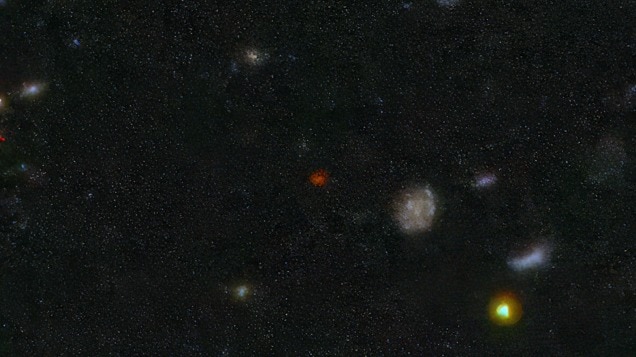
Observations from multiple space telescopes have helped establish the identity of an object that existed billions of years before Earth formed. Here's what it reveals.A small red dot in the centre, marks the farthest quasar in the image. (Photo: ESA)New Delhi,Nov 25, 2026 17:16 ISTAstronomers have discovered the oldest-known quasar, a remarkably bright object powered by a black hole that had already grown to 360 million times the mass of the Sun when the universe was just 630 million years old.Named Dun Aonghasa, the object existed more than 13.1 billion years ago, when the universe was less than 5% of its present age.Its discovery pushes the record for the most distant known quasar back by about 40 million years, giving scientists a proper look at how the first giant black holes grew.The findings were reported in the journal Astronomy and Astrophysics. An artist's concept of a quasar. (Photo: X) WHAT IS A QUASAR?A quasar is the extremely bright centre of a galaxy, powered by a supermassive black hole.As gas, dust and other materials spiral toward the black hole, they heat up and release enormous amounts of energy, making the region shine brighter than the galaxy around it. Black holes themselves do not emit light. Their powerful gravity prevents even light from escaping. The glow comes from the material surrounding them as it moves closer to the black hole.Dun Aonghasa was first spotted using the European Space Agency's (ESA) Euclid space telescope.Astronomers then used several other observatories, including the Hubble and James Webb space telescopes, to confirm its identity and age.Its central black hole is about 90 times more massive than the one at the centre of our Milky Way galaxy. This photo provided by the European Space Agency shows various galaxies imaged by the Euclid mission. (Photo: AP) HOW DID IT GROW SO BIG SO QUICKLY?The discovery has also raised a question about how a black hole became so massive so early in the universe's history.One possibility is that it began as the remains of an early star and grew by pulling in surrounding material.However, the researchers say its present growth rate appears too slow to explain how it reached such an enormous size in the available time.Another possibility is that it formed through the direct collapse of a huge cloud of gas.Under certain conditions, instead of breaking into smaller pieces and forming stars, the gas could collapse into a single massive object that eventually becomes a black hole.Scientists say this could have given the black hole a much bigger starting mass, allowing it to grow faster.MORE DISTANT QUASARS COULD BE FOUNDThe discovery could be followed by even older finds. Researchers believe Euclid could find quasars that existed even closer to the Big Bang.Some models suggest the first quasars could have appeared between 270 million and 470 million years after the Big Bang.Finding them could help scientists understand how the universe's earliest galaxies and their giant black holes took shape.- Ends
Astronomers spot oldest-known quasar powered by black hole. What is it?
Full Article
Original Source
Read the full article at Indiatoday →KhanList aggregates and links to publicly available news content. We do not host full articles from third-party sources. Always verify important information with original sources.