
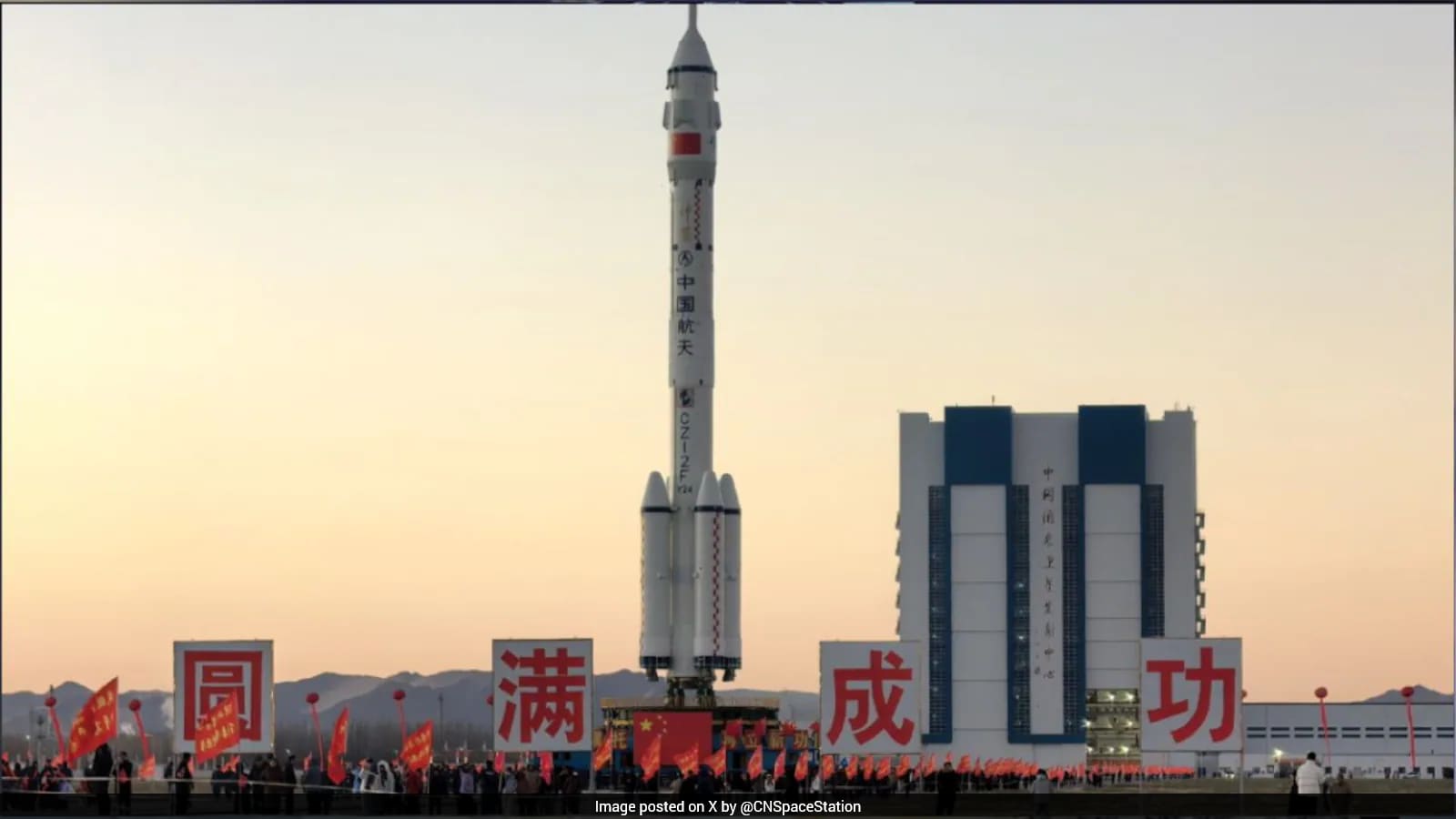
New Delhi: Pakistan is all set to launch its first military trained astronaut to space on a Chinese mission. The lift off is slated for Wednesday aboard a Chinese Shenzhou spacecraft atop a Long March 2F rocket from the Jiuquan Satellite Launch Center in the Gobi Desert.This latest astronaut mission comes more than three years after entrepreneur and adventurer Namira Salim became the first Pakistani to travel to space aboard a Virgin Galactic suborbital space tourism flight. Pakistan is now preparing for what could be an even more significant milestone. If all goes according to plan, either Muhammad Zeeshan Ali or Khurram Daud, both from the Pakistan military, could become the country's second astronaut and the first Pakistani to embark on a full orbital mission to China's Tiangong space station. The final choice will be announced a day before lift off.For Pakistan, the flight would mark a transformational moment, moving from symbolic participation in commercial space tourism to active involvement in a government-led human spaceflight program.The proposed mission reflects the deepening space cooperation between Islamabad and Beijing. Over the past several years, China and Pakistan have steadily expanded their collaboration in space technology, satellite development, remote sensing and communications. Human spaceflight is now emerging as the most visible expression of that partnership.The Tiangong space station, whose name translates to "Heavenly Palace," has become the center piece of China's ambitions in low Earth orbit. Constructed after China was excluded from participation in the International Space Station, Tiangong now hosts long-duration missions by Chinese Taikonauts and serves as a platform for scientific research in microgravity. A Pakistani astronaut joining a mission to the station would become part of a select international group that has lived and worked aboard an orbital outpost. For China this is the first time it is sending a non-Chinese to the space station.Unlike short commercial space tourist spaceflights that cross the internationally recognised boundary of space before returning to Earth within hours, a visit to Tiangong would involve days or even weeks in orbit. The Pakistani astronauts have undergone rigorous training in spacecraft systems, emergency procedures, scientific operations and physical conditioning since 2025. The mission would also likely involve conducting experiments and outreach activities to strengthen scientific and educational engagement back home. The Pakistani astronaut would spend about a week on the Chinese space station doing micro-gravity experiments.The story of Pakistan's path into human spaceflight has developed gradually. In October 2023, Namira Salim, a Pakistani-born entrepreneur and global goodwill ambassador, flew aboard a Virgin Galactic mission. The flight made her the first Pakistani astronaut, the first astronaut from Monaco and the first woman from the United Arab Emirates to travel to space. While historic, it was a suborbital journey lasting only a brief few minutes in space.The upcoming Chinese mission is of a different scale. Reaching Tiangong requires achieving orbital velocity of around 28,000 kilometres per hour, docking with a space station hundreds of kilometres above Earth and operating in space for an extended duration. That distinction makes the mission especially significant for Pakistan's scientific and technological aspirations.The development also carries symbolic importance across South Asia. For decades, India was the only country from the region to send one of its citizens into space through a government sponsored mission. On April 3, 1984, Indian Air Force pilot Wing Commander Rakesh Sharma launched aboard the Soviet Soyuz T-11 spacecraft to the Salyut 7 space station. His eight days in orbit became a defining moment in India's scientific history and inspired generations of students and engineers.The contrast between the two neighbouring countries is striking. India achieved its first human spaceflight milestone more than four decades ago during the Cold War through cooperation with the Soviet Union. Pakistan's first entry into human spaceflight came only in 2023 through a private commercial flight. If the Tiangong mission proceeds as planned, Pakistan's first orbital astronaut mission will occur more than 42 years after India's pioneering flight.Yet the comparison also highlights how the global space landscape has changed. During Sharma's era, only a handful of nations possessed the capabilities to place humans into orbit. Today, countries can access space through international partnerships, commercial ventures and collaborative scientific programs. Pakistan's prospective mission is part of this new reality, where emerging space nations can participate through strategic alliances rather than building every capability independently.For China, flying a Pakistani astronaut would underscore Tiangong's growing international role. Beijing has long expressed interest in opening its station to foreign astronauts and international experiments. Including a Pakistani crew member would send a clear signal that China intends Tiangong to function as a platform for broader international cooperation.Within Pakistan, the mission is expected to generate considerable excitement. Human spaceflight has a unique ability to capture public imagination in a way few scientific endeavours can. Images of a Pakistani astronaut floating inside a space station, conducting experiments and communicating with students on Earth would likely inspire renewed interest in science, technology, engineering and mathematics education.The selection process itself has drawn attention. Both Muhammad Zeeshan Ali and Khurram Daud represent a new generation of Pakistanis who have undergone advanced screening and training for a space mission. While only one is expected to fly on the initial journey, both symbolise Pakistan's growing ambitions beyond Earth. Reports suggest some 200 applied and two were selected.The mission comes at a time when Asia is becoming a major center of global space activity. China operates its own space station and pursues lunar exploration goals. India is preparing for human spaceflight through the Gaganyaan program while simultaneously expanding lunar and planetary exploration. Other regional nations are also increasing investments in space technology and applications.Should a Pakistani astronaut successfully dock with Tiangong, the achievement would represent far more than a single flight. It would mark Pakistan's arrival in the era of sustained human space exploration and demonstrate the country's desire to participate in the scientific and technological opportunities unfolding beyond Earth.For a nation whose first space traveller reached the edge of space only three years ago, the prospect of sending an astronaut to live and work aboard an orbiting space station would be a giant leap. If the launch proceeds as planned, Pakistan will take another significant step in its space journey, one that could inspire a new generation and reshape the country's place in the expanding story of human exploration of space.
Pak Set To Launch First Astronaut On Chinese Space Mission
Full Article
Original Source
Read the full article at Ndtv →KhanList aggregates and links to publicly available news content. We do not host full articles from third-party sources. Always verify important information with original sources.