
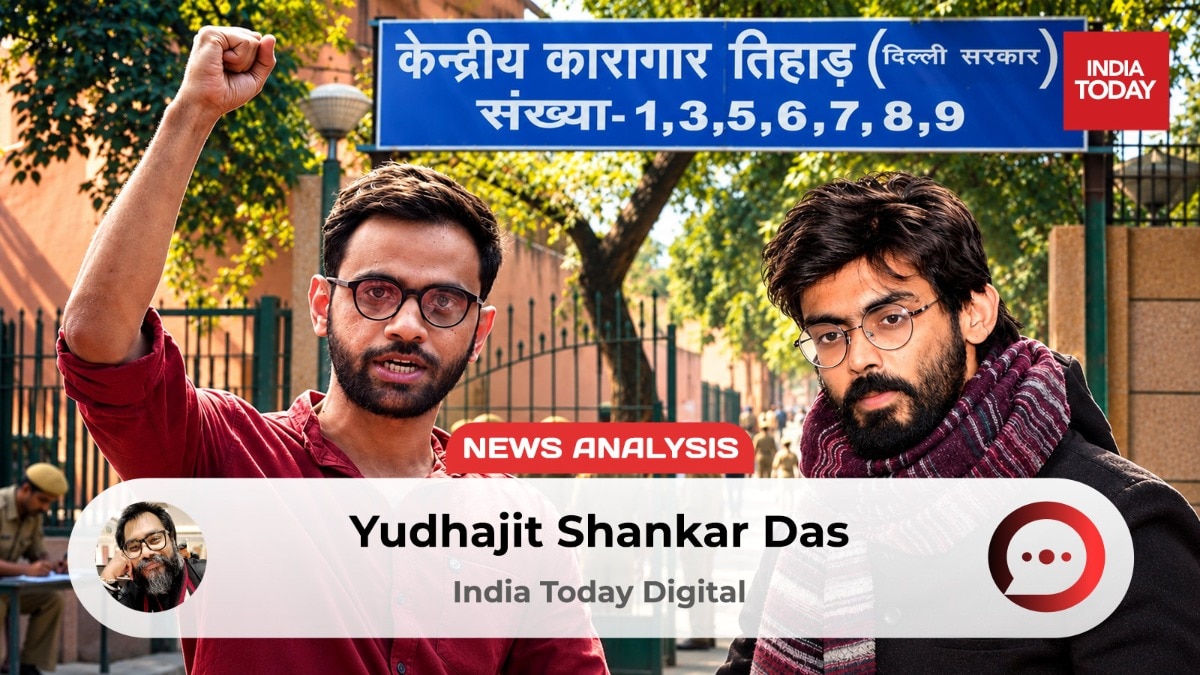
In a recent interview, Sharjeel Imam took to century-old arguments of Jinnah and Iqbal to talk about Muslim underrepresentation and rant against India's foundational principles. Most, while vehemently countering the piece, found it their duty to speak about the activist's prolonged incarceration. While the cases of Sharjeel and fellow activist Umar Khalid are used to highlight the failure of India's criminal-justice system, there are thousands like them who have spent years in prison without being held guilty.While the intent might be genuine for some and guilt-tripping for others, selective highlighting of cases won't help solve a systemic problem. There are over 8,800 people who have been languishing in jails in India for over 5 years despite not being convicted.Sharjeel and Umar have been in jail for the last six years in the 2020 Delhi riots larger-conspiracy case. Both have been arrested under the stringent UAPA, with charges yet to be filed against them.After the recent interview and counters to it, 'Free Sharjeel Imam' and 'Free Umar Khalid' graffiti emerged at Delhi's Jamia Milia Islamia and Jawaharlal Nehru University, respectively. Scores of people, while attacking Sharjeel for his extremist and anachronistic views, felt it was incumbent upon them to mention that his trial hadn't progressed. That he remained in jail for over six years. While elected executives might tend to use the system for repression, it is for the judiciary and independent institutions to ensure that the rights and freedoms of citizens stay protected. In India, the protection of personal liberty, safeguards against unilateral arrests, and provisions for judicial remedies are enshrined in Article 21, Article 22, and Article 32 of the Constitution, respectively.Like Sharjeel and Khalid, there are 3.7 lakh undertrials in prisons across India, with 8,886 of them having spent five years or more behind bars, as of December 31, 2024. This is the latest National Crime Records Bureau (NCRB) number, and shows that another 20,496 undertrials have spent anywhere between three and five years in prison. "The government can put you in jail whenever it wants. You are out because andar jagah nahin hai and unka mood nahin bana (there's no space inside and they haven't desired so yet)," Kamlesh Singh, our in-house satirist and columnist, said in a post on X in 2025. Some facts remain unchanged.Each one of those 3.7 lakh undertrials, including Sharjeel and Umar, have the right to a timebound trial. The state cannot be seen to be punishing through the process of trial. Pause, and think. Seventy-two precent of the prisoners in Indian jails are those who haven't been found guilty yet.Of the 5.09 lakh inmates in India's prisons in 2024-end, only 1.36 lakh were convicted of crimes, with the rest 3.68 lakh being undertrials. This, despite the overcrowding in jails. The occupancy rate in Indian jails was at 112.7% in 2024, according to the NCRB statistics.We asked Naveed Mehmood Ahmad, an expert with Vidhi Centre for Legal Policy, if pendency in courts contributed to such large number of undertrials."Certainly. Delays in investigation and trial are important contributing factors. But the fundamental question is whether undertrial detention is necessary in the first place, and in what circumstances," said Ahmad, a Senior Resident Fellow and Lead with Vidhi's Crime and Punishment Team."Delays in trial should not automatically translate into prolonged detention. We must question this assumption and it is intrinsically linked with powers of arrest, the law on remand etc," Ahmad added.As per NCRB data, said Ahmad, "Murder, NDPS [drugs] offences, attempt to murder, and rape account for almost half of all undertrial prisoners at [2024] year-end."The Supreme Court of India has regularly asserted that "bail is the rule and jail is the exception", which is rooted in the right to personal liberty guaranteed under Article 21 of the Constitution. It says it is true even in terrorism-specific UAPA cases too.Critics, however, point out that there is a marked difference when it comes to even the Supreme Court practising what it preaches.There are around 50 lakh arrests made in India every year and the remand judge or magistrate is the first door of justice that an arrested person finds. And they mostly find it locked.In the landmark Arnesh Kumar vs State Of Bihar case of 2014, the Supreme Court called the power to authorise detention "a very solemn function" that "needs to be exercised with great care and caution"."In many of the cases, detention is authorised in a routine, casual and cavalier manner," the Supreme Court said.The goalpost gets shifted once detention is allowed. The fight is for immediate relief vs denial of bail, not exoneration or conviction."With delays in the system a given, both the prosecution and the defence end up focusing on immediate milestones, and bail becomes one of the most important ones," said Ahmad of Vidhi Centre for Legal Policy."Trial courts are often reluctant to grant bail, for reasons best known to them. Perhaps the bail tests, including the on-flight risk and evidence-tampering, also need re-examination. In several cases, stringent bail conditions, like the twin tests under certain special laws, make release particularly difficult, with bail often requiring courts to make a preliminary assessment of guilt," explained Ahmad.In July 2024, then Chief Justice of India, DY Chandrachud, had pointed the play-safe attitude of trial court judges, saying, "Trial judges are increasingly playing it safe, not granting bail on important issues of serious crimes."Many of the undertrials end up spending more time in jail than the actual sentence they might have received had they been convicted for the crime they were arrested for.This despite India having legislative provision to free undertrials who have served half the prison time they would have been awarded if convicted. In 2014, the government made an effort to release such prisoners, irrespective of the progress of their trial.From prisons having 77% of undertrial prisoners in 2021 to 72% in 2024, there has been a downward trend in recent years. However, the number still remains very high.Let's circle back to the question: Why are India's jails full of undertrials? Courts, burdened by pendency, fail to hear cases in a timebound manner. But the main problem stems from the police making arbitrary arrests, and the magistrates and lower courts failing to check those powers. Rampant use of provisions of preventive arrests compounds the problem.Several Indian laws with non-bailable provisions, including those related to cruelty by husband and dowry, the SC/ST Atrocities Act, and the UAPA, make jailing default. These are all susceptible to misuse and weaponisation.So, highlighting the long incarcerations of Sharjeel Imam and Umar Khalid might help make a political statement or assist in balancing criticisms, but all the lakhs of undertrials in India's overcrowded jails deserve similar attention. Remember, there are over 8,800 inmates who have spent over five years in prison despite not being convicted. Lip-service won't be enough.The Blackstone Ratio, the foundational legal principle in criminal law, says, "It is better that ten guilty persons escape than that one innocent suffer". But in India, where the conditions are generally punishing, the principle seems to be to ensure that ten innocents get punished along with the one guilty.- Ends
Over 8,800 Sharjeel Imam, Umar Khalid in India's jails
Full Article
Original Source
Read the full article at Indiatoday →KhanList aggregates and links to publicly available news content. We do not host full articles from third-party sources. Always verify important information with original sources.